Showing posts with label train. Show all posts

Monday, May 13, 2013

New Platform, New Pay Phone


I’m calling from the platform. I’m using a pay phone. I’m about to get on the train, I hear it coming. Good Bye.


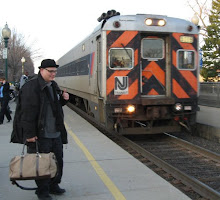
No new pay phones, you say. Guess you haven’t taken a N.J Transit Train lately, at least one that stops at one of their new platforms. Over the last few years, part of the shovel-ready stimulus spending I think, NJ Transit renovated several of their outlying stations in our Hinterlands. This phone was in Ridgewood, New Jersey and was even being used. There are still reasons to use a pay phone. Pre-renovation – which included construction of entirely new platforms – there was no pay phone on this platform before. Now the new platform has a new pay phone.


I wonder if the number of new pay phones in the United States number in the thousands, hundreds… dozens? Less? I even wonder about the word new. Is there a factory still making pay phones, or are they just refurbishing old ones? Those cast metal pay phone shells are built to last, survive all weather conditions. So many pay phones have removed. The transit system is one of the few sanctuaries left for this last century form of public communication, especially new ones and I wonder if the new ones are entirely new or are the old shells being recycled and refurbished.


I’m on the wrong platform. I’m waiting for the wrong train. I’m headed in the wrong direction. I need to call again, I’m going to be later… much later.


Tuesday, February 19, 2013

Terminal Transition


Seems I’ve been blogging about this Hoboken transit hub oncea month; is it because I go through there once a month or my life is a little stressed right now that blog subjects are getting harder to come by? Maybe yes, mostly no. Mainly it’s an inspiring place and space and recently, always changing.


The lobby at the Erie Lackawanna Train Station reopened; 90 days or so after Sandy.


Especially when it comes to non-event local impressions, I like to say I am looking that things that rarely get really seen or looking at things that can only be seen once. These images are the latter. Ravaged by Sandy – six feet of water in the lobby – the reopening is pretty half-hearted. There’s only one stand – no newsstand (even the Hudson News letters are gone), just coffee and beverages and non-cooked food items – the restaurant court and other vendors remain closed.


The Bathrooms remain closed. You have to go outside to porto-johns to go . The long wooden benches and the model train set are enclosed in plywood cases and plastic tarps. There’s some seating, tiny park benches you would get at a garden store. The lobby is also heated. People were waiting.

Plastic sheets also covered the lobby payphones, a pay master’s window. I guess like the wood these mainly metal fixtures require additional, specialized cleaning.


A weird reminder of the extent of our Katrina. The world we know is under assault by the world coming into being. Our buildings and infrastructure and the way of life they enabled are unsustainable in our climate changed wall. The plastic tarps preserve the way things were. No tarp over the water lion. That cat's snout hasn't spouted out water in a decade anyway.


Wednesday, December 26, 2012

Post-Sandy Erie Lackawanna


Hoboken Train Station may be functioning but its grandeur has yet to recover. Dislocation features lots of posts with this train station; I’ve been transiting through this transit hub for much of my adult life. I hadn’t been back since Sandy.  The Hoboken PATH is finally back on line. I was taking the Christmas express to the suburban land of my birth, as I do every year. A FEMA trailer is the ticket station. Everything was closed, the mini-food court, whose renovation was, only completed a couple of weeks pre-Sandy, as well as the newsstands and coffee stands. The waiting room lobby, with its clock and stain glass and lion water fountain, behind doors locked since the catastrophic weather event. I wonder if the furnishings were destroyed, not just the long classic benches but the model train display – you press a button and an HO scale train spins around a fake Jersey town. You put in quarters as a donation; it’s for a charity run by the NJ Transit conductors. Need to heed the call of nature? Port-o-potties  outside. Commuting through here must be depressing as hell. It is like a 3rd world country now. Actually, it is exactly like reality. A climate changing caused storm that was the double the intensity what was prepared for hit a decaying infrastructure. Two months have passed but as a conductor reminded me when I asked if there is any place where you can a beverage for the train ride, we had six feet of water in the stations. Sandy has ravaged not just the Jersey Shore, but one of the few working vestiges of America’s glorious Railroad past.  The Erie Lackawanna is now more memorial than a relevant presence in the day-to-day. We transit through storm-damaged, purely operational space with no where to pause, no reason to linger and reflect. Our ability to endure may be the overriding feeling one gets, but the hope and optimism related to travel that Train Stations inspire, especially around Christmas, is no where to be felt. One cannot escape thinking about the severity of the storm, the inadequacies of our preparations and response, the lack of investment in our infrastructure, and the vast amount of pollution our society has produced, irrevocably altering global weather patterns.  The Hoboken Train Station, instead of symbolizing the potential of our civilization, now is just another sign of the ways that civilization has enabled its own demise.

Sunday, August 26, 2012

Norfolk Southern

 
Rare but far from unheard of spotting of a freight locomotive on the New Jersey Transit line. Looks like it was just cleaned, such a shiny engine. Norfolk Southern, known in the business as The Thoroughbred due to the stallion in its logo.


Norfolk Southern locomotives are often called catfish because the logo also includes stripes which resemble the whiskers of the catfish. I see a locomotive and I dream of hobo hope, hopping aboard to a yard where they let you be, where you’re a given a fair chance at work that will pay for food and shelter.

I dream of a country united by a system of freight that allows us to move my goods to your services, north to south, south to north, west to east, east to east, cities and suburbs and farmland, mountains and sea shores, it’s not virtual like an internet, but real, slicing right through nature and the birds flying overhead in New Jersey may be different species than one above your head in Kansas but there are still birds, and clouds and blue sky and the heavens where God sits in His throne smiling on us both, please his creation created the iron horse and the last great hope for mankind used this form of transportation to unite a nation after the bloodiest civil war in the history of the world.


Norfolk Southern has 21,300 miles of track in 22 states, its system ships most of the coal in used in the Eastern portion of the United States. This particular machine is the EMD GP38-2, a four-axle diesel-electric locomotive of the road-switcher type built by General Motors, Electro-Motive Division. It can run on both diesel and electric rails. Power is provided by an EMD 645E 16-cylinder engine, which generates 2000 horsepower.


Let all trains roll on. Norfolk Southern keeps both the individual and national hope alive. This locomotive can make both hopes one.


Sunday, March 25, 2012

This Big Bruce Train


Ever since Bruce & his E Street boys did take after take, searching for the sound of emotional largeness that eventually combined the sonic lushness of Phil Spector’s Wall of Sound with the incandescent textures of Roy Orbison and Blonde on Blonde, Bruce has never been afraid to appropriate varied sources to help form a singular aural experience. Time has only made him more ambitious, playing with synthesizers on Human Touch, molding a needed truce between his ensemble bandleader intuitions and his persistent wanna be Woody Guthrie complex on the Seeger Sessions and more recently on Working on a Dream’s Outlaw Pete, assembling a nine minute opus that accomapnies a tall tale about a mythical cowboy with strings and choirs and othe studio effects, bringing a boyishly exhilirated pulp sensibly to an Aaron Copeland homage.

All sorts of sonic accents –  drum and bass loops, penny whistles, raps, samples (from Alan Lomax) seasons Wrecking Ball, a collection of neo New Deal songs praising egalitarian ethos, with blistering rockers – We Take Care of Our Own to rocking dirges with both Celtic and industrial overtones, like Death to My Hometown. But the most fascinating appropriation and aural composition is the amazing Land of Hope of Dreams, one Bruce’s most ambitious – and accomplished – recordings.

I love train songs, and Land of Hope & Dreams – is probably the best new train song since Josh Turner’s Long Black Train (I could be wrong about this pseudo-stat). Bruce’s vehicle interest has been and always will be the automobile (Wendy doesn’t seem to be a mass transit kind of gal) and in his only other train song, Downbound Train (from Born in the USA), the train is a figment of an outsider’s imagination, becoming an ominous symbol of doom, similar to Folsom Prison Blues. For his second train song, Bruce creates an aural pastiche where the train becomes an allegory for America, and he does so by audaciously co-opting two train masterpieces – This Train aka This Train Is Bound for Glory, and People Get Ready.

Bruce wrote Land of Hope and Dreams written in the late 90s and some amazing live versions are available. Essentially the song is a suite – an introduction, two stanzas, an extended call and response sequence making up the body of the song, leading to an emotional climax and a coda. The studio version is truly an audio composition, a conglomeration of musical samplings, effects absent from the live takes. Usually a band will try to recreate a studio cut live, or if they’re feeling contrarian totally switches the arrangement from studio to stage. Many other examples show an artist trotting out new material on tour, refining it, basically rehearsing it before committing the track to tape. Bruce foregoes these two traditions; he doesn’t just mess with the arrangement, which he does only slightly, but essentially creates an aural poem. This version of Land of Hopes & Dreams can never be recreated on stage, it is as much a creature of recording technology as Outlaw Pete from Working on a Dream, and to a lesser extent, the more minimalist predecessors as Philadelphia, the Human Touch album and the more synthesizer folk mash ups on Ghost of Tom Joad and Devils in the Dust.

First we hear a lone black gospel voice repeating “This Train” until it is soon joined by a muted choir. Then we hear the beat – a bass with minimal percussion – and it sounds like a classic hip-hop sample. Bruce is obviously making a tribute to two African American musical genres that have and continue to shape music of our land and the world. But as those elements start rising, the plucking of a banjo emerges – album credits say it’s Bruce! – bringing in folk and mountain music. You realize that you also have been hearing organ swells – a sound that bridges Gospel with Soul and R&B. But when the intro melds into the opening of the song, you hear that organ-rich E=Street sound – the shore band sound on Classic Bruce and Southside Johnny album. Not only does this opening serve as a spectacular pastiche of American song, Bruce places his E-Street sound at the center, a culmination of the People’s Music.

He sings:  “Grab your ticket and your suitcase/You don’t know where you’re goin now/But you know you won’t be back/We’ll take what we can carry/Yeah, and leave the rest

The theme is escape, something Bruce has been thinking about in public since Growin Up and was the basis of his first major hit and signature tune, Born to Run. Here, the couple, apparent refuges in a landscape, which except for the train they have boarded, is one of anxiety and danger. The couple swears allegiance, not just to each other, but to hope, which Bruce believes is a virtue: “Well I will provide for you/and I’ll stand by your side/you’ll need a good companion now/for this part of the ride/leave behind your sorrows/let this day be the last/tomorrow there’ll be sunshine/and this darkness past.”

Springsteen conjures up an American idyll as he introduces the titular chorus: “Big Wheels Roll Through Fields/Where Sunlight Streams/Meet me in a Land of Hope and Dreams.” They are not there yet, but they are closer. He echoes the dream all progressives believe in – the dream of a better tomorrow.

Then the next segment of the Suite begins where Bruce sings what the Gospel Singers chanted when the song began, and as the choir returns Bruce leads the, with this This Train being the call, and Bruce’s egalitarian, neo-new deal vision manifested in the response. “This Train carries Saints and Sinners/This Train carries Losers and Winners/This Train Carries Whores and Gamblers.”

In Land of Hope & Dreams, Bruce appropriates the basic melody – which he airs out and adds a back-beat – of This Train, as in, This Train is Bound for Glory. The Glory the original refers is the glory of heaven, i.e. the paradise for the elect and worthy, a paradise not of this world but the next. But Bruce introverts the original metaphor, thus adopting it into his all-encompassing egalitarian vision.
Most versions of the classic This Train  begin: "This train don't carry no gamblers, this train/
No crap shooters, no midnight ramblers."
This Train is performed by a wide array of artists, from the folk music master Cisco Houston, probably my favorite, to such diverse folks as the Delmore Brothers and the Staples Singers. In the 90s, perhaps the most recent version, was by Rockabilly stalwart, Sleepy LaBeef. Rumor has it that Bob Marley even recorded a Version. Of course, Bound for Glory is the title of Woody Guthrie’s autobiography, although as far as I know, no recording of him singing this song exists.
This Train is a gospel song and is also one of the oldest train songs. Trains are a mutable metaphor, which is probably why there are so many of the damming things (I honestly have more than four hours of train songs on my computer and I have yet to rip all my CDs). I get goose pimples thinking that the first train metaphor was metaphysical.
Bruce tends towards gnostic Christianity: God is everywhere and in everyone. His faith is purely egalitarian. Bruce’s update of This Train is really not a rejection of the original, but a correction.
As the song concludes, with some interplay the Gospel Singers and a fading of the full band to the more sparse arrangement that opened this mini-Copeland-esque opera, the voice of Michelle Moore, featured in various spots throughout Wrecking Ball sings the other great train as heaven metaphor song that completes the mash up, People Get Ready, by the great Curtis Mayfield, the classic version being perfumed by his band, The Impressions.
As Land of Hope and Dreams shifts to the last portion of the suite, the coda reprises the intro, Bruce ending his litany of all the losers and outcasts forbidden to board the original This Train by declaring, “You Don’t Need No Ticket,” quoting Mayfield’s memorable lyrics: “People get ready/ there's a train comin'/You don't need no baggage, just get on board/All you need is faith to hear the diesels hummin'/You don't need no ticket, just thank the lord.
Bruce’s vision is more in keeping with Mayfield, whose song – remarkably, a top 10 hit upon its 1965 release on the secular R&B charts – “Have pity on those whose chances grow thinner/For there is no hiding place against the kingdoms throne.” The Mashup and pastiche feel of this spiritual-based tone based poem is that Bruce points out the musical similarities between This Train and People Get Ready, and the latter is really not much other than a slower tempo arrangement.
Woody Guthrie’s Farm Labor Train and more recently, Dave Alvin’s Jubilee Train – train metaphors are always ripe to espouse new deal ethos. Land of Hope and Dreams combines both the Christian spirituality of train as heaven and the political we are all in this together train metaphor, building on past traditions to form a fresh message relevant to our own troubled times. What sells this song, making it truly transcended is one very special sample, serving as the climax of the entire enterprise as well as the segue between This Train and People Get Ready – and that sample is ClarenceClemmons, may his name forever be praised!
According to a recent Rolling Stone interviewwith Bruce promoting the album, Clarence was feeling poorly after recording with Lady Gaga, postponed a session with E-Street, went home and had what would prove to be a fatal stroke. The record producer added a solo from one of the live versions of Land of Hope & Dreams to the finish the track. Ironic and tragic that Clarence’s last studio solo would not be with for the glory of E-Street, nonetheless the sample of the solo enhances the pastiche nature that is the foundation of the Wrecking Ball version.
The solo comes in as the lush mesh of musical influences – gospel, folk, E-Street Rock & Roll – are on full throttle. As Bruce intones This Train carries Lost souls etc… ; as the litany bills Bruce is wailing into one of his trademark howls (pulling out this town a winnnnnner!); and he begins to sing not just about the passengers but the train itself – This Train, Hear The Steel Wheels Singing/This Train, Bells of Freedom Ringing.
Referencing this classic American dream image (also Bob Dylan’s Chimes of Freedom, which Bruce has also covered) – bells of freedom – the song reaches it metaphorical heaven on earth metaphor and as Lincoln continues to remind all Americans, that our country was and is The Last Great Hope For Mankind. Bruce takes two Gospel classics, and by filtering them through his gnostic vision that makes, at least for the purposes of this song – and our current political realities -- obsolete the separation of the spiral and the material. To underscore this message of freedom, Clarence, now in Glory himself, gives us what is tantamount to his last E-Street solo. What the listener is reminded of is not that the technical prowess of Clarence’s playing, but how distinctive it was, how easily his emotional warmth is conveyed by his playing. There’s no mistaking who is playing. There’s no mistaking Clarence Clemmons!
In the RS interview, Bruce talks about crying when he first head the mix. As John Stewart, who conducted the interview, says, it’s a powerful moment. When I was first hearing this song, thinking what a clever take on This Train, Bruce began his wail about the actual land of hope of dreams, getting to the bells of freedom line, Clarence appears suddenlly, unexpected but pefectly, as if from heaven, emerging through the now multitude of Aural Americana. Alive again, in our ears as he is in our hearts. The man who in the 70s returned the saxophone to its rightful place in Rock & Roll, the Big Man. Clarence made E-Street one of the few integrated Rock Bands of the 70s, and his presence in climax of this song echoes the hip-hop and Gospel references of the introduction.
Real tears appeared in my eyes when I first heard this song; it’s so moving to hear Clarence in this context, to hear one last solo in this multi-layered homage to American song and the human spirit. I’m sure I’ll be able to hear this solo with getting teary eyed and chocked up, but it sure hasn’t happened yet. It is simply, a musical moment of supreme magnificance. Consider for a moment, everything Bruce is doing in this song – the studio confections, the blending of musical traditions, the rewriting of two major, well known and beloved, Train songs and in it he interweaves a tribute to not just a comrade but a highlgy recognizable figure to popular culture as well as someone loved by the audience of the record. Bruce doesn’t play it safe. Just the attempt is admirable enough. That Bruce accomplishes these goals, balances them all, conforms them to his vision, augments the traditions the song is built upon, is remarkable. Land of Hope and Dreams is one of his great recordings, one of the few in his latter career that stands up to his heyday masterpieces.
The song begins with a couple on a train, and the fellowship needed to pull America out of the shit hole 30 years of Reganism has dumped us, emanates for the couple on the train. All we have is each other. Bruce, in his liner notes –taken from his eulogy for Clarence – writes: Clarence was Big and he made me feel Big, think, love and dream, big.”

As big as a train that is as big as a Land of Hope and Dreams


Sunday, February 26, 2012

Between Two Trains


I tried to get more information from the NJT worker in charge of this vehicle and the task for which it was designed but while good natured he seemed to be taken back some, who is this guy with a camera interested in trains?  I didn’t get all the details.  It’s a mini water truck; the large plastic container on the truck bed contains water. Two trains were in the station, the vehicle was on the cement platform between the two trains. Cables were attached from the vehicle to both of the trains, and to the same portion of the train, mid-car. On viewing the picture it is apparent that one cable looks like an electric cable, the other “cable” is a water hose. The worker told me he was filling up the bathrooms with water. Both trains were the older models, not the new “blue” NJT trains, but reconditioned cars from Metro-North. I surmise that the cables were using electricity from one train to run the pump used to fill with water the bathroom tanks of the other. The time was morning, just after the rush hour, just another of the dozens of procedures necessary for a mass transit infrastructure to operate.

Thursday, May 5, 2011

1909 Train-Topia


The underground railroad from J.C. to Manhattan dates back to 1909, yep our path, a feat of engineering. Notice in the background though, the watch tower, that’s what is now Liberty State Park, it was the ole railroad terminal, home of the Blue Comet. At the time and throughout the first half of the last century, in addition to this array of passenger rail the whole neighborhood had three different rail yards.

Saturday, April 30, 2011

Something About a Train

My colleague said I wore my engineer cap. I have a head for hats since my hair is “starting” to thin and since the Mets are just too tragic to sport their logo this year. I needed a new warm weather cap. I bought this jaunty chapeau for five bucks at some midtown store. It was only after my friend’s comment that I realized it was indeed similar to an engineer’s cap. He took this picture of me on Amtrak. We had a day of work in Washington D.C. and the high point was riding the train, which was clean and sold out and running on time.

I love Amtrak. I don’t really have a pithy insight other than that. It’s a national treasure. Okay maybe Europe or Japan have better high speed passenger rail, but Amtrak is better train systems than Bolivia or Kenya! Amtrak always gets better and it gets an unfair reputation. We should be proud of this nationwide transportation system; air travel may be faster, but it is often excruciating and always humiliating. Buses? Forget about it. Car travel isolates, it’s not a transporting form of transportation. No matter where you go there you are in your car.

I’ve been busy of late; grueling days at the day job impeding my blogging in the short term. The day of work in D.C. was quite intensive. The three hour train ride made it worthwhile. Until recently, I had a steady gal in southern Virginia and took this train about every six weeks for near a decade, my romance of train travel is multi-layered. Yet, despair dissipates when I’m on the train. Only sweet memories persist.

I read, do some work, look out the window. The rolling of the train on the tracks, the consistent rhythm that so inspired Johnny Cash’s sound. I know a few dozen train songs. When I hear that whistle blow I never run out of tunes to hum.


Several cities campaigned to become the nation’s capital, but with tensions between the north and south becoming more apparent, Washington D.C. was selected because of its mid-Atlantic location, a compromise solution. In reality though, it’s a lowland swamp, similar in topography to the South. In many ways, with its wide boulevards, circular layout and the proliferation on neoclassical architecture, D.C. is very much a southern city. Riding the train down, you can see the landscape change, hill country of the northeast fading into swampier lands, a few miles more and you start seeing the Southern bogs of the tidewater region. Truly an alien land to the union soldiers who came here to keep our country united and in the last two years, enforce enactment of the emancipation proclamation. For the first few years, they were mainly protecting the capital. How different a city from the Northern climes they came from.

Trenton and Philadelphia and Wilmington... empty and decaying factories and warehouses. They built these places near railroad lines. Grimy and often alienating work, they provide real jobs and grew the middle class. That era has long passed. The fallow structures, the long-broken windows...vestiges of a full employment past, remnants of an America that used to be... amazing how many you see... the jobs never came back.

Then you get close to the station, the only place where you get a decent picture really and you see more rail road. Other train lines, different cares, web of tracks. Always fascinated with the systematic nature, the planning to make the trains run and the effort to make them run on time. From the gauge of the tracks that fits the wheels, the design of the cars to hold the optimized number of passengers, the horse power in the iron horse locomotive designed to pull the number of cars needed. Design skills necessary beyond any single individual. Precisions seems antithetical to our humanity, but the human spirit enables us to create the vessels of precision allowing the rest of us the pursuit of happiness. All just so I can doze off with America passing outside and dwell in romantic memories and wake up in our nation’s capital that despite the problems and the power still pays tribute to Freedom and Democracy, aspirations that mark our collective and individual souls. This is the land I love best.

It’s true for NJ Transit, but it is really true for Amtrak. The workers you encounter, the conductors and engineers, they all love their jobs... apparent, remarkable and notable because it is really rare to see workers who like what they do. They bid farewell to their fellow travelers, together for a pleasant journey.

Nothing special, except we arrived safely and on time and now the only thing shared is the memory as we embark on tasks away from the tracks.


Tuesday, April 26, 2011

Paterson Chess Club


The Easter Sunday meeting of the Paterson Chess Club. I haven’t been to Paterson in years, but I see it from the train window on my regular journeys back to Bergen County. When the window is clean I can get a good shot. Saw these two fellows playing chess the other morning. By their looks it is apparent this is not their first game in this park. Maybe like the red breasted robins, the dogwood and forsythia blossoms and the need for antihistamine as the pollen increases, these two fellows playing chess are a sign that spring has indeed arrived, at least in Paterson.


Friday, April 15, 2011

Ex-Token Booth

All that’s left is the intercom. Another victim of the token-free age, this is at 32nd street and if you are getting off the PATH and want to take the subterranean route across 6th avenue you pass this token booth. A fine token booth, two seater. When it closed I was going to take a picture, then they had this plastic fencing and wood and I should have taken a picture. That was yesterday. But I’m not in blog mode, I’m in going to or coming from day job mode. Often there’s cops with the tables searching bags or those really annoying AMNEWYORK paper hander outers and I just don’t want to take a picture. The mode over powers that sort of mood. Then today, GONE. I thought they were just renovating, I didn’t know they were dismantling and removal. I guess they do that at night. What I don’t understand, if these metro cards they forced upon us where supposed to provide all these cost savings – and part of the accrued savings was due to a reduction in the labor force necessary to make our subways run almost on time – how come fares keep going up? Without a booth, there are less MTA personnel at this juncture, making things less safe and if you are having a problem with the system you’re on your own – just use the intercom, see how that works as a solution! Notice – customer – intercom. We are no longer passengers, we no longer travel together in New York. It’s not a journey we embark upon, it’s a product that we purchase. Fares rise, jobs disappear. No more tokens. No more token booths


Tuesday, April 12, 2011

Train Porch Light


Walk by JC Art School on 5th Street lately? Notice any new illuminating apparatus? This is a train light, from an Erie Lackawanna passenger car, circa 1930. Not a headlight, not a lantern. A ceiling lamp, removed from an abandoned train car, cleaned up and repainted a near-fire engine red, which matches the door. The original glass globe still intact. The design echoes confidence, the Industrial Revolution at its American peak. Steel. Iron alloys smelted by union workers

. The rail lines into Hoboken today may just reach into different New Jersey counties, the Erie part meant Pennsylvania also heavy industry, not to mention steel and coal. Lots of travel between there and here and the waterfront docks of Hoboken. Function is paramount, but utilitarian agendas get mitigated with the curve, tool & dye mold making expertise, shaping metal to argue against gravity’s dictates of form, giving us some of that deco in art deco in the passenger rail ceiling lamps. Makes you want to know more about this actual car. I’m guessing at the 1930, I could be off 15 years either way. The image at the bottom I copied from a website. Just a guess, give us an idea, some context. Those old passenger cars look so sturdy. It was before air-conditioning, probably not even heated. Metal fixtures, glass globes – decades before fluorescent. A little piece of history between Monmouth and Coles on 5th.
The abandoned passenger rail car this repurposed porch light was originally discovered in.

A preserved antique train car which may or may not be an example of the type of cars these lights were found in.

Monday, February 21, 2011

Freight Train, Freight Train

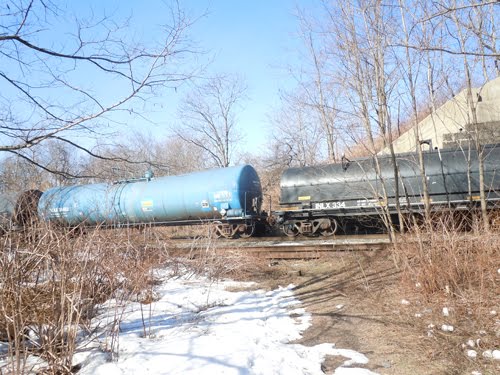
I’ve been wanting so long to get a good picture – or any picture – of one of the freight trains that run through what seems to be the border separating downtown from the heights. Either I do not have my camera with me when I spot one rolling through, or I have my camera and the tracks are empty. The latter has been more common. I don’t know where to get a schedule so I can nab a pix. In this are of terrorism I reckon that CSX isn’t of a mind to publicize their freight train schedule, especially if they are carrying hazardous material. Which I do not know if they are or not, I’m just speculating here, the point being it’s not an easy picture to get and more than once I’ve had the camera with me and seen the train but by the time I caught up to it was away on down the tracks.


The other morning, the stars had aligned and I was close and saw the train and I started to run after it, past Division Street on Newark, behind the field in back of the Fire House there, underneath the abandoned trellises. There it was, the iron horse, in all its utilitarian glory. Rarely do you get this close to a moving train. No fence or barrier or any kind. I got as close as I could. What an exhilarating experience. The sheer weight of the movement, slow and steady, steel leviathan, made by man.


Fuel Cars, Box cars, some of the sides were tagged by brave graffiti artists. Chugging, squeaking, sure I flashed on that great train movie earlier this year, Unstoppable.


I thought about how the tracks and the cars of the train and the freight carried by the cars in the train connect America, united us still just as they attempted to do following the civil war. Every freight yard in the country can be gotten to from any other freight yard. Tracks connect to tracks. The route may not be direct – in fact its circuitous nature is part of its splendor – but you ride that train you ride America. Good Lord, I was tempted, to hop the freight car and ride to the Hobo Jungle.


FREIGHT TRAIN

by Elizabeth Cotton

Freight train, Freight train, run so fast

Freight train, Freight train, run so fast

Please don't tell what train I'm on

They won't know what route I've gone

When I am dead and in my grave

No more good times here I crave

Place the stones at my head and feet

Tell them all that I've gone to sleep.

When I die, Lorde, bury me deep

Way down on old Chestnut street

Then I can hear old Number 9

As she comes rolling by.What an awesome song this.

Some say she was the greatest guitar player that every lived and if you have heard the smithsonian folkways release you probably agree. Trains give her the escape she desires, and she dreams that when she dies the trains will give her the salvation. Didn’t need to get all allegorical like Freedom Train, This Train, People Get Ready. She was singing about Freight Trains.


Roy Acuff saw a much darker side of the freight train, though still sought escape in his Freight Train Blues

I was born in dixie in a boomer’s shack,

Just a little old shanty by a railroad track,

The hummin’ of the drivers was my lullaby,

And a freight train whistle taught me how to cry.

I’ve got the freight train blues, lordy, lordy, lordy,Got ’em in the bottom of my ramblin’ shoes,

And when that whistle blows, I’ve gotta go,

oh! lordy! guess I’m never gonna lose,

The mean old freight train blues.

now my pappy was a fireman and my mammy dear,

Was the only daughter of an engineer,

My sister married a brakeman and it ain’t no joke,

Now it’s a shame the way she keeps a good man broke.

I’ve got the freight train blues, lordy, lordy, lordy,

Got ’em in the bottom of my ramblin’ shoes,And when the whistle blows,

I’ve gotta go, oh! lordy! guess I’m never gonna lose,

The mean old freight train blues.


This narrator was born into a rail road family. For the potential madness read La Bete Humaine. Bruce Springsteen also viewed the nightmare invoked by freight trains in a this vivid couplet from I’m on Fire
At night I wake up with the sheets soaking wet
And a freight train running through the middle of my head
But Bruce didn’t see beyond the metaphor, in this song at least.


The freight train demanded respect. It is deliberate, pragmatic, what it brings we need. If you have a chance, try to get as close you can and just behold.