Tuesday, June 5, 2012

How a Lost Jersey City Statue was Found


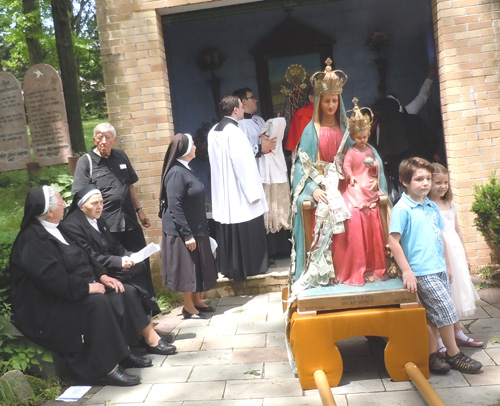
By mid-morning, the rain disappeared. The sun dispersed the clouds and shined down on the dozens who gathered at the Holy Face Monastery in Clifton to honor “Madonna del Sacro Monte” – the Blessed Mother of the Sacred Mountain – and celebrate the incredible recovery of her statue, which had resided in Jersey City for nearly a century. For the past 15 years or so, this rare statue was believed lost, but the determination of one man and a series of improbable coincidences resulted in this unique piece of sacred sculpture being found and restored.
Four generations were represented in those who gathered. They marked the happy occasion with prayer, hymns, food, stories and laughter. For them, this statue embodies the family history and traditions that define their lives. She invokes cherished memories of family members no longer on this earth.
The recovery of the Madonna del Sacro Monte statue is a story that spans decades, continents and generations. But the various strands of the saga of this beloved statue share a single nexus point: Jersey City.
“The roots of Jersey City are everywhere,” said Patrick O’Boyle, a North Arlington lawyer whose dedication to this icon led him on a long plight to save the statue that his family members – all born and raised in Downtown Jersey City – remembered so fondly and talked about so often.


Holy Rosary Church on Sixth Street was the home of the Madonna del Sacro Monte statue for decades. Considered the oldest Italian Parish in New Jersey, Holy Rosary was a sanctuary for Italian immigrants throughout the early 20thcentury. The annual “Italian Feast,” in Jersey City, was originally organized in 1912 by the Maria S.S. (“santissima”) Dell'Assunta Society – Mary Most Holy of the Assumption Society – a group of piasanos from Morrone who donated a statue of their incarnation of Mary to Holy Rosary. Piasanos from other Italian villages also coalesced at Holy Rosary, adding devotions and statues of other Blessed Mother incarnations to the parish community.
The Madonna del Sacro Monte was a devotion for the immigrants from the Cilento region of Southern Italy. The “Sacred Mountain,” which those boring secularists call Mount Stella, houses the Sanctuary of Maria SS. Sacro Monte. I cannot seem to find much information on the specific source of this incarnation, although the image does not seem rooted in the appearance of an apparition, like Our Lady of Lourdes.
Madonna del Sacro Monte is a Madonna with Child image. The Baby Jesus seems a few weeks older than an infant – he has a full head of curly hair. Both Mary and the Christ Child wear ornate crowns. Mary is seated on a throne – the Queen of Heaven, which references some Catholic theological interpretations of the Book of Revelation (12:1) passage: “And there appeared a great wonder in heaven; a woman clothed with the sun, and the moon under her feet, and upon her head of crown 12 stars”, as well as the 5thGlorious Mystery of the Rosary – the Coronation of Mary: “O Mary, Queen of the Universe, you were crowned Queen of Heaven and Earth on your arrival at the Throne of God after the Assumption.”
Young Jesus, straddling her left leg, is holding in his left hand a “globus cruciger,” which is an orb with a crucifix on top and symbolizes absolute authority over the entire world. Orbs as symbols of global power first appeared in antiquity, in the hands of statues of Zeus or Jupiter. The crucifix was added with the advent of Christendom. The Child Jesus of Prague icon, which dates back to the 16th century, also depicts Jesus as a curly headed child monarch, one of the few images other than the Madonna del Sacro Monte featuring a baby Jesus as royal ruler. The Child Jesus of Prague wears an elaborate crown and his left hand holds a globus cruciger.
The genesis of this very regal Madonna with child may be unknown, but the icon and her devotions date back to the Middle Ages. The accessories of monarchy – throne, crown, orb – assert power. Compared to other Mariology images, which tend to emphasize a reassuring serenity, this Virgin Mother is Pro-Active. For more than a millennia, Italy was not really a single nation but a collection of principalities constantly at war with each other. Southern Italy was more often than not the battlefield, in addition to being perpetually plundered and pillaged by invading Arabs, Africans, Greeks and Turks. One might speculate that a Mary with Savior image that projects such unmistakable authority also served a political agenda: it reinforced the independence of the people of Cilento. Regardless of whatever army enforced a claim of ownership over the region, the people remained loyal to a higher authority. And, in contrast to the Italian and Foreign War Lords wreaking havoc, that authority was unequivocally Matriarchal.
Sarco Monte is the highest mountain in the Cilento region. Pilgrimages to the top of the mountain, where the Sanctuary is located, were popular among the peasants, but it was an arduous journey of several days. The people of Cilento prayed to this incarnation for intercession. When they came to America to seek a better life, they brought their faith traditions with them. In the 1920s, the height of the Ellis Island era, Jersey City was already home to many Italian immigrants, including several Cilento families. Like other groups of piasanos in town, they pooled their meager resources to bring the patroness of their village to Jersey City. They purchased this life-sized, vividly colored replica of the Madonna del Sacro Monte for Holy Rosary.


By the 1990s, most of the original Jersey City Cilentani had moved to the suburbs. A new pastor at the church, for reasons that still remain inexplicable, decided that Holy Rosary housed too many statues. The Madonna del Sacro Monte was one of the victims in his short-sighted purge of sacred sculpture. According to newsletter on the website www.gioi.com: “Most parishioners, especially Mrs. Tango and Antonio Russo, were bitter about his decision. Pat was particularly heartbroken by the pastor’s decision and felt helpless as did others. Unfortunately, the priest died suddenly shortly after the statue removal and the faithful were left hopeless to find out where it had gone. They searched in vain for years to locate the statue. The only thing left for Pat to do was to continue his devotion at the Holy Face Monastery at the Madonna del Sacro Monte’s outdoor shrine.”
Patrick O’Boyle is Cilento, on his Mother’s side, a Cilento DePaula. He grew up in North Arlington but his mother is a DePaula (she also is the cousin of my buddyTony’s mother). The most famous Jersey City DePaula is Frankie DePaula, a boxer whose life was short and tragic.
Patrick remembered seeing the Madonna del Sacro Monte in Holy Rosary when visiting Jersey City as a child. The mosaic of the Madonna del Sacro Monte at the Holy Face Monastery was donated by Cilento parishioners from Holy Rosary in 1971. Patrick prayed and meditated there. The address of the monastery is Route 3 but you would never know it when you’re on its secluded, hillside campus where trees align a verdant lawn decorated with statues of saints, the 10 Commandments, and the Stations of the Cross. It is an oasis of contemplation. Patrick, with a group of friends, restored the outdoor Madonna del Sacro Monte, which had fallen into disrepair by the last decade of the previous century.
In 2008, Patrick was in Italy visiting Cilento and he asked locals about the big mountain in the horizon. They informed him that this was indeed the Sacred Mountain. He went up the slope to visit the original Sanctuary of the Madonna del Sacro Monte. His prayer life was enriched; his devotion to this icon increased. After a second trip to Cilento, he promised the Madonna del Sacro Monte to find the original Holy Rosary statue. It would not be easy.
He had no idea where to begin his search. The pastor who implemented the purge was deceased; a series of other pastors succeeded him. No one was left who remembered where the statue was sent. No paper work with possible clues for the whereabouts of the Cilento patroness even existed.
By happenstance, Patrick ran into a friend, Pete Di Petta, whose family also had Jersey City roots, and he told him all about his trip to Cilento, the Sacro Monte and his vow to recover the Holy Rosary Madonna del Sacro Monte. Again, the www.gioi.comwebsite: “Pete answered immediately: ―You may not believe this, but the other day, I saw the original statue from Holy Rosary, Jersey City, for sale in an antique store”
But the store only sold to Churches, not private individuals and the statue was scheduled to be shipped to Arizona. The statue’s price was several thousand dollars, which Patrick did not have and there would be no time to conduct fundraising activities before the ship date. Two days later, Patrick received a surprise phone call from a client, a habitually slow payer who Patrick was about to put into collections. The client wanted to pay his bill immediately and in full. The amount of the bill was the exact amount of the price the antique store owner was asking for the Madonna del Sacro Monte.
After convincing the antique dealer he intended to find a church where the Cilento patroness could be displayed, Patrick bought the statue. When he took possession of the object, he discovered that the heads of Mother and Child were bare. The crowns had been removed and sold separately.
But a crownless statue is better than no statue at all. At least the Madonna del Sacro Monte had been recovered. But the statue needed a church for a home, so the faithful could pray to her for intercessions and fulfill devotions. He contacted a family friend, Monsignor Joseph Ambrosio, pastor of Mount Carmel Church in Newark. Monsignor Ambrosio spent 16 years at Holy Rosary church and fondly remembered the statue of Madonna del Sacro Monte. He offered Mount Carmel to be the new home to the statue. Patrick hired a professional restoration company and delivered the icon to Mount Carmel, explaining to the Monsignor that the crowns were still lost.
Monsignor said come with me. In one of the Church’s closets were a set of crowns the Monsignor had purchased from the same antique dealer months before. The crowns are affixed to the heads with what Patrick described as an unusual wing nut system. The Monsignor had bought the crowns for another purpose, not knowing whose heads they were made to adorn. It was soon obvious that the crowns did not merely fit the Madonna del Sacro Monte, they fit perfectly. They were without doubt the original ornaments.


So, on June 1st “La Festa della Madonna del Sacro Monte” was celebrated at the annual SOGNA (an organization dedicating to uniting the Cilentani and their descendants) picnic. Monsignor Joseph Ambrosio led a bilingual mass – in Italian and English – where he retold the story of the lost and found statue. In addition to the Jersey City Cilentaniand their suburban offspring, some distant relatives and other genuine Cilento residents traveled to the U.S. to take part in the ceremonies. A group of Vocationalist Sisters, of Italian descent, also attended.
In his homily, the Monsignor pointed out that story of how the Jersey City Statue of Madonna del Sacro Monte was saved, should teach us to always keep hope alive.
“We should never lament death before it happens,” he said.
After the liturgy, Monsignor Ambrosia blessed the statue with holy water from an aspergillum then led the participants in a traditional Cilento procession. A ribbon was placed around the statue’s shoulders, people pinned money to the ribbon. Two children led the procession, scattering flower petals. Two women carried elaborate headdresses filled with candles, which symbolized pilgrimages of yore. The peasantry would spend their meager savings on candles to light to the Madonna, and the devoted would carry their possessions on their heads as they trekked up the Scared Mountain. Men carried held poles aloft on which a blue canopy was suspended. Two musicians, wearing traditional garb, played hymns on a Zampogne -- the Italian bagpipe and a Ciaramella, which is a wooden recorder. The men who hoisted the life-sized state onto their shoulders were Cilentani who have sworn their devotion to the Madonna del Sacro Monte, and traveled to New Jersey for the occasion. The nuns led the Ava Maries and we processed along the walk way of the monastery grounds. Late spring was in full bloom, the leaves and grass were lush with fresh chlorophyll.
After processing thrice around the church – another tradition – the monsignor led us back to the shrine, where more hymns to the Blessed Mother were sung. People had their picture taken with the statue. As the picnic that followed, sausage and peppers, chicken, penne pasta and several cakes were served. The Ricotta pound cake was particularly unforgettable. They talked in Italian and in English, they talked about their old days in Jersey City, they talked about family.
A man now retired, was excited to find out that I actually live in Jersey City. He told me about the old days, the different mayors of Jersey City. He had some stories. He was still angry about the Turnpike exit being built by Center Street, which drove down the property values. Long ago, he moved to the suburbs where he raised his family and now plays with his grandchildren.
“I still drive to Jersey City, about once a week. I don’t like to go to the graveyard. I drive to the house where I grew up, that’s where I pray to my parents.”




Monday, June 4, 2012

Lunar New Year Arrives on 1st


Nice guy, intense and funny – young – he didn’t want me to take a picture of his face and only wanted his artist alias – Lunar New Year – on the blog. I’m not sure if it is an alias or the name of his current collection of paintings that includes the mural currently in progress on First Street (near Coles), or maybe those sort of distinctions are some of the constructs he seems intent on disintegrating. “There’s too much ego in art already, don’t you think?”
Hard to argue. The more you know about the artist, the more context you bring to the work and that preconception inevitably impacts the communication between the work and the viewer.

On the side of this building so far, in black and shades of gray and some muted gold are two bearded men, in profile, stare into the distance. The hands of the men are gesticulating; at least their fingers are crossed. For good luck? Gang signs? What are they looking at? Their gaze seems rapt, attentive, serene.

You want to know but the answers may lay more in you than in the art.
The mural is still not complete, although LNY expects it should be within a week or so, weather permitting. There were showers but the skies soon cleared and the work was barely interrupted. I first thought these pictures may be stencils of some kind. They’re very detailed and exact, they could be reproductions. Also, these are tall pictures, about two stories high. Rarely are murals so vastly vertical. To be so precise on this size space, well it is astounding and that is why my first guess was stencil. But they are not stencils, they’re hand painted. When I was there he was using a can of spray paint.
What will do with the space around and between the two profiles? Will you be using other colors? Do you have this painting  planned out?
“Planned out? What fun would that be?”
For now, the artist, the art and the audience are all involved in the same process: surprise and discovery.

Sunday, June 3, 2012

“Summer Blues”


I had never been inside Portfolio Inc., the antique and curio shop on Jersey Avenue. On the June 1st edition of Fridays, the store hosted an art show featuring paintings and photography.
As I walked south on the western sidewalk of Jersey Avenue, I heard a competent, unplugged version of Whole Lotta Shakin’ Goin On; no piano, just guitar. The most familiar version of this golden age Rock & Roll anthem if by Jerry Lee Lewis, essentially a showcase for boogie woogie piano evolving into Rock & Roll before your ears, but with just acoustic guitar, it had a stripped down let’s have a party everybody’s here impromtu feel. I dug it. Karen and Jo were the Duo act, with Jo played mainly lead and Karen handled rhythm and vocals. Their set touched on a few other well known classics, concluding with Down by the River, Neil Young’s rocker.


The art on exhibit was on one wall of the long but narrow store, the rest of the space was an entrancing clutter of furniture and objects. A typewriter caught my eye. The old school music and the antiques added a interesting if unintended context to the art displayed.
The artists featured included: Clair Arthur, Lynda D’Amico,Aura Highsmith and Jim Legge. I spoke with D’Amico, whose painting “Skies and Kisses,”in dreamy shades of pastel blues, featured the a bird on a branch as well as the title on the panting. It was part of a series she started, with words incorporated into painting that has a revelatory purpose. “I want them to capture simple moments that make life worth living.”


Friday, June 1, 2012

The Milwaukees


Maybe two years ago, I was talking with one of the local scene critics about some of the music you get to hear around town, especially in the summer, and he mentioned the Milwaukees as being awesome. I had heard their name, but for one reason or another, I just never was able to catch a set. Friday was one of those special Groove on Groves that coincided with Creative Grove and Jersey City Fridays, and lo and behold the Milwaukees played. The front man, who sang and played mainly rhythm guitar implied something about a hiatus being over. According to their website, some of the band members became fathers and indeed, the music had been on the back burner for a few months.

But now they’re back and if this set is any sign of things to come, Jersey City is in for some undiluted Rock. The Milwuakees played the most memorable set I’ve seen in Jersey City this year.


Classic Rock wasn’t called that until the 80s, when the genre had basically ended, replaced by punk and post punk and new wave and hair bands and various categories of metal. FM formats started in with the Classic Rock, which recycled hits of the previous decades, although the category was soon broad enough to incorporate anything that was popular, loud and rocked. Arena rock is probably the more precise tag. As guitar-based bands started touring larger venues, the hooks got bigger, the sound got bigger, sounded as good coming out the speakers in your car as it did even in the upper rows of the Brendan Byrne. Classic or Arena, the genre is both a recycling of Elvis and the Beatles and dozens of others and taking those strains and making them new, adding more volume and a (then) contemporary attitude.

The Milwaukees add a chapter to that story. They blend the Bob Seger and the Van Halen and probably a few other riff-based Rock, one step removed from the blues. Power pop is another applicable term.

The set started with a thrilling rocker. Children – young children, well under 10, were jumping around, excited. The music was loud, some of the loudest I’ve heard at Grove Street Plaza (seriously, that’s what official name givers have anointed it). I guess the sound police have finally been successfully bribed. Some of the children had ear plugs. It was fun to watch them jump around, with adults soon joining the pogoing.

The kids were cracking up the band. “We were afraid of our audience getting older, but now we’re finally reaching the youth,” said the singer.

They were having a great set. The kids soon wandered away, replaced by adults many of whom were familiar with the songs. The drummer seemed especially on, attentive to the intense, concise guitar jams as they explored every idea suggested by their thick hooks. A power ballad, Carolina Beach and a rocker, Victoria (or was it Valerie), were particular striking, the set having built on a momentum, then exploded in some pure Rock (without cliche). A woman, a friend of theirs, was invited on stage, she added back up vocals to the concluding number. She was introduced as a new mom, fitting for the rocking day care center that accompanied the earlier songs of the set.

Arena Rock – the stuff of FM formats for three decades now –is an established genre. You can imagine these guys listening to their music with their fathers. But this is Classic Rock with the energy of Punk, delivered with genuine musicianship. Hearing it in an open air setting – under a canopy tent with the Fender Amps turned up to 11 – showcases just how much complexity those hooks contained.


Daddies Ketchup


When it comes to Ketchup, it’s either Heinz or nothing, and I’m looking at you, Hunt’s! Daddies Ketchup apparently is a real brand in the United Kingdom and this artist seems to be evoking the spirit of Andy Warhol reproducing commercial art. This giant ketchup bottle balloon is an inflatable and is part of the Common Ground Art Exhibit at City Hall Park, which is right near the WTC Path.
I’m trying to conceptualize what Irish Ketchup might be like. Non-American ketchup, that’s just not right. But I am actually 25 percent Irish and enjoy ketchup on hot dogs, which on those of Irish descent seem to understand.  There’s no apostrophe so it is not the recommended condiment of a specific Daddy, but the ketchup of all fathers and father figures. The guy on the label resembles William F. Buckley.
Daddies Ketchup is by Paul McCarthy. I am not sure what social significance it inspires, but a giant ketchup bottle amongst the green branches of summer is pretty funny in a when ketchup attacks kind of way. Catsup is scarier though.


FDR in Jersey City

Blogging about the 1972 McGovern Rally in JerseyCity– which indulged my love of microfiche – inspired me to start a new Dislocations series: Presidential (or would be Presidential) visits to Jersey City.


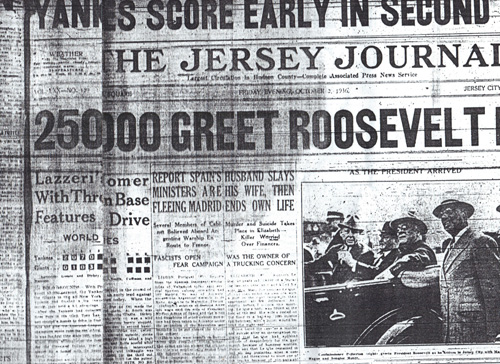
Newspapers differed on the size of the crowd, but when FDR came to Jersey City in 1936, the vast majority of the town turned out to welcome him.

These scans from print outs of microfilm copies of period newspapers are not the best quality, but the point is still made: Mayor Frank Hague and President Franklin Delano Roosevelt are in solidarity and Mayor Hague was able to get a huge crowd for this photo opportunity. One wonders if there’s newsreel footage of this event.


In 1936, Franklin Delano Roosevelt – the greatest president of the 20th century – came to lay the cornerstone to what eventually became the brown skyscrapers in our southwestern corner, the old Jersey City Medical Center. The J.C. Medical Center renamed itself Liberty Medical Center and moved to Grand Street, and the original buildings are now residential and known as the Beacon, and I kid you not, some people believe those condos are haunted by ghosts of patients from the former bone factory.

But I’m writing about Presidents not the paranormal.

350,000– That’s the number in the headline, setting what is likely a record for a presidential visit and maybe for any sort of public gathering in our fair city. One of the sub-head Headlines in the Hudson-Dispatch Account proclaims:“Greatest Demonstration in Jersey City History.” Another says: “70,000 Screaming Children Line Four Mile Route.” A motorcade carried FDR from the Holland Tunnel and Up Montgomery Street.

The Hudson Dispatch: “President Roosevelt wrote chapter of thanksgiving into the history of Jersey City – thanks to Frank Hague for Developing a Medical Center which bespeaks humanitarianism and thanks for the New Deal’s ability to help in its growth.”

The Jersey Journal (The Star Ledger Microfiche does not date back far at the JC Main Branch) agrees with the number of the children: “70,000 Pupils Line Up and Give Vociferous Greeting to President, “We Want Roosevelt” Is Cry”

Note how odd this writing sounds today, “vociferous” and “Is Cry,” Today’s editors would call this too wordy, but newspaper writing tended to be wordy back then. Jersey City had four major dailies (NYC about twice that amount). The Jersey Journal account was an evening edition, its Roosevelt in J.C. story appeared on Friday, The Hudson County Dispatch on Saturday. Media sources were limited to newspapers and radio, both which are verbal. Hearing is just another way of reading the news, so there was a real competition among the writing and a real connoisseurship of writing among the audience. Readers appreciated wordy because they had no television to distract them from enjoying a sentence. The love of language seems mutual between news providers and readers.

Apparently though the crowd estimates changed as well, the J.J. estimated 250,000. The Dispatch, where the crowd did not merely “Greet,” but “Honor” FDR, grew the number by 100,000. Estimating a crowd is not exactly easy of course, and an approximation is just that, but a difference of that magnitude – how can two counts differ by 100,000? – suggests that the Dispatch was using some Hague mandated poetic license. 


250,000 welcome FDR, according to the Jersey Journal; The Hudson Dispatch had 350,000. There’s no clear answer to why this descrepnancy, but perhaps the higher number pleased Mayor Hague, to whom the Disptach shows a brazen bias.
 FDR in his convertible. Notice the other pictures at the grandstand show him from the chest up. FDR had polio of course, but no one would see his braces or him in his wheel chair because of public relations subterfuge.


 Another poor scan, but you get the idea of the crowd. “Vast Throng,” I love that. Remember that writers back then did not simply highlight a word and press shift F; they actually had to lift a book and go through the pages if they needed a better word choice. Kids, go ask your parents what a thesaurus used to be.


The sight of even a (conservative) tens of thousands on Montgomery Street must have been astonishing. I don’t believe another event since then has attracted such a public outpouring of the actual public. The entire city had to be there. Perhaps had is the key word here.

A full page Ad two days prior – in the Dispatch, not the Journal – had an official proclamation by Mayor Hague. He declared the day a holiday!

“I herewith proclaim the coming visit of the President of the United States on Friday October 2, 1936 and declare a holiday that day. I shall call upon all the people to aid the Mayor and City Commissioners to make this occasion a memorable one in the history of the city and his visit an even that will by large attendance and cordiality of the welcome, impress upon the President a substantial measure of the warmth and appreciation in which he is held by the majority of the people of the nation.”

The Dispatch: “The President Rode through a populace that was solidly with him, from the tiniest school pupil to the burliest cop, from the obscurest committeemen to the highest lieutenant in the rank and file of Mayor Hague’s Democratic organization and from the weakest human voice to the loudest – all were with him… the President heard his name on thousands of lips and saw his face repeated in the monotonous uniformity on thousands of windows, saw it flashed on railroad trestles, on tenement houses and apartment houses, on every conceivable spot he laid his eyes. “In the faces of men and women I see God,”said Walt Whitman. In the faces of men and women you saw Roosevelt, and he came as if in the nature of a god to many who hailed him”

When was the last time a reporter – this was the actual account, not an editorial – read Whitman much less quoted him in a story. The Dispatch seemed to be the publicity arm of the Hague administration. Hague not only show gratitude to the president – and titular head of the Democratic Party – for a new city hospital, but proved that his political machine could bring out a vote. The reporter’s repetition on the phrase “with him,” reads like someone writing under the order of editors to leave no doubt that the people of Jersey City supported FDR and the New Deal, and that Frank Hague was responsible for that support. But given that, the reporter not only paints a vivid picture of the city at the time – “railroad trestles” – and reinforces that Roosevelt signs were everywhere, when he brings in the Whitman quote and makes the analogy – “in the faces of men and women you saw Roosevelt” – which is so wonderfully hyperbolic, also shows how Roosevelt was genuinely beloved. As the news media reminds us we live in the worst economy since the Great Depression. By October 1936, the Great Depression had entered its seventh year. Jersey City was working class, most of those people in the crowd were born to immigrant parents or immigrants themselves, and struggling to survive in an era of economic insecurity. Roosevelt brought people together, gave them hope and alleviated their feeling like strangers in a strange land. Yes we can criticize aspects of his administration, but regardless of the Dispatch’s agenda to glorify Hague, the reporter shows the feeling of the time – a genuine love for a commander and chief.

For reasons– bad and good – even when we support a president, all subsequent generations are incapable of feeling that kind of esteem – it’s LOVE! – For a president. The very idea seems absurd to our cynical times. We seem to love only irony. We may be more realistic, but we’ve also lost something, perhaps some of our capacity for hope.


 The Hudson Dispatch seen unashamed of being a propaganda tool of the Hague administration, implying that FDR called the Mayor “great.” Franklin and Frank, what headline writer could resist the alliteration opportunity?


Slightly more objective, the Jersey Journal ran these three pictures but take particular note of the headline above the bottom shot: “Crippled Children Hail Their Friend.” I take that to mean two things – the children were students at the A. Moore School for Crippled Children, built just a few years earlier, under FDR and with WPA funds. But also, although it was kept out of sight, FDR’s polio was well known and the newspaper is making a well intentioned reference to his affliction.


Promotion for FDR’s Jersey City visit, which appeared in the newspaper the day before.
I wish I got a better scan of this full page advertisement in the Hudson County Dispatch with Mayor Frank Hague’s proclamation that FDR’s visit would be considered a city-wide holiday. Can you imagine such a thing happening today? I cannot. I do imagine though, not attending would have not go unnoticed and probably resulted in unfortunate consequences.

The new hospital was courtesy of a $5 million grant by the Public Works Administration.

Roosevelt thanked the crowd for the “Jersey City’s commitment to the policies of the New Deal.”

He was reportedly very moved when, as part of the corner stone laying ceremony, he was given a bouquet of roses by a blind girl, who was a student from the “A. Moore School for Crippled Children,” which was one of the first public schools for disabled children. The school opened in in 1931, has since dropped “Crippled” from the name and is now part of New Jersey City University.

Roosevelt was stricken with polio, but was rarely seen with the braces on his legs. Indeed, all the photographs in both papers show him either sitting in the motorcade car or standing behind the podium. He may have hidden the affliction, but the affliction was well known. Look at this very strange paragraph in the Jersey Journal.

“He appears in Jersey City as the “Great Humanitarian – and one can successfully deny that he is one. He appears in Jersey City as a president who has the humility of one who has suffered sickness nigh unto death.”

This was an election year; FDR was the incumbent, the election a referendum on New Deal policies. The Republican opponent was Alf Landon. While the cornerstone ceremony was tacitly a campaign stop, October 2 was still a month before election. FDR emphasized that he wanted to shun politics; the newspapers were hyping the Great Humanitarian angle.

But why this heavily publicized highlighting of his avoidance of Politics at the Jersey City event?

Al Smith.

The newspapers indicate that Roosevelt would return later in the month to Jersey City to address a meeting of the J.C. Democrats, a traditional, less newsworthy campaign stop. Like Roosevelt, Al Smith was governor of New York and Roosevelt’s New Deal was based on Al Smith’s policies. Smith ran against Hoover in 1928 –other than his progressive policies, Smith was anti-prohibition, which he rightly saw as unjustly targeting immigrants.

Hague was an instrumental supporter of Smith. Roosevelt vied for the Democratic candidacy for president in 1928. Hague backed Smith then and even backed Smith in 1932 at the start of the convention, but after it was clear Smith could not be re-nominated, Hague – arguably the most powerful politician in New Jersey – put his full support behind FDR. Now, while ideologically kindred, and both New York Democrats, Smith and Roosevelt despised each other. Smith had the more vindictive personality. He was unable to overcome his animus and sadly, his later years were tainted by his petty, obsessive hatred of FDR. The day before FDR came to J.C. to lay the hospital corner stone, Al Smith announced his support of Alf Landon. Smith went rogue! FDR – a master politician – publically– “shunned” politics and played the great “humanitarian.”

The whole nation was watching Jersey City on this day. The first major public appearance by FDR, after the philosophical godfather of the New Deal disavowed this legacy by attempting to torpedo his reelection, is at the helm of a new public works project. Instead of trading insults with a politician, the leader of the nation is laying down a cornerstone (how biblical) to a hospital.

Jersey City was the setting when the very public display of citywide gratitude squashed a political attempt to undermine the New Deal. FDR is cheered by “crippled children,” making Al Smith’s personal vendetta seem mean-spirited, his disloyalty to the party would not be forgotten.

For the rest of his life, Al Smith lived under the cloud of being a Democratic apostate. His lasting legacy is the Al Smith Dinner, where every four years, whomever is running for president – or their surrogates – meet in an informal dinner –and fundraiser for Catholic charities – sponsored by the Archdioceses of New York, where in a public display of national unity, the two candidates act friendly, jibbing and ribbing each other. This charade of bipartisanship is exactly the opposite of Al Smith’s vain attempt to sabotage the New Deal in 1936. Al Smith was a great leader who tarnished his legacy over his petty resentment of Roosevelt and it seems that every four years the Al Smith dinner reminds us more of Smith’s post-office failings than his accomplishments in office and as the first Roman Catholic to win the presidential nomination of a major political party. In 2004, John Kerry was not invited to the Al Smith Dinner because of his pro-choice stance.

Later in the month, even though the Dispatch said he would return, FDR did not attend the J.C. pre-election Rally. Instead, Hague verbally attacked Al Smith, his fellow Irish Catholic politician, who also owed his rise to power to the patronage politics of a city political machine.

Hudson Dispatch: “10,000 at Jersey City Rally boo Al Smith as Hague Reads Him Out of the Democratic Party.”

FDR did not lower his reputation to battle in the muck with Al Smith. Hague was more than capable of slugging it out with Smith and that punch contained even more wallop since it came from one of his biggest supporters. Hague proved himself the loyal solider. Roosevelt never had to appear less than Presidential. Al Smith was unable to a spoiler to FDR, and the endorsement of Landon coming in the same weekly news cycle as a new hospital in a major metropolitan, working class city, made that endorsement sound merely spiteful. It did Landon no good.

FDR was a master when it came to politics. Hague knew all too well which horse to bet on.

“Mayor Charges Former Ally “Has become a Republican Spokesman – Says Hudson Will Give President Majority of More Than 125,000 and State Will Be Frist to Report in FDR Column Tomorrow.”

FDR won in a landslide. The New Deal was popular, Social Security and Unemployment benefits had been enacted and the WPA was giving out jobs. FDR won 523 electoral votes; Roosevelt received 98.49% of the electoral vote. Jersey Journal Headline: “FDR Sweeps Hudson County by 172,000 Margin.”

In Jersey City, Roosevelt received 116, 168 votes, Landon 28,079. More than four times as many people voted for FDR than his opponent, now that’s a Democratic city. (if 70,000 of the 350,000 crowd were children, where did the 163, 832 come from? We have metro editors on the payroll don’t we Tom?)

In the 1928 election, Al Smith was whipped, though not as bad as Landon. Hoover turned out to be one of the worst presidents in our history, but Smith just couldn’t connect with enough of the population. The anti-Catholic, anti-immigrant, anti-progressive sentiment was too widespread during the jazz age. He could not sell his act outside the New York area. In 1928, Al Smith lost New Jersey by a large margin, but won Hudson County – 153,000 to 49,000 for Hoover.

Frank Hague could get out the vote and could get the president to build a hospital. The buildings are still in use and the hospital he built is still serving the public, in fact, Liberty Medical is considered one of the best hospitals in the New Jersey. Justified support for a leader, a city political machine getting some good done, a government project whose echo still reaps benefits almost a century later.

Give or take 100,000 in the crowd, what city could ask for more from a presidential visit?


FDR’s visit to Jersey City was his first major public speaking appearance after his Democratic adversary, Al Smith, endorsed the Republican in the race, Alf Landon. The press loved Smith’s public apostasy, and the pressure was on FDR to reference it in Jersey City. 


Later in the Month, Mayor Hague played the loyal FDR surrogate and lambasted Al Smith as a traitor. Hague was a major supporter of Smith in the decade prior, although history now remembers him as one of the head of one of FDR’s most dependable big city political machines.