Friday, June 28, 2013

Like So Much Lost Time by Erin Parsch


A lone stool in a spot light. A small cloud of fog drifts across  the scene, eances the dreamy atmosphere. A wistful dream unfolds.


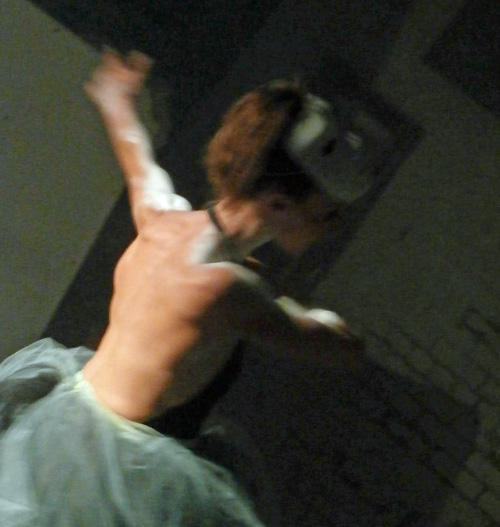
She floats in like an apparition to the stool, her shoulders and arms painted white, matching the white mask which is on the top of her skull like a hat, not yet a facial disguise.
 
 
She orbits the simple, three legged chair to a languid, ballad-like instrumental track, the fog gradually clearing. The stool becomes a prop, then an apparatus to the dance as her body contorts, coils then stretches.


The movements are elegant, always fluid but they shift from a preternatural hover to very physical and human, gyration, graceful, smooth, followed by a strained pose. The tendons and muscles in her well toned back and arms,, visible, apparent, rippling beneath her skin.  You could almost see her pulse from across the room.  All too human indeed, then it’s back to a more ethereal physicality.


Erin Parsch is a dancer, visual artist and performance artist, whose website is here.

;


Like So Much Lost Time was a performance dance piece featured at Fish With Braids, whose gallery space will be closing imminently. A rare but not uncommon performance art work at this space, a former warehouse, has a nice urban feel, shadowy light and painted over brick walls. The humanity of the artist seemed emphasized in this repurposed vestige of our industrial past.


The slow, moody dance – modern but accented with ballet flourishes – had a whiff of tragedy. The title -- Like So Much Lost Time – evokes a feeling of regret. At the conclusion of the piece, the dancer slips the mask over her face, which I took as symbolizing death. The inevitability of our shared mortality underscores the sorrow when we realize the reality of time. Lost time is lost forever. Lost time is not found again. What moment isn’t fleeting?  All we can really know is our own mortality. She sits on the stool and waits. Eventually only the stool remains.

 
 Website: Erin Parsch


Sunday, June 23, 2013

Abstract Devices


The WhiteStar Bar is dimly lit and the pieces are hung high above the heads of patrons, which makes it difficult to appreciate the moody, at times darkly emotional, aspects invoked by the work, a series of uniquely made abstractions by Luca Cusolito.

The opening of Left to My Own Devices / New Works by Luca Cusolito was delayed by the relentless spring thunder storms; it was originally scheduled to debut the first week of June.  It is now up at White Star on Brunswick Street for a few weeks.

Luca, who hails from Florida, is an art organizer and advocate, has been part of the Jersey City art scene for the several years, but was reluctant to show her pieces, especially in an exhibition devoted exclusively to her own work. Previously, she had only been part of group shows. But guess what. The work started selling; she started getting more inspired.


While having little to no formal training in art, Luca has been making art since her teen years. The current abstractions – which are layers of paint on canvas beneath a glass surface – began under unusual circumstance: quarantine and pox.


About two years ago, Luca was stricken with adult Chicken Pox. Spots covered her body and she was under doctor orders not to leave the body until her complexion normalized. With the only the paint and other scarce art supplies at hand in her home, she constructed her first abstractions. A friend and neighbor who also dabbled as an art curator saw the work and persuaded Luca to sell her the piece and adamantly encouraged her to produce more. The pieces were included in subsequent group shows. All the original abstracts produced during the pox phase have been purchased.

The core of the Left To My Own Devices show are  4” x 4” canvases, which clustered together on one of the brick-red wall of the White Star Bar seemed to be a single, mosaic-like work of art of its own. They also exemplify the work itself. Using different types of paint – acrylics, oil, water, etc. – she layers the various substances and colors – 28 layers in some cases – and once the desired effect is achieved, she places the glass on top of the paint, which by drying affixes it to the work, essentially creating a glossy result and a protective cover. “It has to be timed just right, or else the time is wasted,” she says.

In other words, unless each step is properly timed, there is no art. While the steps are the same, each piece is distinctive. “It is intentional to some degree, but it is also accidental each one comes out.”

Do the at least partially spontaneous outcomes also result from a deliberate expression of feeling? While deliberation seems to be at a minimum when it comes to inspiration an abstraction jag, feeling does provoker to produce. “When I am in the mood, I work on the art, I tend do a lot at one time.”


Outlet or urge, in the final analysis does the root motivation really matter as much as the clever and creative result? In addition to the 4” x 4” 's, there were larger pieces using the same glass and canvas production methods. Others used a resin finish instead of glass; the abstractions resembled drips and splashes but had a more textured surface. Another piece featured gel-caps filled with glitter within a brownish-pink color, invoking a bleak decadence (this party did not end well).

The pill pieces may have been unusually blatant, the oft-obscured dark mood dominated many of the pieces making up the “Left to My Own Devices” exhibition, which seemed to contradict the upbeat enthusiasm Luca radiates. She is a bit of a jack-of-all trades, involved with several Jersey City based organizations as well as entrepreneurial  endeavors including Creative Enabler, a digital public relations company serving creative types and Lollibomb Beauty, a line of hand-made soap and cosmetics.  

Until now, her art was secondary on her agenda. “I think I’m going to be spending more time with it.”


Wednesday, June 19, 2013

Abandoned Warehouse Graffiti


Always fun walking around the mostly abandoned warehouses. Every few months new graffiti seems to appear. Graffiti is often both obvious and obscure – how many other forms of communication can say that about itself?
 
 
Some tags are familiar, others fresh to the eye. Something brave and obstinate in this the oldest form of street art. Why can’t art be both art and vandalism? Maybe more art should aspire to vandalize, at least challenge and provoke conformity. No real testament to Visigoths here. But as in centuries past, an individual break with the social order, the latest iteration of Kilroy was here.


I’m an individual, no matter how illegible or personally referential or ethereal, I am here. I exist. The urban landscape of old concrete, rotting bricks and cracked warehouse windows – the vestige of the industrial past not yet refurnished into condominiums and mix-used projects – a self-proclaimed artist – is there any kind, really? – scrawled a souvenir of a life, evidence some one was here and that some one was I and I needed proof even if that proof be briefly amusing strangers looking at old building while going from one neighborhood to another.


Tuesday, June 18, 2013

313 Gallery, Post-Hattery


This eastern box turtle shell was part of a gallery within a gallery, curated by Bunny Pearlman that featured folk art and crafts and some found art pieces, like this shell. I love turtles and used to have a box turtle pet as a child I named Tank.
I’m jumping the gun on this blog with a pure turtle love digression,  in memory of Tank, gone more than 40 years now.
 
The 313 3rd Street branch of the Jersey City Art School opened two years ago as a workshop space and sometimes gallery. The opening was a fun event that I wrote about here.
 
 
The 2013 313 re-opening for this may have bee a little more staid when it than a couple of years ago, but there was more art to see.  The big news is that the gallery portion has become more permanent. The 313 Gallery will now be open Saturday and Sunday. The gallery is the latest outgrowth from the Jersey City Art School, and word is that it may the first of a trio of spaces with art for sale on a regular basis. Artists have lived and worked here for years, and people visit to see the work and meet the artist at various events throughout the year, but an ongoing gallery with regular hours and art for sale that people will come to and purchase outside of an organized event, like the Studio Tour… well, regular gallery hours just like you find across the Hudson... that’s new and probably about time.


Construction for the gallery also include the addition of a massage therapy studio Evolve|Revolution Massage by Ceallaigh Pender (Pender also runs the school’s ceramic program) and the gallery opening also included the grand opening of this by appointment mini-spa. 
 
The space is nicely repurposed, tall  ceilings, painted walls of brick  and cement. The artist work spaces are in the back, behind the back. Makes you wonder what used be here.

Millinery Manufacturing

But not at first.

A visit to the  New Jersey Room, at the main branch of the Jersey City Free Public Library tells the tale, or pieces to the story at least.
 
 
Originally it was a stable, at least in 1887, the date of this city map. Yes, it is hard to tell, but look closely, using the pen as your pointer; This is a map of 313 Third Street way back then. See the X, according to the key, that designates a stable, for horses one assumes.


By 1893, a listing indicates it is now the location of a Samuel Wachtel Hat Company; In 1910 it is listed as New Jersey Hat Company. By 1926, it is Modern Hat Company and Modern it is a name that seems to have stuck, although with variations such as Modern Hatters, which appears in a local program for the Italian Village feast in 1979. It sometimes appears as A1_Modern Hat Company, the aA1 being a common device back then to get a company listed at the beginning of an alphabetical listing.


In 1956, the City map lists it as Felt Hat Facty (factory).


313 3rd  Street circa 1981, Modern Hatter still making hats in Jersey City. (Joseph Brooks photo.  New Jersey Room, Jersey City Free Public Library).
 
 
 Men used to wear hats all the time, until 1960, fashion historians say, with the election of John F, Kennedy, who famously did not wear a hat for his inauguration and was rarely seen with one. He wanted to project a youthful image and thought the hat made him look old or least a member of the old guard. As a result, hats fell out of favor – not that the wearing them entirely disappeared, there was always a market, but the 60s and 70s were tough times for hat manufacturers. The hat business started to come back after Indiana Jones brought back the wide-brim fedora and Urban Cowboy revitalized the Cowboy hat. Around the same time, the casual wear of the baseball cap became ubiquitous. Hats as a fashion item have returned in the 21st century, but by then Modern Hatters of Jersey City had gone the way of the Brunswick Street Blacksmiths. Except for say Stetson, most hats are now made overseas.
 
But these Jersey City Milliners lasted a long time.  Modern Hatters was still listed in a 2001 Jersey City Yellow Pages directory. More than 50 years under one company name. Modern Hatters must have made good headwear.


The cement walls, open space, industrial feel still exists in the building, giving the gallery a kind of steam-punk feel, a sense that art is the contemporary manifestation of urban productivity. But like I said, I was most taken with the gallery within the gallery by Bunny Pearlman, and her mix of found and folk art, as well as her small, wistful paintings. Hats were once made in this space, finding their way for sale across the country; now art from or at least reflective of rural America has made it way here for view and purchase.