Monday, July 13, 2009

St. Anthony’s Festival


“A lot of good food there’s gonna be,” said the woman when I stopped by the Saint Anthony’s Festival in the afternoon. Got to love idiosyncratic New Jersey syntax. I returned to the scene in the early evening. The church celebrates its 120th anniversary this year, and the festival, actually entitled—“I Love St. Anthony’s Festival (I guess the “heart” is for the church and the festival)—was the first one ever. Thickening clouds threatened to fulfill weather reports predicting a thunderstorm, but the Festival was rocking.

Back in the pre-white flight, mid-20th Century Jersey City, the city was mainly Italian, Irish and Polish. The majority of each category saw their numbers decline as parishioners moved to the growing suburbs and African Americans and Hispanics—primarily Puerto Ricans—moved in. From the 50s through the 70s, a cycle was created—as more ‘people of color’ moved in, more ‘whites’ moved out. That’s only part of the story; not everybody moved. Some—maybe not most, but many—were not enticed by suburbs. They stayed. They weathered the bad times, and accepted a new paradigm—being minorities in a city of minorities. Enough descendents of Irish, Italian and Polish immigrants remained in Jersey City that their presence can still be seen and felt—bakeries, restaurants, bars, other businesses are still here, some since the 1920s. But unlike the Irish and Italian, the Polish community in Jersey City has been infused by new émigrés from Poland. Not that the Irish and Italians do not have ethnic pride, but it is at least three or four generations removed by now—their pride possesses more of a nostalgic tinge. They are not getting new infusions fresh off the boat. The Polish are. You hear the polish accent in young & middle aged adults, not just the senior citizens—most of the seniors have Jersey accents these days. There’s nostalgia going on—and nostalgia is attractive—but the culture has also been newly refreshed with late 20th & early 21st Century arrivals from the old country.

A delightful mix, and a friendly bunch. These street festivals are parish fundraisers, they are also a big party for the parish, and a way for the community at large to celebrate a segment of that community. And, you get to drink beer legally in the street!

Actually, they were serving a quite tasty Polish Lager, available at the semi-full-bar in a church court yard. It was the court yard of Holy Rosary, which holds its own Italian Festival next month.

The food, all home made, was really delicious. This was authentic and top notch fare. Kielbasa, Bratwurst, Pierogie and Potato Pancakes. There was stuffed cabbage—I am cabbage adverse—and other food items that I didn’t get to sample. Unlike other street fairs, this food was not just authentic, but gourmet-quality—as good as any Polish restaurant I’ve experienced. Without a doubt, the best Kielbasa, Bratwurst, Pierogie and Potato Pancakes I’ve ever had. The Potato Pancakes were especially good—they have long been a favorite of mine—these were crepe thin and flavorful. I will hold all future Potato Pancakes to this new standard.

I didn’t get to see any Polka, but there was a good rock quartet kicking out the jams, mixing covers of Rick Springfield, Cheap Trick and Green Day. Young guys with some real talented playing, lots of energy and a sincere Neo-Punk Rock edge. They were witty, brash and the crowd loved them. A rocking good time was had on the stage and the street!

Residents of the neighborhood wandered and ate and drank and played games. Street Fairs are the summer. Because of the unique dynamic of the polish community, the fun-vibe here was different. A gathering of several varieties of Polish Americans sharing and continuing their culture. A table sold Polish Language DVDs, another table of sold imported polish food items, another with Religious items. New arrivals assimilating and multiple generations of Polish Americans not just reminding themselves about their cultural past, but learning about the Poland present. There was more than just pride here, but a genuine pleasure. And, everyone was invited to their party. The Patron Saint of Miracles, Saint Anthony of Puda, gazed upon us all and held back the storm. Everyone repaid him with gladness and gratitude.

Friday, July 10, 2009

Dave Alvin: Dave Alvin & The Guilty Women

The closest Blaster fans may come to a reunion of the Alvin brothers any time soon is in the song “Boss of the Blues,” on Dave Alvin’s new record, Dave Alvin & The Guilty Woman. Phil appears in this autobiographical number. He’s driving Big Joe Turner down Central Avenue in Los Angeles, with Dave—“16 years old in 1972”—in the back seat. Joe is telling the boys about the good old days of this neighborhood—“a poor man’s paradise”—where “we used to jam all night long/everything was jumpin back when Big Joe Turner was the boss of the blues...” but after witnessing the 70s era urban decay—“Burned out buildings and abandoned stores,” and realizing “no one around here remembers who the hell I am,” Joe can only weep. A gripping song that explores the glee of young musicians hanging out and getting approval from a hero, role model and mentor as they drive through the bad part of town. But that legend becomes human, affected by his response to the conflict between the nostalgia he feels and the present degradation he witnesses. In turn, the young Alvin boys gain a crucial understanding of how social collapse causes internal wreckage.

For those paying attention, this first record featuring new material by Dave Alvin since 2004’s Ashgrove, continues a new strain of songwriting for Alvin, the musical memoir. The title track of Ashgrove was a blues-rock reminiscence about the famed west coast club where the Alvin Brothers first got turned on to rockabilly and the blues. Another song on the new record, “Nana & Jimi,” depicts his mother driving (and even making him a sandwich) Dave and his friends to see Jimi Hendrix, “and nothing’s going to be the same.” This song made me nostalgic, remembering my friends mom driving us to see concerts at the Capitol Theater in Passaic (the Jerry Garcia Band was one I recall). You get out of the car and into the rock concert and you know this world was more dangerous but nothing like the live you had lived. You feel a new freedom. Then you get back in the car and wonder about how you’ve changed. Alvin delves into his trademark blues-rock for this autobiographical yarn that reflects the erotic energy that was Hendrix and the carefree fun of being a young teenager.

In addition to the new installments in his musical “Chronicles,” the new record is also notable because Alvin has put his great band, the Guilty Men on hiatus following the untimely death of band-mate, Chris Gafney. Alvin hooks up with a mainly acoustic bunch of indie Americana females— The Guilty Women. I’m not sure if this is a new direction or just a side-project that serves as a way to regain his bearings, but whatever the reason, it’s another fine collection of songs by one of the most under-appreciated musicians of the last 25 years.

According to the line notes, the project’s inception occurred in 2008 at the Hardly Strictly Blue Grass Festival when Alvin teamed up with a group of roots-oriented women musicians. “I knew they were all master musicians who could handle any sort of song that I could throw at them.”

That they do, and he throws at them nearly every category of roots music in existence. It is a credit to these group of musicians and to Alvin, that not only do they give some amazing performances, but Alvin, working with new musicians, proves his skill as a band leader. The album has a hootenanny attitude similar to Springsteen’s Seeger Sessions, which is an apt comparison since both albums showcase work with a band newly formed for a specific project. Of course, Springsteen had a good ole time romping through some old folkie chestnuts—something Alvin did on his Grammy Award Winning Public Domain. ‘Guilty Women” is a mix of original Alvin, a couple of songs by other band members and some cover material. But, like Springsteen’s Seeger Sessions, the new musicians inspire an infectious energy. If the Guilty Men created a smokey barroom feel—danger always lurking in the shadows; the Guilty Woman have a more wholesome edge—old friends playing on your back porch long into the night.

The Joe Turner song is especially compelling, starting with a real “Jump” music feel, ole-time Rhythm and Blues then phasing seamlessly into Western Swing music. What if Joe Jackson played with Asleep at the Wheel? What if T Bone Walker played with Tex Ritter? Well, I could name drop above my actual knowledge (and record collection) all blog long, but this genre-busting arrangement surprises—just as the song gets into its most blues groove of the R&B sound, that blues sound is played on the fiddle. The ever-eclectic Alvin has always been adept dabbler in a host of genres, sometimes melding them, sometimes playing them straight, but always revealing what the genres have in common while also finding forums for his gravely baritone vocal chords and tasteful guitar technique.

The CD opens with yet another version of Alvin’s Blaster classic, “Marie, Marie,” (Alvin often dips into his song book on new releases; he’s released multiple versions of many of his songs). This take is loose, with a genuine hoe-down feel. The fiddle playing by Amy Farris (who also plays viola) and Laurie Lewis—here and throughout the record—makes you want to clap your hands then slap your knees.

“Marie, Marie” involves a guy who pleads with Marie to ignore the family that detests him and to leave with him, even though his credentials are sparse: “I got two weeks in back pay, and gas in my car.” Alvin is in his 50s now, not the young Romeo when he penned the tune. The song gains a contemporary depth, echoing middle aged love in our economic downturn era. “And you sing so sad... but don’t you understand, I just want to be your loving man.” The sadness may in a large part be due to current global circumstances, but this world weary perspective only makes more poignant the middle aged romantic love expressed.

“Marie, Marie,” with its new how we live now feel interpretation is followed by an explicitly topical song, “California’s Burning,” with Alvin showing off his powerful blues chops, harmonizing with the female voice about some of the natural disasters afflicting the Golden State “if the fire’s don’t get you, the mudslides will.”

“Anyway,” a folk rock tune with country overtones, tells a Carver-esque tale of two lovers who, on the verge of giving up, decide instead to get drunk together— “let’s drown our sorrows honey, drink up all of all of our money, we’ve said all that we have to say.” Classic Alvin, in sound and theme—empathy for those suffering—the song is co-written with Faris, who sings harmony. These days it’s hard to hear down and out tales without thinking of the economy—“let’s kill another beer, pretend that we aren’t here”—and though this may not be overtly topical, the impact of our New Depression on the internal lives of these two lovers is apparent. But there isn’t just bleakness here; with Faris’s sweet harmony, even though it seems that some love has faded and they may have few economic choices other than having a few drinks, the listener is left with the satisfying feeling that their love will be salvaged.

In another autobiographical vein, “Downey Girl,” is about the other singer from his California hometown, Karen Carpenter, who sang “sweet suburban songs.” Profound empathy distinguishes Alvin’s songwriting, but here momentary identification evolves into something else. A hometown may connect these two artists, but their music and careers could not be more different. Alvin portrays a wisdom that comes with age—“Now that I’m older, I can understand her pain, I can feel a little pride, when people say her name”—the wisdom he experiences is the pride in who you are and where you are from and an understanding that maybe the suburban hometown had something to in causing that pain, a pain they both shared but one she couldn’t overcome. Empathy than is transmuted into a movingly somber nostalgia—“a thousand years from my home town/ missing friends and family who are no longer around/then I hear her singing, on the car radio/ a sweet suburban song from a long time ago/and I think about her sadness/and I think about her pain/and for a few sweet minutes/I’m back home again.” Sad violins emote, the guilty women back up the chorus like an ethereal choir and Alvin transcends his ambivalence towards Karen Carpenter’s celebrity, music and the fact she was also from Downey. His empathy enables Karen Carpenter to embody for a moment his own past. She inspires a reflection on his life from which he derives a deeply personal solace. Finally being able to understand her is how the narrator is finally able to understand himself. Empathy is not always the easiest emotion to experience, or act on, but maybe solace is eventually empathy’s worthwhile result.

“Potter’s Field” is another standout track, sung and written by Christy McWilson. An egalitarian lament for the ones who die alone, buried in Potters Field. Like most of this acoustic-centric, folkie-leaning record, this song is a captivating blend of old time mountain music and California Folk Rock, like Ralph Stanley meets Jackson Browne. “Bury me in Potters Field,” Mcwilson sweet, ragged at the edges, voice intones, “in the fields where I belong, where the powerless are strong, and the nameless are unclaimed and unrevealed.” The song confronts death “the dreams and all the disappointments/ fading like footprints in the grass,” and becomes a poignant meditation on mortality and everyone’s inescapable fate. This may not be an Alvin song, but it shares his empathy with the ones society neglects. A testament to ultimate solidarity—empathy doesn’t end at the graveyard.

Other non-Alvin songs include Tim Hardin’s “Don’t Make Promises,” and Kate Wolf’s “These Times We’re Living In.,” delivered in a Buck Owens unplugged style. When all is said and done, there might be other albums in Alvin’s oeuvre I might recommend first, but this is a very entertaining addition to that canon. Eclectic as ever, he is real gamer with this new group of musicians—and perhaps because they are women—they augment Alvin’s finest qualities. A lot of joy and fun is felt in these songs, capped off in a raucous, countrified boogie-woogie version of “Que Sera, Sera (Whatever Will Be, Will Be),” made indelibly famous as the theme song for the Doris Day Show, a 60s sit-com. Another duet, with McWilson plays the mother in the song. There are hilarious moments, when Alvin asks, “Mother, will I be rich,” and McWilson intones a doubtful, “well...” Then the whole band goes hog-wild as the singers testify a cheerful acceptance of life “whatever will be, will be, the future’s not ours to see.” The performance is not corny, not karaoke, not a novelty song. It sounds like it was always meant to be countrified boogie-woogie, capping off this eclectic outing with a playful ode to fatalism.

I often think I listen for texture the most in music, and on that score this record has an amazing texture, thick with Americana sounds: fiddles, dobros, resonator & pedal steel guitars, bar room pianos, mandolins. It’s not entirely acoustic, since electric guitar often chimes in—but that’s more sauce than meat. The texture accommodates all the whims of the musicians and the arrangements. But, special attention must be paid to Lisa Pankratz, the band’s drummer and percussionist. Pankratz is able to navigate these different shores as she propels the texture so it always rocks and is never too sweet or too harsh. The intelligence and attentiveness with which she plays, sustains the energy of this record. You may not notice the drumming right off the bat, but that is precisely why it is so appropriate. By the second or third listen, you realize what is making the texture of this music effective—astute percussion.


Thursday, July 9, 2009

Terminal History


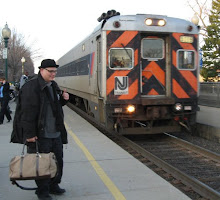
It feels like a scene in a post-apocalyptical film seeing the Central Railroad of New Jersey Terminal at Liberty State Park. The terminal is now a pavilion where tourists take the Ferry to the Statue of Liberty and Ellis Island, but the tracks leading to the station are all overgrown with weeds and brush. Here a once great railroad thrived. Here, the remnants of a civilization decay. Any moment on the horizon I expect to see apes riding horses casting nets on fleeing humans.

The Jersey Central Line was a regional railroad with origins in the early 19th century, running until 1976 when it was absorbed into Conrail. The terminal opened in 1864. It was a departure point for Union Troops and materials to the South during the final years of the Civil War. Soon after, the terminal initiated one of the defining aspects of America, the post-war period of immigration. From 1890 to 1915, approximately 12 million immigrants were processed for entry at Ellis Island and they entered the country via the terminal. It wasn’t Plymouth Rock or Jamestown where most folks first witnessed a land, as Fitzgerald wrote, “commensurate to (their) capacity to wonder,” it was Jersey City!

The "Blue Comet" railway train traveled between Jersey City to Atlantic City from 1929 to 1941. My Sister-in-Law’s Parents, Ned & Rose Katz, were from the Atlantic City area. They grew up there, when Atlantic City was known as the “World’s Playground.” When I first moved to Jersey City, Ned told me about taking Rose on the Blue Comet to Central Railroad of New Jersey Terminal, then the Ferry to Manhattan to see Frank Sinatra at the Paramount Theater—a famous series (Bobby Soxer shows) of concerts in ole Blue Eyes career. Tickets were fifty cents said Ned. After the concert they ate corn beef sandwiches and cheese cake and waited for the morning train to take them back down the shore. They fell in love and were married until they passed on during the last decade of the last century. Sinatra in his prime. A long train ride to talk and kiss. The Statue of Liberty glistening in the breaking dawn. What couple wouldn’t fall in love?

The Blue Comet was one of the last Steam Locomotive passenger trains to run. The Central Railroad of New Jersey went bankrupt in 1967 and was absorbed into Conrail. Trains ceased to travel from Atlantic City, the terminal ceased operation and became a landmark. Liberty State Park and this terminal is one of the most visited tourist spots in the world. It’s a place where history echoes—a station that helped Union victory, that enabled immigrants to uplift our country and decided the long marriage of Ned & Rose.

Monday, July 6, 2009

Safety = Success


Practical wisdom always carries the price of lowered aspirations.

Fishing & Crabbing on the Hudson


A couple and their young daughter were fishing and crabbing on the Jersey City banks of the Hudson River. “We come here just about every weekend,” said the wife.

The husband tied fish shards into the crab trap then flung the trap into the river. “I caught two today,” he told me.

“I caught a striped bass,” added his wife.

“We almost always catch something,” said the husband.

“How do they taste?”

The woman laughed. “Oh, we usually throw them back.”

Renegade Cafe

At the end of the High Line the crowd is serenaded from a cabaret on a fire escape.

On Friday, a slightly humid summer evening, my buddy, Tony was in town and we walked the new High Line walkway, which opened in June. Originally a freight train railroad trestle, not in use since 1980, and instead of knocking it down or as I would prefer, bring back the freight trains, it has been transformed into a walkway. It starts on Gansevoort Street and only goes to 20th street , although it is scheduled to be extended to 34th street. What these New Yorkers won’t do to get another view of the Jersey side! The walkway, mainly cement, has design accents echoing railroad tracks and there’s foliage scattered about, places to sit. But the best part was the Renegade Cafe, which is what the singer called the fire escape stage.

There’s a fence near the stair way at this temporary end-point to the High Line. Across the way is an old apartment building, with near-perfect sightlines of the fire escape. Plastic colored lanterns dangle from the railings. The High Line has spotlights which illuminated the fire escape. Wearing a light green gown, the woman sang a cappella standards. She was wonderful. It wasn’t just a performance, it was a serenade.

“I’ve been in Chelsea for 31 years,” she said at point. “And I’m not leaving, no matter what my landlord says.”

I felt like I was in some Science Fiction story, standing on the latest urban development project of 21st century Bloomberg New York while viewing a lovely siren from old time Chelsea singing across an abyss of time.

Luckily I missed the New York Times article a few days earlier, so encountering the Renegade Cafe on the fire escape was an utter surprise. Turns out, in this apartment—you not only can just see the fire escape, but right into the living room—lives Patty Heffley, who was a photographer of some renown of New York punk. A visit to her website(
www.pattyheffley.com/), reveals some familiar images of punk icons, including what I believe are the last concerts of Sid Vicious at Max’s Kansas City. Heffley has lived here since the Freight Train era and according to the Times piece, when she realized her fire escape, where she hangs her laundry, would be a perfect performance space for a captive audience of pedestrians on the newly opened High Line walkway, she asked her friend, Elizabeth Soychak, a jazz singer, (www.elizabethsoychak.com) to perform. Thus the Renegade Cafe was born.

Being a Jersey City citizen, I could only think that the High Line might be an example the 6th Street Embankment, also former freight railroad trestles, will follow. I’m ambivalent about that prospect, unless of course there’s a Renegade Cafe where an apparition-like singer can serenade us from a not so distant past.

Visit:
Renegade Cafe on Facebook

Sunday, July 5, 2009

Thriller Belongs To The Ages

Around 1986 or so, I was at this apparel trade show where the wholesalers specialized in surplus and what was called vintage clothing. The wholesalers bought containers—better known as ‘lots’—of unsold lines of clothes and sold them to apparel retailers, like army/navy stores or hip, downtown boutiques. There was and still are markets for things like actual authentic original 501 jeans as opposed to the newly made Levis jeans called original 501. This one wholesaler had the original red Thriller leather jackets— bright red, fire engine shiny, a tricked-out motorcycle jacket design, severe 80s shoulder pads. The guy was selling them for $5 each (at the time, the retailer’s mark-up was usually twice the wholesale price). “Three years ago, they retailed for $1,000.”

That was how popular Thriller—and Michael Jackson was—a clothing company invested enough to copy a garment he wore in a video and people spent top dollar for them. I wonder how much they are going for on E-Bay this week?

I never owned a red leather anything, but I did get Thriller, a few weeks after it came out. I bought it on cassette. I played it all the time, several weeks, perhaps months.

By the time I talked to the vintage clothing jobber wholesaling Thriller leather jackets at $5 per, I am sure it had been a year since I played it last. At least a year. Brilliant, new, captured a time and a moment but for me at least, it didn’t move with me once the moment past.

Thriller was a confluence of musical trends—soul, gospel, funk, rock, pop, Motown and Disco. Michael Jackson made Disco respectable. His lyrics had the depth classic Disco intentionally lacked and he returned the beat somewhat to its funk roots. Electronic percussion and other “synth sounds,” so new at the time and so well crafted by the genius of Quincy Jones made the record absolutely current. Rich with sounds of a host of popular musical genres and catalyzed by a multi-racial, urban sensibility—the sound, the melodies, the rhythms, the lyrics, the beats of Thriller felt exactly like the world was at that moment.

I was a rock and roll kid, which then also meant being part of the disco sucks crowd. “Billie Jean,” with that irresistible bass line, revealed a funk complexity to your basic Disco riff that encouraged respectability for all previous Disco, an era that ended right before Thriller. At the same time, Thriller made the real Disco seem shallow and sound like period pieces. “Staying Alive” required an entire movie, Saturday Night Fever, to give Disco some depth, at least a back story of alienated urban youth finding self worth on the dance floor. To be fair, not a half-bad flick. But Billie Jean didn’t need a movie to make it a haunting story, a danceable song, and a cultural talisman. After Thriller, “Stayin Alive” was just cornball nostalgic kitsch. Same with “Disco Inferno,” “Gloria,” “I Will Survive,” etc. “Billie Jean” not only had more rhythm and musical complexity than “Do The Hustle,” the lyrics inferred a love story that included the dance floor, dancing leading to lust, and the repercussions of lust— illegitimate parent hood. It was a three minute opera of the perils of young adulthood.

But Thriller wasn’t just smart Disco, it recast the music by melding pop tunes with dance beats. This genre is still with us; in fact, it is still top 40. Britney Spears, Justin Timberlake, before them, Madonna. Dozens, hundreds of musical acts, both those with longevity or the one-hit wonders copy Thriller. Put on KTU sometime (I hear it a lot at the gym)—all that stuff is Thriller re-dux. Add to that the rap and hip-hop songs that have sampled Thriller—perhaps the most widely sampled recording. This degree of influence is without precedence. Signs of influence that border on or are an out and out replication will always be with us—Oasis is the latest iteration of the Beatles sound—but to dominate popular charts, to still be garnering hordes of fans, 30 -some odd years hence and showing no signs of abating? Nothing compares. Maybe the Ramones music is noticeable in each ensuing crop of punk music artists, but there’s only one Green Day these days, and as great as they are, Green Day doesn’t have the scope of pervasive popularity of Michael Jackson (if they did, they wouldn’t be Green Day!). Thriller is, by several miles the leader of the pack in terms of longevity, followers and apostles.

It’s astonishing how much music Thriller contains—a duet with Paul McCartney, the hard rock guitar and melody of “Beat It, the funk meets soul that gets hard-edged with “Pretty Young Thing,” and sensually ethereal with “Human Nature.” It used to be that music was seen as specific genres and specific audiences—and it still is to some extent. With Thriller, it was obvious Jackson owned as many James Brown records as David Bowie records. New and revolutionary at the time, although there were some cross over artists, no cross over album had as many hits in the segregated billboard as Thriller produced. After Thriller it seemed everyone was free to be fans of other music. “We Are the World”—co-written by Jackson—had Willie Nelson singing with Stevie Wonder, something that would be unheard of 10, and certainly, 20 years prior. Jean Wyclef paid tribute to Johnny Cash a few years before the man in black passed on to the other shore. I would argue Thriller not only led to that moment, it led to that moment not being revolutionary. Bono could duet with Frank Sinatra. Jackson made all music fans eclectic. Thank you, King of Pop!

Thriller was so huge that it is hard to find a fitting adjective. Bigger than Elvis or the Beatles falls short. Mega-stars that Elvis and the fab-four were, the King of Pop redefines the term. Those songs were everywhere for years. Michael Jackson toys, lunch boxes, (not to mention apparel products!) He appeared with Muppets. His videos had highly promoted premiers on television. The tours attracted audiences of all ages. When the Partridge Family hit, their “Bubble Gum” rock had the pre-teen audience, but not beyond that. Led Zeppelin was the big thing for older teens and young adults, but they were not popular with the early elementary school set. What I’m getting at, Grammar School, Junior High School, High School, College (nobody cares about your music tastes after age 21) all had their own musicians to follow. Thriller not only crossed over with race, crossed over with music genre, but the college kids were hip to the same thing being listened to by 5th Graders. There were different audiences for MTV than for Toys R Us. Michael Jackson had both those audiences. For about a year or so, he was the Jonas Brothers and Nirvana. A few acts may have gotten close to that level of popularity, but no one has ever achieved it, or achieved it so lastingly and spectacularly, as Michael Jackson did with Thriller.

I don’t think such an extraordinary degree of popularity can be planned, but number one records rarely happen by chance, and with guidance by producer Quincy Jones, Thriller is perfect—the hooks, the singing, the playing, the texture of the sound—every moment is exciting and deliberate.
Perfections may inspire admiration, but even perfection can not withstand over exposure. Thriller was played for what seemed like 24/7 for at least the rest of the 8th decade of the previous century. Stores, bars, clubs, radios from other cars, your car radio, the cassette, you heard it everywhere, every day. I never found it unpleasant, I can’t remember ever being sick of it. But this over exposure diluted the music for me. I ceased to enjoy it. The Thriller red leather jacket for five bucks, by that time the music had become so pervasive I found it meaningless. A friend of mine said the other day, “I like Michael Jackson but I never bought his music because it was played everywhere anyway.” I appreciated the perfection, and I appreciated other genres popping up after—hip hop and the house and the jungle and the trip hop—but, it never became my thing. The over exposure turned the Michael Jackson sound into the white noise of an air conditioner’s hum, and my subjective musical preferences (Rock & Roll, Blues, Jazz, Country—the usual suspects) led me to different artists.

By the early 90s, he seemed just a weirdo celebrity. The constant plastic surgery was so compulsive and pathological. That forced kiss with the daughter of Elvis was grotesque. He made me sad. Here was an unprecedented musical genius and he was trapped in a tabloid celebrity fame made in large part by his own outlandish and uncontrollable eccentricity. The child molestation allegations, while never proven, did reveal that Jackson had some serious issues with his own childhood. He didn’t hide his pain, nor did he dwell on it or talk about it much, but it is obvious that this peculiar pain took over his life and eventually led to its destruction. His Peter Pan motivation to create a childhood he never felt he had was a tragic ideal. It is impossible for a man to be a boy. He could never accept that impossibility.

What I have come find out since he died, that my experience with Thriller is a mere footnote to the legacy of this album. I bought and listened to it when it was hip and I was hip. Late teens, early 20s, listening to what is hip is quite important, or least it used to be (or is that seemed to be?) Jackson put out several other records, some got reviewed well and there were hits. In spite of his weirdo celebrity-hood, he retained a large following. I was not in that following.
Talking with friends and family members who are not just under 40, but under 30, I found out that while they haven’t fervently followed Michael Jackson as they grew up, Thriller is part of their childhoods, it’s part of generations of childhoods. All kids see that video. All kids listen to Michael Jackson. Everyone who was ever seven years old—my anecdotal research indicates that is the age—experienced Thriller and the fun pop of Michael Jackson. It makes sense, the music is easy to understand and that song and its visual depiction tells an entertaining horror story. I think seven is the age where kids become aware of the world beyond their play pen; they leave their play pen. When they got sick of "The Wheels of the Bus," they experience Thriller.

I was out with a friend the night he died. We were in New York City. Michael Jackson died somebody said on the street. Suddenly, that was all what people on the sidewalks were talking about. Strangers stopped each other to trade thoughts and feelings. Everyone was shocked. Was it true? A heart attack? We went to a bar. Michael Jackson music was on. There was a young woman—maybe 30, probably younger, crying. “He was such a part of my growing up.”

A friend of mine, born in 1988 told me the same thing. Born six years after the release of Thriller, add seven years (I guess that’s about 1995)—that’s about the time she fell in love with Thriller. Thriller is a benchmark of early youth for millions of adults either running the world or poised to take over. He was fun, gentle, entertaining, a fondly remembered pied piper. He sang and danced and they sang and danced with him. I was old enough to get the cultural import of Thriller at the time, how he was raising the bar on musical genres, evolving way beyond the Jackson 5 I knew from my own grammar school days. The look he adopted included new wave meets Sergeant Pepper style. I knew how new, fresh and clever it was, and the way he sang, what a great voice, sweet, smooth, yet also guttural, with high-pitched yips and bassy grunts jumping off the lyrics. But it was not part of my childhood, my relationship could never be as deep or emotional as those younger than I.

In our new media type of world, pundits have used the term collective experience to describe what no longer can occur. Culture and audiences are too fragmented, the media delivery systems too numerous, to produce the collective experience anymore and many have said that the popularity of Thriller was the last vestige of that sharing of a moment. It’s true as far as it goes. But that collective experience didn’t end after Thriller finally slipped from the charts and the radio station play lists. Gen X, Gen Y share Thriller as a collective experience that occurred sometime between pre-school and junior high.

I don’t think that childhood collective experience is over by any means. My 12 year old nephew told me he bought Thriller in March at CVS for $8.00. “Beat It is on Guitar Hero. I saw the Thriller video when I was kid though.”

No other musician or artist ever affected audiences of so many generations as this man. He was a great singer, great songwriter and great dancer. I don’t think there’s been any dancer of note who wrote songs, and while there are dancers with competent voices, and singers who could hold their own when hoofing, you can’t quite claim anyone as great in both categories. Michael Jackson is singular. His musical talent was complete in mind, soul and body.

The outpouring of feeling toward him, both in the media and what I’ve seen personally, proves his art has transcended his often very strange persona. In the 80s, his music didn’t just capture the zeitgeist of a time, it was the zeitgeist. And, hearing it the last week or so again, with new ears, I got nostalgic for that moment. Now it seems that moment has been captured for all time, sort of the way Francis Scott Key, inspired by a sea harbor battle during the War of 1812, turned his feelings into a song that sums up a nation. For about two centuries now, all generations share that moment.

My 26 year old nephew said, “he was the biggest freak on the planet but "Billie Jean" is a great song and no one can take that away from him.”

Or from us.