Illegibility is still present; see that object that sorta looks like a soda cup with straw, like the kind you would get at a fast food establishment, near his temple. Sorta is the key word, not soda. Illegibility seems to be the aspect that creates the line between street art and defacement of public property. Decipherable or not, graffiti reminds us that our urban landscapes are products of our humanity. We are the city. Otherwise, an impressive illustration. I liked this guy floating on this wall, on the side of building in our warehouse district. Some kind of construction going on, probably won't be around much longer. He looks like he is talking but he looks none too bright, appears agitated, like what he is saying about the subject is not important but he is agitated with good reason and the subject affects us all.
Thursday, January 12, 2012
Meter Collection
An ordinary day, another morning, the day city workers collect change collected in the parking meter. Coins are in the thing that they empty into the locked thing that’s on the thing with the wheels. He never sees much less touch a coin. He’s talking on the cellphone. The winter has been stalled, not as cold as it could be this morning. Hub cap in the foreground, reminding us the night before has a secret to keep.
Terrarium Display
Monday, January 2, 2012
Politcal Ideas for Our Political Year
One of my credos when starting this blog was no porn, no politics. Like New Years Resolutions, credos are made to be broken.
I still do not feel inclined towards overt prurience for prurience’s sake but from time to time, politics has reared its not always ugly head. Credos be damned, 2012 will be a year dominated by politics, so lets get used to that fact from the get-go
Politics – frustrating, often tedious, but unavoidable. We live in a Democracy, for the system to work we must participate. In one way or another, politics eventually must be addressed. During a presidential election year, that discussion will be constant. I just wish less horse race talk and sports metaphor saturated commentary on candidate’s winnability and more discussion of political ideas.
My basic rule for this blog is to write about stuff I feel like writing about. I don’t feel like writing about politics, as they are covered in the news, and the idea of making a candidate endorsement is ludicrous. Examining political ideas, another matter entirely. That’s why the tag on the blog is political ideas, not politics. It’s hard to separate politics from political ideas and even when separate that division lasts much less longer than their comingling, but I’m going to try.
Not everything about politics is bad. Rhetoric can have clever turns of phrase and speeches can contain some of the best writing of the day. It’s easy to say throw the bums out or some other narrow view of politicians and lets face it, the easy way is the road most travel. I resist this easy way, the world is too complicated, the solutions to our problems require too much thought, deliberation and effort. I have found most politicians (I know a few, interviewed more than few) sincerely enter public service to make the world a better place. The paradox is they are human, their iindiviudal ideology may differ from yours and finding common ground can be impossible, and that they can hold contradictory positions of dabbling in corruption, accept some of form – and they’re many forms – of bribery, yet also still retain the conviction they ware working to make things better. Abdicating your responsibility as a citizen by painting them all with the “dem bums” label is anti-intellectual, immature and nihilistic.
I criticize politicians; there are more of them that I hate than like. The ones I love I can count on one hand. When political commentary boils down to Bush Sucks or Obamacare, I roll my eyes, often bile seeps up my esophagus. Here, I will try to be honest, intelligent and focus mainly on ideas. I’m not trying to convince anybody about whom to vote for. I do not care if you share some, all or none of my progressive political beliefs. By reflecting on the issues, and political ideas, maybe we can make better choices with the limited choices with which we are presented.
In 2012 we face what will be a pivotal – aren’t they always thus – presidential election.
Both nationally and locally, 2012 will also be a political coming out party of sorts for Gen Y. Funny how Gen X – the Friends generation – seems not cover as many birth years. Boomers stretch from 1945 to 1964; but it seems that people born after 1974 consider themselves Y, not X. People born in say 1992, who will be voting in their first presidential election, consider themselves Gen X. Well, let the marketers figure out the official designations so they can decide which consumer products to sell to whom, my point is that this cohort is large and more politically aware than Generation X (where was the Friends voting episode or the voting scene in Reality Bites! When did a character in a Kevin Smith film ever vote? These Reagan teenagers can seem indifferent to the fate of the world) Or the Baby Boomers, who might have made a global clamor during the Vietnam era and for whom the voting age was lowered to 18, but they failed to elect McGovern over Richard Nixon and their voter turnout consistently declined in every subsequent election.
Generation Y seems to have a different attitude, both nationally and in town. Their generational peer pressure is to vote, the opposite of Boom/X. They’re a lot more uppity and given the world in which they now enter adulthood, who can blame them.
I make no bones about it, I’m a Democrat. I’m a New Deal Democrat. I like to say that my political beliefs come from the songs of Woody Guthrie and the Sermon on the Mount, which is clever but the truth is complicated, especially when it comes to transforming those beliefs into political action. I believe the role of government is to do for people what people cannot do for themselves. The government must do more than protect private property rights. However flawed or ineffectual the Democratic Party can be, they come closer to my political philosophy than the republicans and voting third party is voting for a republican. Disagree if you want, I’m not saying the situation is ideal, I’m not promising or expect utopia. I’m just stating my feelings about the situation. I am expressing political ideas and the values through which I arrived at them.
I love FDR and I love Bill Clinton. The country was better when they left office than when they took office. That’s just a fact. You may say it wasn’t because of them, but I think you’re wrong and would probably like to have a conversation about say in a bar, but please don’t start with the Comments on the blog. Clinton, at least during my lifetime, was the only president that about can be said the country was better off when he left in 2000 than when he came in, in 1992.
Supply Side Economics was tried and failed. The tax burden on the investor class was lessened; they invested in companies with factories in foreign lands whose workers were and are willing to accept slave wages. In the 80s and the 00s, Real income dropped in the U.S., the middle class was depleted, and the nation’s deficit skyrocketed. In the 90s, Clinton’s “third way” take on Keynesian Economics reversed this trend, eliminated the deficit, created government surpluses, we regained full employment and incomes rose. Bush II reinstated Supply Side with a vengeance, the financial sector, unchecked, has wreaked havoc here and abroad. A truly retarded phrase is being spread about, “Obama Socialism.” The fact is that Keynesianism is still Capitalism. FDR & Clinton, in effect, saved capitalism from itself
I support the Occupy Movement, even participated some but my worry is that they don’t seem motivated to participate in the electoral process. They have the right idea in that participation in a Democracy is more than just voting, but it is also more than just a demonstration too. I follow a few of the Occupied places on Facebook and one time there was a survey, asking about political stuff, including activities like do you vote or have you ever written a letter to an editor. But there was no question about attending a town, city, school board of other type of legislative meeting. People criticize the movement for not specifying issues, although they are affecting the debate and may be affecting our consciousness, but they are falling short of pragmatic actions towards implementing change, at least right now.
Real change takes effort and time. Politics requires consensus, coalitions and compromises. The dilemma is that people starve in the short term, not the long term.
I’m voting Obama in 2012. My lack of enthusiasm for Obama is overwhelmed by my fear of another Republican president at this time in our country’s economic history.
How does a progressive assess the Obama administration? It’s impossible not to feel some disappointment, he’s lost the sheen of excitement of his election campaign. He can still conjure up a compelling turn of phrase, but his rhetorical style, in contrast to Senator Barack, seems fatigued as President. Hard to deny he’s been a little more to the center than originally thought. The economy still sucks; the wealthy, I mean, a-ahem, job creators are getting record high tax breaks, paying record low tax rates and creating no jobs. The healthcare bill, which has a lot of great things, fell short of Universal Care, he caved on the Public option, the benefits of the legislation have yet to kick in and it is uncertain how lawsuits disputing the legislation will pan, except for further delay a just, equitable and effective healthcare system for the citizens of the United States. Buyer’s remorse maybe justified, but what is the alternative?
Are Obama’s personal flaws as a leader to blame or are those shortcomings exaggerated and the real problem has been the hostile congress with its Tea Party, Koch Brothers funded majority and apostate democratic like Lieberman (aka, Gore’s fatal flaw), who undermined every piece of legislation, no matter how potentially effective, especially removing the teeth from the stimulus package thus gelding its simulative power.
If you believe the former, you will have a harder time casting your vote for Obama. If your political beliefs are not strongly aligned with the right or the left – in other words, if you haven’t thought deeply about political ideas and have lived your life with out developing a personal political philosophy, i.e., the so called undecided – you’re liable to vote Republican. Throw the bums out has been a popular sentiment among America’s yahoo segment of the population, a significant portion of the nation. I fear that Occupiers who blame all the administration’s failures on Obama not being the progressive we thought he was will either not vote or vote for some third party bozo like Nadar, adding to the ranks of the undecided who are dissatisfied with the current state of the nation and lack interest in political ideas.
The Occupy Movement may evolve into a 3rd party, some scuttlebutt implies. Do not repeat the Nadar catastrophe. First field candidates in local and state elections.
Recent Facebook talk posed a statement along the lines of not supporting any politician who isn’t committed to getting money out of politics, an admirable goal. Given the structure of campaign financing and an electorate more interested in TV ads than the discussion of political ideas, this goal does not immediately achievable. It requires not just candidates signing a pledge but office holders to devise legislation that can achieve this objective. If your commitment to such a goal means that one of these Republicans currently seeking the nomination will become President that will be a devastating setback to all the other political ideas espoused by the Occupy Movement specifically and progressives in general.
Politics combines idealism and pragmatism. The perpetual political challenge is that implementing your ideals pragmatically is a process requires building coalitions and accepting compromise. If too many ideals are sacrificed, why compromise? But, if you’re hungry, how can no loaf be better than half a loaf?
Can the occupiers occupy our electoral process without electing one of these republican candidates, who honestly scare me to death? All of them. One is crazier than the next. Imagining this next generation of Supply Siders in power keeps me up at night with fear.
What does my political philosophy, based on Woody's best songs and Jesus’s core scriptural teaching, tell me? I want a country where working people get a better deal, where food, shelter, education and healthcare are constituional rights, where there are more decent paying jobs and more opportunities for jobs, where our infrastructure is broadly defined to include not just physical necessities like roads, bridges and unities that enable our society to function and help make possible life, liberty and the pursuit of happiness, but people as well. Education and Healthcare are infrastructure issues, and as such must be recognized as rights and given to all because a smart and healthy populace is much a necessity as those roads and bridges. It’s why I vote Democratic because however flawed the party is, they are a lot closer to supporting those ideals than the Republicans. A two-tiered society where the rich have all the power is self defeating and destructive; to get closer to my ideals and a better world will require a tax policy where the more money you make, the higher of a percent goes to the broadly defined infrastructure.
This will be a political year, and hopes the rhetoric we are bound to hear is equal to our passion, to our ideals and principals, to our intelligence. I refuse to give into simplistic cynicism.
May I also remind everyone that there is more to life than politics. A warm winter day filled with light greets another orbit around the sun. Regardless of who is in power and who is not, this day, our earth, that sun, it’s there for us.
Saturday, December 31, 2011
2011: My Best Reads
In March, I had a month long calamity. The apartment above mine had a flood, which severely damaged my abode. The repairs, clean up, dealing with the subcontractor to compensate my losses, basically meant I wasn’t able to read books for a few weeks. But I had some interesting reading experiences so as a first, thought I would try a best of list. These books are worth noting. These are the books that come to mind when I ask myself, what were the best books I read in the, rather arbitrary, period of 356 days. It’s not quite a third of the books I encountered 2011.
William Trevor is a contemporary Irish writer, known mainly for his short stories. Love and Summer was one of the better novels I read this year, it’s a few years old, and while it takes place in Ireland it has a real universal flavor. Takes place in a rural setting, a farmer’s wife has an affair with a man who has returned to the town to pack up his dead father’s house. Just a superbly sensitive portrayal of desire, how we cope with loss and how happiness is not just out of reach, but more complex than we realize, especially when we don’t want to admit we have it.
Cheri by Collette. I had read her short stories, which did not move me. I like French literature (in translation) a lot, but mainly 19th century. A recent film was made of this novel, I haven’t seen it but I read the book instead. Cheri is a young man who is kept by a courtesan twice his age. Early 20th century French society was filled with contradictions, Lea while a kept woman for her youth and unmarried, is accepted to a degree by society. Cheri is pampered and a narcissist. Everything is just below the surface in this novel. The two fulfill each other sexually but they make the fatal mistake of falling in love, the man being the one admired – the descriptions of his body are feverish – the woman being the one who keeps him reverses the more typical man/woman dynamic. They must part because he must marry for money, a woman his own age and because love, true love, is the biggest threat to society. The edition I had included the sequel, the Return of Cheri, takes place after World War I and there is an uncomfortable reunion between Lea and Cheri. The world has changed – more so than Collette cared to admit I think – and love remains, insistent yet neither former lover dare not speak its name.
The Way We Live Now. England is a very odd country, I sort of like Trollope, I mean, I’ve read him, he’s sort of fluffy and while not as gnarly as Dickens or Hardy– who are not as gnarly as Zola or Melville – there’s something honest and infectious about him. He seems to celebrate the Victorian era he lived in more than he criticizes it. I only read this book because it is one of the few classics I still had left of the bucket list, but I enjoyed it more than I anticipated. An undercurrent in the book – the instigating event that sets the plot in motion is an American coming to London to solicit investment in a railroad company that soon goes bust and wreaks havoc in the lives of some brits yearning to remain, at least in appearance, aristocratic – struck a contemporary chord. Europe’s current crisis can reasonably be blamed on the corruption under the Bush administration of our financial system. I don’t know how much I like Trollope, but I enjoyed reading this plump 19th century tale. The realism was more in the story than the writing, which is not always the case, especially as realism became more the standard in literature post-Trollope.
Grand Oaks Books, which I think is a publisher on demand with a deal with Amazon came out with The Fortune of the Rougons by Emile Zola, which may be the first translation of this novel, the first in the Rougon-MacQuart Cycle, which they are calling Zola’s great 20 works of fiction that follow members of a French family in the 19th century. I love Zola, he is one of my favorite writers, although I always thought Theresa Raquin started the series. I’ve read all I can find in English, which is about 17 or 18, as well as some of the ones he wrote after this, his life’s work. The action takes in Plassans, where the peasantry rise up against the forces of Napoleon III; a young peasant couple, Miette and Silvere meet and fall in love and join in the uprising. Dr. Pascal makes a cameo, his story is the last novel in the series where he sums up the previous 19 or so books and their characters. Trains, Farms, Restaurants, Department Stores, Banking, Artists, Mining, Prostitution, Clergy, just about every facet of 19th century French life, falls under Zola’s scrutiny. This lively translation was seamless, the book itself well made, a large photograph adorns the simple cover, large typeface that fills the page, it’s a beautiful paperback. The company claims they are going to publish, for the first time in order, new translations of the Zola cycle. I couldn’t be more excited. They said four a year for five years, but I haven’t seen another edition since this debut, so who knows. Finding a new Zola to read is pure pleasure.
Best Re-Read of the year: As I lay Dying. It’s been more than 20 years since I did a college paper on this Faulkner. I love Faulkner, I estimate between the college Faulkner class and the reading since; I’m about 80 percent through. Spotted Horses is still my go to, but his multiple narrator work in a stream of consciousness style was fun to revisit. I read Intruder in the Dust right after cause I didn’t want to let ole Bill go so fast. I hadn’t read it before, it was fun, the writing seemed a tad forces, I got impatient. A black man is falsely accused of murder and a lawyer, Gavin, who appears in the stories in Knight’s Gambit, Faulkner’s brand of who dunnits, proves his innocence. Faulkner had progressive views of Civil Rights for his milieu, but could never imagine a world different than Jim Crow south. Unlike To Kill a Mocking Bird, where the black man’s innocence is incidental to his fate under the apartheid system of the American South through most of the 20th century, I didn’t believe it for a second. Yet, it was a full explanation of Southern Mentality of the era, unvarnished and without apology.
My favorite new book of 2011 was Train Dreams, by Denis Johnson. It was one of the few “new” books I read this year. One of the greatest living American writers, I’ve been following his work since Angels, his first novel. Train Dreams is a novella, a gnarly tall tale of America and an individual. He works for a time as a railroad man in the upper Midwest, marries and has a son, but soon die and he lives out his life mostly as a recluse. With sensitivity, intelligence and a sense of wonder, he explores American individuality it a way that makes you feel that it is a new discovery. What a fine writer.
In a review I read of Train Dreams, Seek, Johnson’s collection of reportage and nonfiction pieces, was heavily praised. I had a read a couple things in Esquire or was it GQ, and wasn’t impressed for whatever reason and never picked up this work. Train Dreams was short, I read it twice through first time. I have a collection of his poetry, which was good but the collected poems – and apparently all his collections – are now out of print so I did pick up Seek as well as Shoppers, which is a play, actually two plays. Anyway, the plays were seriously, barely readable yet Seek was also one of the best books I read last year. He reports on the wars in Liberia and a Rainbow Tribes festival where he tries to revive some of his druggy hippie day; a series of essay looks at different deserts. All brilliant writing, as brilliant in their own way as Jesus’s Son. An obvious antecedent might be Armies of the Night by Norman Mailer, but this novelist nonfiction dabbling I think is superior. Word for word, he’s a better writer than Mailer – I love Mailer – also the pieces are more eclectic; who the heck wasn’t writing about the anti-war pieces in the 60s; when was the last time you read an essay on Liberia? That’s what I’m talking about. Well, as far as I can tell, except for one collection of poems, I’ve read all of Denis Johnson. Poetry gets no respect and as far as a serious readership of literary poetry goes – the very phrase and its apparent redundancy, literary poetry makes me sick but in our Spoken Word era what is one to say? – There are too few of us to count. It makes me sad.
Speaking of Mailer, I finally read Tough Guys Don’t Dance and loved it. It’s out of print and wasn’t really trying very had to find a copy, but in the library at my mom’s assisted living facility, which are just donated books, I found a copy. I dug it, better than the weird movie with Ryan O’Neil. Mailer adapted his style to the demands of noir as aptly as McCarthy did in No Country for Old Men, although Mailer was giving props to Raymond Chandler yet Mailer’s weird obsessions with Freud and sex and the failures of the American dream would not be tamed. Best noir, perhaps my favorite genre, I read all year. It’s more than 20 years, that’s sad. Underrated in Norman’s oeuvre, probably his best short novel, and made me want to read the rest of the oeuvre. I miss having Mailer around.
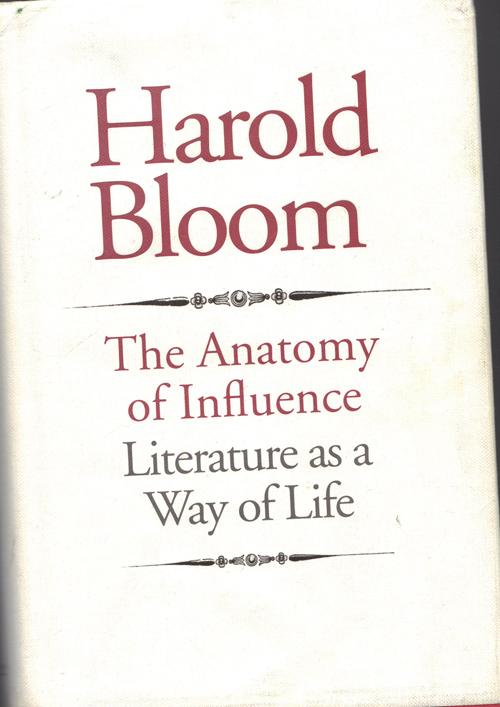
I haven’t read Harold Bloom’s Anxiety of Influence, where he lays out his main literary theory, which looks at literature as a whole with Shakespeare at the center, but I picked up his latest, Anatomy of Influence, where he furthers his theories. I’ve read enough of Bloom, particularly the Western Canon, so I’m hip to his jive. This may be his last major book; he hints as much, the man is in his 8os. The chapter on the poetry of D. H. Lawrence was illuminating, I used to love his poetry in high school but he has fallen out of favor and is known primarily for the novels. Bloom loves Hart Crane and the Montaigne. I soon picked up Hart Crane again; I was mainly familiar with The Bridge, now I went for his collected works – introduction by H.B. himself. I’m not sure, he’s a difficult read. Am I too far gone for poetry? I still read Whitman, not much else though and while I’ve written some rough things, I haven’t been encouraged to flesh out and make a poem again. I don’t know. Montaigne though, I had never read and I got a collection of his essays and found them quite brilliant and familiar, mainly because his influence is so dominant, the guy invented the essay practically, that nearly everyone in his wake owes a debt.
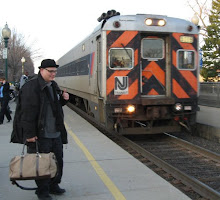
Bloom mainly led to my central reading experience of the year and also perhaps, my life. Shakespeare, perhaps you heard of him. I loved Shakespeare in High school and one of my most memorable College Courses was a Shakespeare class. I have always tried to include classics in my reading and would read a Shakespeare here and there, and figured I would get through them all, eventually. I recommend the Folgers editions, which feature definitions for all the words and phrases that need definitions – yes, just about every other line – as well as brief scene by scene synopsis and an interesting essay about the specific play. They are also cheap, five bucks and easy to carry, small, reasonably plump paperbacks. Perfect reading for the PATH and NYC subway. Huh? You say. Subway reading is filled with distractions and at best, you only get a 10-15 minute batch, the thing with Shakespeare is that the language which is beautiful but inverted, archaic – he anticipates Melville and Joyce, who are probably harder to read – so to really absorb what he has written, small but consecutive doses work best. Reading the plays in clusters – and aside from newspapers, magazines, websites and BLOGS! Shakespeare was my reading. It was my Summer Shakespeare, more than six weeks I reckon. Shakespeare wrote 38 plays and prior to my Shakespeare, I had only read or seen 20. Once I got rolling, I found that I could read about three per week, reading them back to back made the reading faster and easier. Whether reading or see a stage or film production, there is always an initiation period with Shakespeare, your mind has to adapt to not just the language but the way of thinking. With Shakespeare, anything could mean everything. It’s not really a double entendre or taking things more than one way, but everything about the human experience is taken into consideration.
The Merry Wives of Windsor and the Two Gentlemen of Verona are rubbish, but Titus Andronicus was a phantasmagoric nightmare. Anthony & Cleopatra, probably the only major play I had yet to read, seems to anticipate the femme fatale in Cleopatra, more so than Lady Macbeth, a woman the desire for whom drives men to extreme yet is not without love. Pericles had a real yarn about it. The Noble Kinsmen was a thoroughly, unabashed entertaining read. Richard II, the man ill suited to be king, was quite moving. What was really funny that about a week after reading Timon of Athens, I saw it performed in Van Vorst Park. I was able to talk to young actors and their not so young director, in depth, about the play. Reading the plays in a cluster of about two months was an exercise I recommend. As a guide, I read Shakespeare: The Invention of the Human by Harold Bloom, where he analyzes each play, enabling me to get the most of out each reading. Also, he gives history of the criticism of each play, so you get an idea of how it was interpreted and where it might stand in the Western Canon. But where does it stand within Shakespeare? This is a fun question. I remember my college Shakespeare teacher saying how Titus was a bad play; it was one we didn’t read. There was always an acceptance that not all of Shakespeare is good. Yet, beyond a core (Hamlet, Lear, etc.) what is the best. It is an open question, one that has to do with trends of fads of any era. Bloom doesn’t like Titus, but admits that he might be wrong, yet I consider Titus, well maybe not Hamlet or Lear but as interesting, entertaining and well written as Macbeth, better even. Bloom says that 12 to 15 of the plays are great, so even he admits to an inconclusive answer. My Shakespeare summer not only was about the plays I read, but, with the help of Bloom, I thought about the plays that I have had previously read as well. The idea of bad Shakespeare started to bug me, Merry Wives not withstanding. Bloom and my College professor were wrong about Titus. I’m not sure what to think of the term Minor Shakespeare, except that it is misleading. Hamlet and Lear are simply incomparable works of genius. Those aside, I guess I would put it, there is a lot more major Shakespeare than is generally agreed upon. Lastly, Bloom writes about how Shakespeare reads us. He talks about the categories of Tragedy, Comedy and History and how Shakespeare actually evades them. So true, all the plays have elements of Drama and Humor, they are a complete experience. Humanity is a funny thing, a mix of comedy and tragedy as we all, together and individually struggle with our fate – we can never chose our parents, the decisions we make within the context of our fate and endure the defining component of humanity – the burden of mortality. As the summer wore on, Shakespeare was reading me.
Looking back now, I realize, it was weeks, probably a month, before I read anything that recall as of value. A prejudice lingered. I did not want to give up that world.
Anyway, for the record, these were the plays in my Summer Shakespeare Festival: Love's Labour's Lost, Measure for Measure, The Merry Wives of Windsor, Pericles, Prince of Tyre, The Taming of the Shrew, Twelfth Night, The Two Gentlemen of Verona The Two Noble Kinsmen, Richard II, Henry VI, Part 1, Henry VI, Part 2, Henry VI, Part 3, Henry VIII, Coriolanus, Titus Andronicus , Timon of Athens , Troilus and Cressida, and Cymbeline.
William Trevor is a contemporary Irish writer, known mainly for his short stories. Love and Summer was one of the better novels I read this year, it’s a few years old, and while it takes place in Ireland it has a real universal flavor. Takes place in a rural setting, a farmer’s wife has an affair with a man who has returned to the town to pack up his dead father’s house. Just a superbly sensitive portrayal of desire, how we cope with loss and how happiness is not just out of reach, but more complex than we realize, especially when we don’t want to admit we have it.
Just Kids by Patti Smith. This literary memoir will move you regardless of how you feel about Patti Smith. She’s a major hero to me, I’m a huge fan and this book filled in a lot of gaps about her life. She’s a true believer in literature too. Mainly it’s about her relationship with Robert Mapplethorpe, the photographer. There have been friendships and relationships between artists before, both within the same medium or in different mediums. Patti Smith redefined music and Mapplethorpe redefined photography. They were both major and game changers in their individual mediums. I don’t think there is another example of such a close relationship between two artists of such comparable stature. But it’s not about their celebrity, or really their work, it’s about a deep, loyal relationship, against a backdrop of the 60s became the 70s until Mapplethorpe became another victim of the AIDS pandemic of the 80s. Really accomplished writing too. Right on sister!
Cheri by Collette. I had read her short stories, which did not move me. I like French literature (in translation) a lot, but mainly 19th century. A recent film was made of this novel, I haven’t seen it but I read the book instead. Cheri is a young man who is kept by a courtesan twice his age. Early 20th century French society was filled with contradictions, Lea while a kept woman for her youth and unmarried, is accepted to a degree by society. Cheri is pampered and a narcissist. Everything is just below the surface in this novel. The two fulfill each other sexually but they make the fatal mistake of falling in love, the man being the one admired – the descriptions of his body are feverish – the woman being the one who keeps him reverses the more typical man/woman dynamic. They must part because he must marry for money, a woman his own age and because love, true love, is the biggest threat to society. The edition I had included the sequel, the Return of Cheri, takes place after World War I and there is an uncomfortable reunion between Lea and Cheri. The world has changed – more so than Collette cared to admit I think – and love remains, insistent yet neither former lover dare not speak its name.
The Way We Live Now. England is a very odd country, I sort of like Trollope, I mean, I’ve read him, he’s sort of fluffy and while not as gnarly as Dickens or Hardy– who are not as gnarly as Zola or Melville – there’s something honest and infectious about him. He seems to celebrate the Victorian era he lived in more than he criticizes it. I only read this book because it is one of the few classics I still had left of the bucket list, but I enjoyed it more than I anticipated. An undercurrent in the book – the instigating event that sets the plot in motion is an American coming to London to solicit investment in a railroad company that soon goes bust and wreaks havoc in the lives of some brits yearning to remain, at least in appearance, aristocratic – struck a contemporary chord. Europe’s current crisis can reasonably be blamed on the corruption under the Bush administration of our financial system. I don’t know how much I like Trollope, but I enjoyed reading this plump 19th century tale. The realism was more in the story than the writing, which is not always the case, especially as realism became more the standard in literature post-Trollope.
Grand Oaks Books, which I think is a publisher on demand with a deal with Amazon came out with The Fortune of the Rougons by Emile Zola, which may be the first translation of this novel, the first in the Rougon-MacQuart Cycle, which they are calling Zola’s great 20 works of fiction that follow members of a French family in the 19th century. I love Zola, he is one of my favorite writers, although I always thought Theresa Raquin started the series. I’ve read all I can find in English, which is about 17 or 18, as well as some of the ones he wrote after this, his life’s work. The action takes in Plassans, where the peasantry rise up against the forces of Napoleon III; a young peasant couple, Miette and Silvere meet and fall in love and join in the uprising. Dr. Pascal makes a cameo, his story is the last novel in the series where he sums up the previous 19 or so books and their characters. Trains, Farms, Restaurants, Department Stores, Banking, Artists, Mining, Prostitution, Clergy, just about every facet of 19th century French life, falls under Zola’s scrutiny. This lively translation was seamless, the book itself well made, a large photograph adorns the simple cover, large typeface that fills the page, it’s a beautiful paperback. The company claims they are going to publish, for the first time in order, new translations of the Zola cycle. I couldn’t be more excited. They said four a year for five years, but I haven’t seen another edition since this debut, so who knows. Finding a new Zola to read is pure pleasure.
The Age of Reagan by Sean Wilentz, first and foremost, is a great read. I could not put it down. In 2010, I read his book, Dylan in America, which is the best book on Dylan, which isn’t saying all that much because all the biographies stink. He’s a historian and places Dylan within the context of America, really original and insightful work. This book came out the year before, and is essentially a political history of the 80s and 90s, even though he illuminates the strain of conservative politics as it emerged mid-20th century. It’s non-polemical, to such an extent that it may be a flaw; it’s an objective look with telling details, such as Clarence Thomas, never a judge before his objectionable appointment to the Supreme Court, who was an Education Department official in the Reagan administration, gaining popularity by blocking any educational initiative. Another insight I think about was the white flight in the cities and those WWII and Baby Boomer folks who lost allegiance to the City Machine Politics. They voted Reagan in for sure, but a lot of them different vote. Barely 60 percent of the country voted in 1980. The Age of Reagan is marked by drastic drops in voting. Scary and illuminating, this is a well written book entirely about politics in America during basically the era where I grew up. It was published in 2008, I bought it was a cheap remainder at Barnes & Nobles cause it isn’t out in paperback, wasn’t in the J.C. library and I refuse the Kindle. Reading this book the same year the Occupy Wall Street movement began gave me nearly as much new perspective as the immortal Bard.
Best Re-Read of the year: As I lay Dying. It’s been more than 20 years since I did a college paper on this Faulkner. I love Faulkner, I estimate between the college Faulkner class and the reading since; I’m about 80 percent through. Spotted Horses is still my go to, but his multiple narrator work in a stream of consciousness style was fun to revisit. I read Intruder in the Dust right after cause I didn’t want to let ole Bill go so fast. I hadn’t read it before, it was fun, the writing seemed a tad forces, I got impatient. A black man is falsely accused of murder and a lawyer, Gavin, who appears in the stories in Knight’s Gambit, Faulkner’s brand of who dunnits, proves his innocence. Faulkner had progressive views of Civil Rights for his milieu, but could never imagine a world different than Jim Crow south. Unlike To Kill a Mocking Bird, where the black man’s innocence is incidental to his fate under the apartheid system of the American South through most of the 20th century, I didn’t believe it for a second. Yet, it was a full explanation of Southern Mentality of the era, unvarnished and without apology.
Saturday, December 24, 2011
Christmas in the Heart
I love Christmas music, but only just before Christmas. I do not want to hear it before Halloween, before thanksgiving even and if you play it on December 26th, I might be forced to commit an act of violence we’ll both regret. But today. Christmas Eve, I love it and it is really the only thing I’ll be listening to as I wrap presents and get ready to joyfully fulfill my holiday obligations.
We always hear Christmas songs, hymns and carols long before the holiday. More and more radio stations go all Christmas all the time and going that way earlier and earlier. I heard one or two before Halloween; just like I saw Christmas ornaments and related housewares, albeit a small display, Labor Day weekend at Kohls. After Thanksgiving, Christmas music gradually pervades, until around the third week of Advent that’s all you hear. Christmas music creeps in like a vapor as Fall comes upon us and by the time of Winter, December 21, it’s more than half of the songs you hear.
I can do without Last Christmas, otherwise I don’t mind any Christmas song. I love most of them. I don’t play holiday songs at home until Christmas Eve’s Eve, as we called it when we were kids, actually a day or two before, like the first day of winter. Happy Solstice.
Sometimes you hear holiday songs and they can only annoy, intrude upon your reverie; another harsh reminder of the holidays: spend money, think of gifts, organize and/or attend events with family and friends. The office and job related stuff. End of year madness, everything winding down, lots of reflection, long dark nights, snow and you have to bundle up and trudge day in and day out, everywhere you go; wet socks, cold feet. Who needs it?
I don’t have the time or the money! you scream to deaf ears.
We all feel a little like Scrooge at first, not a full blown bah humbug, but we postpone the hassle and the music initially only reminds us of the inevitable. Eventually you give in, especially after homes, store fronts, and municipal fixtures get all decked with lights and other yuletide imagery, both secular and sacred, mangers and menorahs. You start going to parties and other get-togethers. I learned long ago it takes too much effort to be a professional crank. I am never sorry to see the Christmas Holidays go, but I enjoy them while they’re here.
Yesterday, after leaving work early, I took a break from errands and such, sat in an Argo Tea, my new favorite place, having a Yerba Matte with steamed soy milk and hazelnut flavoring (my new favorite drink), and a version of Santa Claus is Coming to Town came on the sound system. I noticed a woman softly singing along, absent mindedly and outside young people walked by, one in a red santa art, the other wearing reindeer antlers. I realized I hummed the song as well, wiggling my head back and forth. There is a simple joy, a shared joy, holiday music invokes and encourages. Soon or later, it overcomes your cynicism.
I heard just that morning. I play music in the morning, usually as I shower, shave and dress for work, after getting a blast of NPR news. I always play Christmas music from say 12-20 – 12-25, and only then. Even Last Christmas no longer makes me cringe by then, I no longer roll my eyes at Feliz Navidad or Santa Claus is Coming To Town by Bruce and E Street, which gained a special poignancy this year because of the loss of Clarence. But that's part of Christmas too, the tinge of sadness; as remember the childhood joy of Christmas morning, you now remember people who were with you then who aren't with you this Christmas
I play the Elvis Christmas Album, of course. I like the John Jacob Niles album of hymns and carols, The Band's Christmas Must be Tonight Gets a whirl, and this cheap R&B compilation with the likes of Jerry Butler probably gets a play. But, being a hard core Dylan freak, it’s not the holidays now until I put on Christmas in the Heart, Dylan’s Christmas album.
If you don’t like Dylan, if you are unable appreciate the phlegmatic rasp his aged voice has become, you’re not going to like this clever collection of mainly standards. Bob Dylan has a truly awe inspiring knowledge of music, particular American music; it’s not just the eclectic mix he plays on his radio show, but he has made landmark albums in a range of styles: Folk, Country, Gospel, Rock & Roll, Blues; you can even see splashes of reggae, klezmar (Street Legal), and more recently, jazz and crooning. Christmas albums are essentially novelty records and so this is Dylan’s novelty record, among other things. The album features choral singers, and Dylan intermixes with this choir. It is the first time he sang with a choir since he toured with gospel singers, the last time with Tom Petty & The Heart Breakers (he referred to these singers as his heartbreakers) in 1986. Dylan first worked with background singers and choirs on Self Portrait in 1968. The singers here have an oddly 50s incandescent to them, like the Rooftop Singers, even more so than All the Tired Horses or the intro to Days of 49 from Self Portrait. It’s freaky, yet in keeping with the novelty record feel and damned if it doesn’t sound Christmassy. Christmas is about warmth and coziness, glad tidings and peace on earth; it’s one of the few times were mawkishness and schmaltz is expressed without irony or apology. What would Christmas be without a little kitsch and corn? This may be Bob's most fun album, fun all the way through at least.
The only new song, new to my ears I mean, is It Must Be Santa, a rare polka ditty. The song was made into a viral video. I never cared for or about Rock Videos and never will. When I heard this I thought, now I understand where Lily, Rosemary & The Jack of Hearts comes from. Western Swing only tells part of the musical history of that song. The other song that is rare is Christmas Island, but I was familiar with the version by good ole Leon Redbone, whose voice Dylan’s now resembles.
Otherwise, Dylan does the known standards, from Blue Christmas to Silent Nights, even doing a verse in Latin of O Come All YE Faithful. My sister says that Dylan’s voice has gotten so harsh that I’ll Be Home For Christmas sounds like a threat, not a promise. There are times where I burst out laugh. He’s long since shot out his voice. The last time I saw him in concert, I had never heard his range of notes being so limited; he used the rasp effectively on his most recent collection of new songs, Together Through Life, him going through these well known, time honored classics, songs everybody knows, really reveals his vocal uniqueness. Yet, Dylan’s unique phrasing may be tarnished, it’s still there and he puts genuine feeling into these songs.
From Blowin in the Wind up to the present, Dylan songs always echo an awareness of the divine presence. The sacred songs, such as Silent Night seem to resonate with me here, because they echo so many other themes and ideas in Dylan’s vast catalog, hundreds of songs – I’ve been listening to his music literally my entire life. Whatever your beliefs, and I am not one to preach and proselytize, one reason Christmas so permeates the western world is not so much the belief in Jesus Christ, the son of God, but the idea that how clever, how appropriate, that if there is a God who created human beings in His own image, that when he sent his son to save mankind, that son would be born in a manager, in “low estate,” wrapped in swaddling clothes, recognized at the messiah only by local shepherds, three wise men from far off lands, and perhaps a kid with a drum. The Nativity is perfect as story, be it turth or myth or both.
Another rarity is The Christmas Blues, a nice jazzy romp that bemoans, “Santa only brought me the brightly packaged, tinsel covered Christmas Blues”, which features a harmonica riff. Harmonica playing has been rare for America’s bard during this, his late period phase. More importantly, he touches on the melancholy feelings (he also sings I'll Be Home For Christmas) that the holidays also bring and as blues music teaches, humor is the best way to survive sorrow.
Well soon it will be Christmas day. I might be listening to Bob, maybe you go to Frank or Phil Spector (We should all go to Elvis), but basically we are listening to the same collection of songs, give or take. Amazing how we can listen to the same songs, regardless of whom is singing, again and again, especially as we approach the actual holiday.
Today I love Christmas music and so do you. I wish you all the best. Merry Christmas, Happy Holidays.
By The Nose
This, that or the other, nary a week passes without going to Union Square Park. This elephant has been balancing on his trunk since September, on one of those cement islands off to the side, the west side if I recall now, of the park. But for whatever reason I rarely am in that particular corner of this world, so I haven’t noticed until the other day. It’s Gran Elefanret by Miquel Barceló I like the size, it seems about as large as a small elephant, which conveys the intended feeling of mass being self-controlled on what is gravity defying impossible. But maybe in the world of this sculpture it is only seemingly impossible, check out the two back legs there in the air, how they’re unaligned, asymetrical in a realistic position as if the pachyderm is indeed shifting its body so he can be suspended by the nose.
Subscribe to:
Posts (Atom)