Showing posts with label literary. Show all posts

Tuesday, April 1, 2014

Year Five: Reflections


Five years a blogger.


I apologize for the typos, I can’t afford a copy editor. I also appreciate the kind words, encouragement and compliments I’ve gotten in person and by email. I’m not sure exactly what service Dislocations actually provides, but it’s good to receive genuine appreciation. Originality and depth is something I strive towards and it’s nice to both have that acknowledged and to know that many appreciate such aspirations. Last year I passed 100,000 vistors or readers or however the blog-stats are interpreted.

God Bless you all

This may be the last one, by the way.

THE FINAL DISLOCATIONS!

I do not want to make such a grand statement – because, really, who knows how one will feel come any given morning – and it’s not that any hiatus is being planned – but the fact of the matter is that that each year I’ve written fewer blogs posts. This feeling has been nagging me, that maybe I’ve to the end of the blog format. Things I feel like writing about now, ideas that are coming, do not lend themselves to Dislocations posts.

Maybe blog notions will come again. Maybe I’ll just do pictures with funny captions, or maybe start another blog with a different mission than Dislocations. People have said to me, I love your blog about Jersey City. I thank them, but this blog was never really about our isthmus, it’s just mainly set in Jersey City. Ultimately, my statement is about the human condition, our experience of mortality, how we reconcile the need for community with our limited ability of understanding – we really can know nothing other than the self. Indirectly though, maybe it is about Jersey City, and maybe I do not have much else to say, especially about what fascinates me the most, ordinary life. Noticing anew things we experience every day. It’s those moments, the ones we hold in common, that I fnd the most revelatory. That keeps me going, gets me through.

I’m done. Okay, I’m not saying I’m done. Just kinda done. Maybe. 

Maybe I no longer feel the same Dislocation that inspired me five years ago to launch this endeavor.

For more traditional forms of poetry, fiction, and memoir, go visit my website, Timhrklit.


Without a doubt, the most fateful blog (s) was a pair I wrote about White Eagle Hall. Turns out, they were so well-received by the principals have asked me to work for Jersey City Theater Center, the organization creating a Theater & Arts complex in this neck of Newark Avenue. It’s very exciting and I’ve become their quasi-chronicler as well as publicist and general writer.

Basically though, I had been passing the four heads on this building near-daily for so long I had to find out who they were. The research was fun and included input from the Association of American Polish Historians, and the blogs formed the basis of an academic article available here.

A great place that serves both great tea and is a great drink that great tea opened, but this blog was a reason to write a memoir pieceabout why I never drink coffee, thus have devoted my hot (and sometimes iced) caffeinated beverage life to the leaf.

Always a favorite,  myfavorite reads, the best books of 2013, the most subjective reading list ever-committed to the internet.

A bad fire on Grove Street led to these empty lots and some memorable ponderings.


Jersey City got a new mayor this year, don’t you know. Steve Fulop, nice guy, fast talker, one of the leading young democratic politicians who are exemplifying that generation X is now taking the reigns of power. His inauguration was a city-wide block party, and his man of the people rhetoric struck a chord, and a pre-GWB-Gate Christie showed why his appeal is wider in person than on TV or YouTube. Is Fulop Bloomberg or DiBlasio or is it enough for the majority of the newly arrived that he isn’t Healy? But Fulop already performed a historical task no other media outlet deemed fit to acknowledge – Jersey City’s firstJewish Mayor – his family are Holocaust Survivors – lit the city Menorah. In the 1990s, Jersey City became the test case that led to permitting municipal governments to exhibit holiday decorations.  Nobody else appreciated the multi-layered irony of this moment. 

Murals have become the cornerstone of the art scene in Jersey City and some special city funding implemented a mural project, here are two examples, here and here, of some of the most compelling.

Paint the Car was this interactive art event at the regular interactive art event known as Creative Grove, a sort of artsy flea market that survives in town despite of its misguided detractors. The point, paint art and graffati on a car. FIGHT CONFORMITY NOW!!!

One of the greatest record stores in the history of record stores closed, JR Music, which is by the World Trade Center, downsized last year and will probably close this year. I happen to go to the old, two-level location on Record Store Day last year, the last Record Store Day of the oldlocation, whoo hoo! JR is a series of stores that sells appliances, electronic equipment, computers and CDs, but now that series has been consolidated into one brick and mortar store. I bought a couple of CD players there, recently a computer monitor. But they too are moving their selection online. Kind of sucks if your mouse decides to go kaput and you’re on deadline; I remember going there and finding a dozen different types of mouse to purchase. Now there’s one. Used to go to the record store, buy some CDs – they had a deep inventory and were really cheap –I got a Roy Acuff for $4.95! – but now everything is one location, they phased out the jazz selection. I get the feeling they are selling off the rest of the stock and that will be day. A way of life gone forever. This blog was not intended to be but turned out as both tribute and obituary.

 I love writing about Shakespeare and I caught some really fantastic summer productions, a really great King Lear up in Inwood, so far up the isle of Manhatto that my nose bled. A good buddy, Bob Armstrong, played the titular role of the man who usurped his life. On the Jersey Side, the Hudson Shakespeare Company presented the rarely performed Henry VIII – not the Bard’s best history, but this production made me realize how it is a significant footnote to the Henriad and its two Richard bookends. The same group later presented a remarkable interpretation of Macbeth and in October, presented Titus Andronicus in a cemetery production. I love Titus, and while I quibble with the black-comic interpretation, this was a very satisfying Titus.
 

My music obituaries are part-memoir. Musical tastes – what makes up our own personal soundtrack and how that soundtrack changes as we follow our journey through life – is an area of interest for me. Why we listen being as important as what we listen to is an idea I keep coming back to even. RayManzerak and Lou Reed provoked a reverie and Pete Seeger’s passing invoked a memory of my interviewing this friendly great man when I was in College, and I was writing it up, I had insight into his momentary bizarre behavior, something about Phil Ochs.  

He may not have died this year, but the Cohen Brothers released that film based on his life and his being in the news sparked a memoryof Dave Von Ronk.

Local singer songwriter Kelly Saint Patrick performed a splendid set at Groove on Grove, probably the best show of that summer series.

At the Exchange Place Starbucks, I witnessed a guy proposingto a gal. It was sweet and romantic and she said yes.

Dislocations revived my interest in photography as a hobby. I take pictures and think of funny or interesting at least, captions. A puddleforms in this lot after every rain. When the light is right, the puddle reflects our world back to us. This lot was paved over a few months later. The grass is gone, but the puddle still forms and the reflection return.  

Another down time there by the dock, got a good shot of aguy catching a flounder.

The place to be come mid-August is Sixth Street for The Feast. This year I “covered” some of the processions and other events as well as the evening bacchanals.

Winter. We just got through a doozy. I happen to be in the New Jersey Room at the main branch of our public library on a day of a real bad snow storm and a great shot of Van Vorst Park. Then I walked through the unblemished snow of the park, wondering about the illusion of infinite, icywhiteness.

Tachair Book Shoppe held its first annual theater festival, some really compelling performance.  Dare I say surprisingly fantastic.

Local artist, Kayt Hester, works in tape and celebrated the 7-year-return of the Cicada at a special show. A few months later, she had agallery show in NYC, but this space had large glass walls that Kayt had some fun with, messing with our perception of what is 3-D.

Living in Jersey City, warm-weather festivals are a way of life. You see family and friends and neighbors and have some fun and eat food you only eat once a year. The Santa Cruzan festival, a Filipino party, at the end of May, kicks off the season. The 2014 edition – the 35th – was really fun. Jersey City has one of the largest populations of Filipino Americans in the country. What a blessing. What a fine bunch of folks.

I’m a film-buff. A cineaste. I’ve been seriously studyingthe western – by which I mean, I’ve  seen a ton of them and watch many several times. The genre’s best decade is the 1950s, and here’s a list of some more obscure Westerns that are noteworthy. If you haven’t seen The Searchers or Seven Men From Now, watch those agreed upon classics first and then you’ll be ready to appreciate the greatness of the american film-making these 10 films achieve.  


Here’s another piece of news, about newspapers, you will only find out about on Dislocations. The Jersey Journal moved their offices to Secaucus, and bequeathed more than a dozen metal filing cabinets of a meticulously kept clip file to the Jersey Room at the Main Branch of the Jersey City Library. You want to see the history of Hudson County, get a feel of what was important in the daily life, thus get an authentic peak into an area, spend some time with these unique files. 
Stephanie Riggi’s work I’ve seen around but I never had the pleasure of meeting this artist until last year.  Her illustrations are vivid and twisted, and she possesses one of the brightest pallets in town

Luca Casulito is a real go-getter in Jersey City, involved with the arts and her own business. But she also happened upon this process of creating this somewhat bizarre, but very moody and provocative abstract pieces, art objects. She’s always interesting to talk to, but talking about her art is a rarity. There’s a freshness and originally in her abstractions worth noting.

The 313 Gallery is a permanent gallery, meaning they are not a bar and have regular hours – albeit only on weekends – and that is rare and perhaps a first. Also it’s a really interesting space, whose history you can only read about here, and this show featured Bunny Pearlman, whose diverse array included water colors and found art.

Eva – this a German pop artist – had a wonderful show at the now defunct, gone but not forgotten, Fish with Braids gallery.

Art Activates is a mural project for alleys. This was fun to write. I not only wanted to report on this unique, urban beautification project as well as the really fantastic art that has been erected on these rarely seen surfaces, but I tried to convey the experience of seeing this art unfold as you stroll through the alley.


Thanks Everybody. See Ya on down the line,


Monday, February 10, 2014

Tachair Bookshoppe's First Annual Play Festival

There’s off Broadway and off-off Broadway and  maybe additional offs or another qualifier all together are needed  to help define what happened on Newark Avenue this weekend. 

Amidst the organized clutter that is Tachair Bookeshoppe, a local gathering place and purveyor of used and volumes was turned into an intimate performance space, presenting a credible weekend of short theater pieces, including play excerpts, one-act plays, monologues and an immersive story reading with stand-up comedy in between
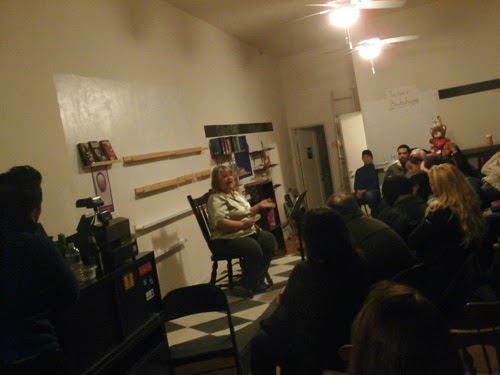
Tachair is hosting more events poetry readings, lectures, and author signings – you know, the typical bookstore type open to the public affairs.  As this niche grows, the store has been modified to better present public events. A small-platform has been set up along part of the wall and with the lounging tables cleared away, a near-black-box-sized audience can be accommodated. The First Annual Play Festival showcased mainly local playwrights and performers, in retrospect a logical evolution, given that theater and plays are a growing segment of our arts community. Tachair is a Jersey City-grown cultural nook committed to catering to its neighborhood and city.

I went to both nights. They were well-attended events, all the seats were filled, about 50 folks. There are plenty of repurposed spaces and black-box theaters that accommodate that size capacity. Intimate theater is its own experience and that uniqueness is intrinsic to its charm.

The literary backdrop of the bookstore only added to the intellectual validity of the proceedings. Bookstores – especially those brave enough to preserve in our current era – are monuments to the printed word, thus by definition encourage theater, well at least in the mind. Novels and short stories and even much non-fiction informs our imaginations of different places and people. They enable us to dream, or at least dream better. What better environment for theater than one already so adept at disposing of disbelief? Indeed, what might have been anticipated as a distraction, instead enhanced. You were immediately drawn into the each of the pieces featured in this anthology, existing for a short while as the artificial world explored issues relevant to all our lives.


The Play Festival featured mainly local playwrights and actors, the back-to-back nights of theater was hosted by Rich Kiamco, an established comedian whose credits include Howard Stern appearances hosted both nights, warming up the crowd. Love was the main theme of the plays presented on the opening evening, this connective tissue played into Kiamco’s strengths, which is relationship humor. He also has the very local reputation of being one of the first (or is that among the first) gay couples to be married in the Jersey City Hall when marriage equality became Garden State Law. He was half of a couple to be among those to mark this breakthrough in freedom by being married at midnight by the mayor.

Setting the tone on this first night where the reality of love and the hope both love inspires collide and co-exist, Kiamco, who is of Filipino descent, talked about coming out at 14 to his very catholic and conservative parents then fast forwarding to the present day where his parents and relatives were unsure of the wedding presents to send or whose last name he would be using. In-between, he engaged the audience with his warmth, which was agreeably sarcastic. He proved always ready with a wise-crack and the audience was enthusiastically responsive. He asked how long the couples in the room had been together and how they met, making comic material of a couple, together 30 some odd years, who actually met through the Village Voice Personal Ads section. He started off with asking who had been together pre-Facebook, being confronted with a couple who began in the Desperately Seeking Susan era was comedy gold. Kiamco’s comedy universalizes the subjective – immigrant’s son rebelling against conformity or a couple going against the odds of personal ad dating resulting in a sustainable romance – into relatable experiences.

 
I apologize for not being able to get the names of the non-author actors. No disrespect was intended, I write this in free time and tracking down all the name proved too time consuming. Feel free to email me or better yet, put their names in the comment section.

The present reality of individual couples chilling love to be more than just pleasant was the at the core of Three Bites by Summer Dawn Hortillosa, the third act of a three act play –  the play is the story of a couple told a years apart, each act set over a meal. The Tachair act was the third and final slice of the lives of these two people. The couple are clearly falling out of love, bicker and snipe, perplexed that the blackened catfish they ordered is “burnt”. The woman is poet writing treacle platitudes about love for a greeting card company and her husband of three years seethes over her apparent hypocrisy of imaging these praises to romance where the reality he feels is that their relationship lacks romance. They blame each other for the disparity.


There’s much clever banter, such as “Hindsight is 50/50.” Fate may not be determined at meals, but we’ve all had meals where it seems the past and the present are somehow contained in unsatisfying entrĂ©es. We’ve all been in that place where we blame the one we thought we love for the facts of our life we are unable to change.

Three Bites showed a relationship at a point where everything that was is now the opposite of what was once hoped, where once shared dreams – the greeting card lines the woman scribbles in a note book – are now disconnected from the reality. The tension and sorrow boiled beneath a Seinfeld-like surface of a restaurant scenario, what to eat, whether to eat what you are served and interacting with a waitress who can infuriate the couple only by the fact her southern accent indicates how oblivious she is to their plight.


The scenario in Do-Not-Call List by Laryssa Wirstiuk, explores the conflict between human connection and our digital enabled relationships. Digital technology increases both the number and efficiency of relationships, but at the same time further distances us from the human connections actually at the core of romantic love.


Instead of directly breaking up with a boyfriend she met online and whose communication seems entirely conducted through an internet dating service, she is canceling her membership. This initiating plot-point is based on a conceit, that one is still able to go to an office in person when interacting with service providers in this digital era we all find ourselves enduring and the play actually makes some comedy over the confection, with the company representative constantly reminding her they prefer to handle these personal issues online. An implication of the play is that the man at the desk is actually the online love interest of the woman, although this bait and switch idea was not developed.

The play effective satirizes the frustration everyone experiences when dealing with billing or technical support where the protocols strictly adhered to are totally unrelated to what the customer wants. The woman is reluctant to reveal her reasons for canceling the service, but when it is implied that her boyfriend has communications with other women on the services, becomes adamant about seeing those communications, which of course violates company protocol. Some very funny slapstick occurs with the woman trying to see the screen of the laptop  and the corporate petty bureaucrat hiding the screen. Technology offers an illusion that it can obliterate the heartbreak and anxiety of romantic involvement. This feisty sketch depicted how our humanity proves otherwise.


House of Doors by Yvonne Hernandez introduced the monologue portion of the evening. Hernandez becomes – the makeover and characterization so complete that acting is an insufficient word – a homeless woman being interviewed by a college student working on a paper. Why she is homeless is not explicated – this is not a public service announcement abut the devastation of mental illness or a political diatribe about an unjust economy and merciless system. This woman has fallen through the cracks and the umbrage she feels about being pigeonholed as a stereotyped – as someone less than human – is honest. The core of this characterization comes from the title – she lives in a makeshift shelter where discarded large doors make up the walls – and one day she returns home from panhandling to find it burned down, killing the woman she lives with. The woman is convincing her interviewer that she has a past – she’s a daughter, a mother, a sister, used to read Charles Dickens – that she is literate and a “somebody” – just like her, but the real lesson is not that her ability to love is not just part of her history, but her present. This monologue enraptured the audience, a story of how a life survives through severe depredation, and but how survival consists of the essential attribute of our humanity – the ability to “love and be loved.”


The monologue Senses by Summer Hortillosa kept soaring from and descending back to a reality of a millennial couple – told by a the woman (Summer) – on the verge of falling in love or perhaps admitting the love they feel is mutual and authentic.

It is the moment of a kiss in public, with fingers interlocking, time freezing and love. The kind of kiss that makes the two feel they are now at the center of the universes. The woman fantasizes about this perfect potential of impending couple-hood, a world where they both become wildly successful, earning dual life time achievement Grammy Awards but then must still find love even she admits to their less than perfect jobs and more realistically sized bank accounts  and all the other obstacles our contemporary world throws at today’s 20-something’s.


Do they kiss? Well, you may have to find out for yourself. This was a high-energy performance. The momentum kept mounting, the imagination at work and the rapid and constant succession of ideas and images was breathtaking, yet never artificially manic. Every detail of import to a young woman caught between her optimistic outlook and the harshness of reality is expressed with a break-neck, free-associative fervor. You start by eavesdropping on a romantic incident and then are suddenly sprinting through the inner caffeinated subconscious where love is defined by an individual’s hopes and dreams, which of course are far from unique to the individual or her generation.
 
 
Yvonne Hernandez returned to the Tachair stage to close opening night with another character study of a woman survivor. Fifty Ways begins as an extended riff on a song she “remembers growing up,” the Paul Simon classic ode to dumping the other in a relationship. This song was at one time was a number hit, dominated top 40 and FM radio to such an degree it comes close to era-defining. It was probably Simon’s biggest post Simon-&Garfunkel hit and has one of those catchy hooks that time only makes cloying. Many songs you can’t get out of your head, but this Simon ditty is one of those you wish you could. Even Simon fans admit this fun song soon gets grating and annoying.

The woman searches the lyrics, hop on a bus, etc., for guidance in leaving a relationship. The pop music offers only useless advice because she only leaves “10 stitches and two restraining orders later.” The comic careens into a powerful though more tragic truth. The reveal of domestic abuse is not a shock – we now understand what were clues to the squalid reality this woman struggled to escaped from.


Simon’s novelty song is cavalier about matters of the heart, a love ‘em and leave ‘em anthem. Her childhood dream of idealized, even empowering love is compromised by the reality of suddenly finding herself in an abusive relationship where leaving your lover is not some preference in the pursuit of greener pastures of pleasures but a matter of life and death. This monologue was sly and thoughtful, hits you right in the gut with dramatic twist that only after the blow the audience realizes  the true story was hiding in plain sight  all along. She invoked a collective memory of a pop song then reminds that reality isn’t just far away from the pop music sentiments, but often the opposite of those sentiments.


Second Night

Kiamco returned to his role as MC and warm-up act, repeating some of the same growing up Filipino jokes but adding parking jokes, working the hyper-local angle into his act. Looking out, he saw that it was mainly a hometown audience and bemoaned a problem he has working where he lives, “you all already know my sh-t,” but he had some fun with a couple who had been together for a long time, meeting in a bar when they were both drunk. His audience interaction put the people at ease, made them comfortable with seeing provocative theater in a peculiar setting of a local bookstore.

He may have had the hardest task, it was like working a cocktail party where everyone there ready to listen but you were the only who had to talk.


Illogical Defiance by Tricia Milnamow was first up, a love-triangle dramedy that veered into melodrama – I love melodrama, a term that for some has gained unwarranted negative connotations.


The floor is littered with paper, what could be pictures. The couple is seated and we eavesdrop as a minor squabble between a man and woman begins and we all know what is said may seem inconsequential in its content now, but will undoubtedly lead to a live changing event.

The woman is complaining they need to move to a bigger space, which means the man must make more money by taking extra shifts so they can afford to move. The guy, an aspiring photographer, doesn’t see the need to move because their current abode is large enough to contain what he considers essential. Her needs and what she needs he feels justified in dismissing.

These complaints are obviously just deceptively petty tips of an emotional iceberg. She is conflicted by love for him and the nagging sense she can do better and perhaps the guilt of her wanting more than he is capable of providing.

Then his best friend knocks at the door, his girlfriend, apparently from the upper-class, has thrown him out of their apartment and he needs a couch to crash on. The men seem to have a past and perhaps present involvement with each other’s girl and the crasher can now rekindle his romance with his best friend’s girl – “I’m his best friend, but you can do better than him.”  The three here are concealing information from two of the parties and it is not at this point clear who knows what. I wanted to be there when they find out what they don’t know, but this was just excerpt.

While it worked as a skit, or an enactment of a minimalist short story, what was presented was the first act of a longer play. The acting had a mumble-core quality, but the self-ironic overtone did not obscure the human truths at the core of the tale. These adults are facing the lowered expectations of fading youth. There’s tough choices ahead and the woman knows the decision she makes will hurt one of these two men, even if her heart is broken first. But like I said, I love melodrama, especially of the kitchen-sink, dirty realism variety. For the time being I was fine with filling in their future (there will be emotional pain, there will be love).


Playwright & Illogical Defiance cast.


Mykel Dicus apologized for not having a drummer or the sound and lighting and other theatrical accoutrements for his one-man, multi-character show – Mykel's Kashmir Nirvana-Unplugged  -- which is about his time in a Hells Kitchen Railroad Apartment in what seems like the 80s into the 90s – sometime in the still recent past when Hells Kitchen was still Hells Kitchen (not Clinton) and when at the time he survived a horrible beating by the hands of one of those room mates. The violence is not depicted, just the frustration of a court system where the perpetrator receives an inexplicably minor sentence.


The gears shift in this accelerated stream of consciousness yarn-spinning – he is waiting on the money from a room mate to pay the landlord and this room mate is an African American diva from the south who is ordering take out Chinese food, who gets into a altercation with the Asian worker brushing off her complaints about the food she is given. Dicus portrays both the Asian and the African American while shifting back to himself, the main tenant in need of room mate rent money to play the cigarette smoking landlord (he used an electronic cigarette as a prop, thus not violating the no-smoking policy at Tachair, as well as state law). The performance was raucous, although I felt passing discomfort about the ethnic depictions – these people were not exactly compassionate character, making avoiding stereotyping a challenge for an actor playing an ethnicity not his own. But, he convened us these were genuine New York experiences. A modern day Damon Runyon, the characters were believable and manifesting themselves with meth-like acceleration.


Conspiracy of the Cocked Hats, Washington Irving may not qualify as a play, but the reading by Trish Szymanski was a performance to behold – hand gestures, raised voice and frothing. I’m not a Washington Irving fan, thought to be the first American to make his living by writing, but maybe horrible grammar school teachers are to blame. I do not remember reading this piece, a colonial-era satire. The tale is an imagined diatribe by a Dutchmen enraged about the unstoppable “Yankee” encroachment on the isle of Manhatto  and finds the only solace in the Dutch survival on the Jersey Side. The culture of the original Dutch settlers remain strongest in Jersey City, the still recognizable locations Irving referenced delighted the audience.


Szymanski’s introduction, explaining the background of Irving, reminding us of the Dutch roots of our area, framed the performance. She invoked believable outrage, adding a fresh comic layer to the wheezy prose of this bygone era scribe by infusing a Jersey Pride attitude to the rant against inevitable change. Funniest stuff I heard all month and it’s almost 200 years old!


A reprisal by Yvonne Hernandez of House of Doors and Fifty Ways concluded the two day festival of short plays. I asked Carol Valeau why she had this repeat, and she replied she liked the work and thought it was worth seeing twice. I have to agree, I liked both the second time, but House of Doors especially. I found I wasn’t as bothered by the lack of political or personal explanation as to why the individual was in the state she was in during the second performance. Instead, I was more impressed how Hernandez made undeniable visible someone who we as individuals and as a society ignore as invisible. She went deeper into this character’s inner struggle to retain her dignity.


Events are on the rise at Tachair and while this one had the modifier, “first annual,” the theater has invaded the bookstore and may become a more constant presence here.
 “I don’t want to wait a whole year before we bring plays here again,” she said.
 Everyone in attendance seemed to agree. This theater was as valid as it was unique. What a funny and moving pair of evenings.