Monday, September 13, 2010

In The Moment

I was sort of bleary eyed, impatiently waiting for the Old Glorys and found myself lingering in the Gallery section of the 58 Gallery and taking in what was the actual purpose of the event, the opening of In The Moment, new paintings by Kirk Bray. For whatever reason, I wasn’t in the best frame of mind to observe the visual arts. Luckily the art made a valiant attempt to convince me otherwise.

I happened to chat with the artist, whose website is here.


Born in Tennessee, raised in Minnesota, then moving to Jersey City from Los Angeles, the work was humorous, albeit subtle.

For instance one was called “Trust,” it had a large male figure with a red cape standing on a platform, rocking back on his heels, surrounded by a crowd. The artist explained to me that the concept was a take off on the old summer camp game of trust, where you lean back and trust your friends stop your fall.

Another that I liked was a race of barrels and a waterfall, the old guy going over Niagara in a barrel. Except these barrels were emblazoned with consumer products, similar to the decals used as promotions on NASCAR participants. Crowds filled platforms above the water, holding signs. It was a commentary on spectator sports. One of the signs had a scripture verse, and considering that maybe not all the people inside the barrel would make it out alive after going over the waterfall, the presence of the bible was quite funny.

I was too tired to take in the whole thing, and soon the set by the Old Glorys started. These were pictures you had to look at for a bit before you smiled. They are funny. It was sort of like looking at the contest on the last page of the New Yorker, where readers look at a New Yorker Cartoon then make up their own tagline.

Fare Tree Well

All Week I looked forward to seeing the Old Glory play 58 Gallery on Coles. Although impressive at Groove on Grove, where they announced this gig, they were at times during the set, a little uneven, which I blamed on the inadequacy of playing on the sidewalk.

The musicians are a talented crew, the band showed promise, but it was also a chance to see Tree perform. I’ve been enamored of this woman’s music since I stumbled across her former band, the peppy Country Rock combo, Any Day Parade a couple of years ago. She writes great songs, is a fine musician—plays well with others and always selects cats that complement her (and each other’s) talent and style—and has a great voice. Of course all this hyperbolic gushing is likely familiar to Dislocation readers since I’ve blogged about them a few times already. Here. Here. Here.

Visit their myspace page
The acoustic, Appalachian drenched, country/folk inflected Americana journey on which the Old Glorys have embarked reflect much of what has been my personal sound track the last few years. Roy Acuff, Louvin Brothers, Ralph Stanley, Carter Family and several different Smithsonian/Folkways complications, that’s about half what I’ve been playing (the other half has been Dylan, Dead, Elvis, the usual suspects and not exactly antithetical). The Old Glorys were right up my alley.

At 58, the Old Glorys did not disappoint. Their unevenness had been shed. They were much tighter, exhibited cohesion throughout an absolutely KICK ASS set. Tree introduced an intriguing new song—first time played according to Tree—about one half of couple seeing the classified section of a newspaper with items “circled that we don’t need,” the wondering if her partner is considering a future that “doesn’t include me.”

Tree has a gift for depicting what on the surface might seem like an ordinary moment but in reality after she gets through exploring the moment, the listener realizes the layers of meaning imbued by her observations and knows that the worlds for those sung about, are now no longer the same. What seemed ordinary was in reality anything but.

The centerpiece of the set is her new masterpiece, With Time. A demo-version of this song is streamed on their myspace page, but the song has been amended with additional lyrics. Hearing it again, in a setting more conducive for performance, has increased my conviction that this is one of her best songs. Basically the narrator professes an expansive litany then has a spiritual conclusion. The narrator thanks God. Before she gets there, she reflects on the personal, like getting older and the grandiose—a Charleston sunrise. I love it when the intimate and the expansive appear side by side in a song.

There’s a quiet poignancy to her songwriting. Country music, the best of it anyway, achieves a dichotomy that portrays melancholy while simultaneously provides uplift. Blues and Rock & Roll often achieve that dichotomy, but Country music just seems to do it better, or at least more often. I’ve been listening to acoustic and golden age country a lot lately, so perhaps I’m just more attuned to the themes. The songs sound timeless. Tree taps into that tradition, achieving both authenticity and originality. Country songs seem the best equipped at capturing the counter-intuitive nature of the human heart where sorrow and empowerment not only coexist, but strengthen the other. Tree is in another link in the lineage of America’s Sweet Sadness.

The final song was the Carter Family classic, You Are My Sunshine. Now, to the uninitiated this might be a hokey old tune. “You make me happy when skies are gray.” But think about the ending snippets of the chorus—“you’ll never know dear, how much I love you. Please don’t take my sunshine away.” It’s spooky stuff—and at the core of the human condition—that we never truly know the depth of feelings of another for us. Even as the narrator declares her love, she is also declaring that even though she is not certain that love is shared or even reciprocated, she can't live without it.

There are a lot of talented musicians and songwriters here abouts and most have CDs and they are usually pretty good. I’ve seen several entertaining and at times even extraordinary sets. I’ve seen a lot more sets than the few I care to “blog” about. Tree though, I play those two ADP CDs (not really an ipod guy) often and I honestly forget they are from a neighbor or that we’re acquainted (Tree and I “share” a bodega) when I play them. These are real songs and some of the best new songs I’ve heard in the past two to three years. These are not just good songs within the context of Jersey City as some new Gen Y oasis of hipness, a Garden State Williamsburg (shoot me now).

Those ADP songs are as good as any material being produced anywhere at any level of the music industry. I should know, I have excellent taste and an extensive record collection. If you don’t agree, start your own blog. I forget that I know her or that this music is part of a “scene.” Tree transcends the local. The Old Glorys CD is due to be released in November. My expectations are high.

Unfortunately, for those who live here, her songs will no longer need to transcend seeing her at the corner bodega and shooting the breeze about the weather or street construction. At the 58 date, we all found out was this was the last Tree set in Jersey City, as a resident at least. She’s moving back to her Old Kentucky Home. After “ten years of chasing my dream,” as she phrased it to me, she’s leaving town. She has some family obligations that she has to take care of. I’m sure it’s more complicated than that; obligations usually are. Nonetheless, she plans to return to these parts for the CD release in a month and Old Glorys also have a tour planned. Even though the band members may no longer be living in the same physical community, the endeavor appears not to be abandoned any time soon. Old Glorys will adamantly carry on! I sure hope they gain audience beyond a 10 block radius of Coles Street. The integrity in which they play this music may be enough for me, but I can’t imagine my respect is enough to pay the bills.

I’ve saw ADP about a half-dozen times, I don’t remember ever at place with a cover or even a proper stage and heck, they had what could be considered a more commercial sound than the new sextet. Trying to make a living out of music, especially when also maintaining a tangible level of artistic integrity, is a very tough row to hoe. The attempt should be as celebrated as any arbitrary measure of success. But celebration is rarely enough to get by.

The 58 Gallery is a great space. It’s the first time I stayed for the music at the gallery. The gallery is a store front, a clean and respectable atmosphere for hanging art. Through the gallery door the back space, the light goes dim. It has a nice subterranean feel to it, reminded me of some of the East Village clubs I went to back in the 80s and early 90s, slightly dank, very dark, muted lights, shadows. Tarp-like sheets are draped on the walls. I couldn’t find a place to sit, there didn’t seem to be any chairs. (I have a bad knee all right!) A makeshift bar set up in front of what seemed to be an abandoned kitchen area. It was great to see the band this up-close. The sound was quite good, you could hear the texture of the instruments. I always think that one of the aspects of music that appeals to me first is texture, which has much to do with the melodies as the way the melody is played.

I love the way you hear the parts and the whole at the same time. I love the rustic honesty of acoustic instruments. It’s an incredible string band, the Old Glorys (although the mandolin and fiddle player, whom are brothers, do a couple tunes on trombone and tuba), and the moments of cohesion—of which they were many—when the banjo, two guitars, stand up bass, combine with the mandolin and fiddle—are truly sublime.


Is it rolling... Tree?

The set had an emotional overtone since everyone knew Tree was leaving and a lot of the folks there were not just fans like myself, but close and personal friends who surely will miss her. I barely know her but it is obvious to me that she is a quality individual, a good sort. She is warm. I’ve no doubt she’s a good friend to have. Musicians in town all respect her, at least a few have told me so. I am not an expert on the current scene. I barely hang out anymore. But her name comes up frequently during many of the conversations I’ve had with the local players. Esteem for her is far and wide.


Her leaving, this being a supposed last set, engendered a foreboding mood. This end of an era feeling was then startlingly reinforced after the last song of the set. The MC came to the mike and announced that people must leave the area. The police had informed him and the Gallery owners that we were not allowed to congregate on the sidewalk in front of 58 gallery. It was a bit of a shock to say to the least.

Please send memo: next time postpone political rant until AFTER the encore.

I couldn’t believe what I was hearing, that there were warnings (even tickets?) being issued by the JCPD. This was JC Friday’s after all, the quarterly event. I doubt more than 50 people were there, maybe 75 tops. Most were to see the opening act, few were outside smoking. The MC went on to say how the cops were starting crack down on the artists and called for a change in the municipal code. He did not get into zoning specifics. Forgive me, I am not doing what he said—which was reasonable and articulate, even the word rant is misleading—justice. He pointed out that the city government has to do more to support the arts and that it was still a who you know system. “The artists are the ones making Jersey City a place where people want to move to.”

Right on! What kind of madness would lead the police to crack down on a bunch of adults, not that young really—most are late 20 somethings or early 30 somethings, not rowdy college kids. Just up the street there is much more noise and crowds—not to mention open alcohol consumption—during the Italian and Polish Festivals. These JC Fridays things are every three months, you would think the authorities would ease up on some of the petty restrictions, but apparently that’s not the case. I’m not taking a survey or keeping a tally, but I’ve heard some other complaints by the folks who organize the art events in Jersey City that cooperation by the authorities is inconsistent at best. That is why it occurs to me the “last” Tree show might be a turning point.

Jersey City’s art scene has been a real DIY enterprise. The galleries tend to be make-shift, often temporarily repurposed spaces. The bars that have live music usually only have performers a few nights a week. there’s no proper stage or PA system, rarely a cover charge. How could they charge a cover? The scene cannot sustain itself as is; it may indeed be at a turning point. Either a more substantial club and nightlife scene will emerge, an extension of the galleries (which may have to find a way to stay open beyond the quarterly Friday events); or the scant beginnings now in place will fade away.

A Maxwell’s in Jersey City; or better yet, a Bottom Line ( a guy can dream); it’s not going to happen if the police are issuing warnings when more than a dozen people show up for some bluegrass entertainment during an art opening! No club owner will invest in such a climate. The art will stay local. The bars will stay dives with open mike nights (when the games are over). Unable to make a living, the talent will move back home to Kentucky.

I don’t know. Jersey City is still in New Jersey and New Jersey has a way of keeping its head up its ass for years after sticking said head up said ass. Then New Jersey wonders why creativity is stifled, or why that Italian kid from such a nice family feels that he was born only to run out of town with Wendy.

In this day and age, access to Tree’s music will probably not be an issue. I can still be a fan, still follow her career and she’ll likely come back to play a gig or two every once in a while. Still, her leaving town makes me sad. Her move is our loss. But, on the same night you hear of this loss, you find out that police are cracking down on your freedom of assembly outside an art gallery on an evening where there is supposed to be a city-wide support of the arts. I can’t help but feel that there might be a deeper significance to her departure. It does not augur well. It’s the kind of synchronicity nobody needs.


Wednesday, September 8, 2010

The New is The Old

I’ve seen signs go up, but rarely am lucky enough to see one go down. I remember when it first went up, posted here, the sign for the Feast, in July. The Feast was in August. As typical, a month later the sign for the feast is finally removed. What I didn’t realize at first was the sign actually covered an existing Groove on Grove sign, a cleverly efficient usage of banner hanging. A Clutter of banners would defeat the purpose of banners all together. I liked the way the Italian Feast banner is draped over the existing banner, which was underneath it all the time. Either this week or next is the last Groove on Grove, so the sign is still good for a little anyway. I keep an eye on it because I figure by the time they get around to covering it up with more relevant banner it signals me to start my Christmas shopping.


Monday, September 6, 2010

Scheduled Decay

Not so long ago this funeral home was a working concern, I can recall seeing mourners at a wake, congregating on the sidewalk, talking and smoking cigarettes as pedestrians passed by in courteous silence. I even recall water in the fountain or at least I think I remember the water spouting and gurgling, Shuttered for a few years now, the growth is always thick, the upkeep of the property up to the usual standards of J.C. realtors. The fountain is cracked, will probably never function again. I like the stone horse design. I like the weather worn paint on the door. Probably one of the oldest buildings in the neighborhood. I don’t mind watching it rot. I guess it is more likely to be knocked down than restored and in this day and age, it’s even odds that decay may be better than what will replace it. That’s what I say, enjoy decay while it lasts. Some properties are maintained, some restored, some knocked down and replaced and some just rot, waiting. We’re all subject not just to the whims of social and economic changes, but who owns title to when each whim occurs.


Post Theft


What about the kid who found her bicycle like this, frame still locked to the signpost, everything gone but the frame and handle bars. I understand the value of tires, but who would steal the seat and the pedals? Probably been here for weeks or even months before I wandered by more attentive than usual. It’s so sad, so sudden looking, the apparent shock of it all. The lock intact like the ultimate inevitability of a false yet eternal security, the chain calmly rusting away, both the chain and the rust, oblivious.

Lackawanna Illuminated


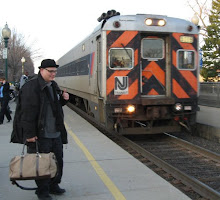
Follow the lights and you can take a train out of here. Make the right connections and you can be anywhere you want to go in the hemisphere without leaving the ground. Manhattan swells in the distance, bursting out of the very horizon. The Hoboken Train station, humble, utilitarian, steadfast and competent on the other side of the river, providing transit for everyone other than the rich and famous. They got the gold but we got the numbers. Illuminated Lackawanna rising up in the machinery of night, barely visible footnote to the intense glitter of the Manhattan skyline, grant me passage either to an adventure or the way back to home.

In The Garden

Paramus. I grew up there. It’s a suburb of New York. Long Island is the genuine suburb, an extension of Brooklyn or Queens, a tendril sprouting directly from the Evil Goddess, Manhattan. We’re a whole different state across the Hudson River on the Jerseyside. We weren’t Tories during the Revolution and ever since, we've been met with a habitual and customary disdain from the citizenry of the other Manhattan tendrils. Even our own cities, like Newark, Hoboken and Jersey City exist as shadowlands of the great urban whore of Babylon.

Paramus was technically considered a suburb of the whore, a kind of Levittown, a place entirely transformed by the housing boom of the 50s and 60s. An agrarian culture that remained mainly Dutch—who drove out the few Lenne Lenape they hadn’t murdered—from the colonial era throughout the 19th century. By the 20th century, the Paramus farms had become famous worldwide for celery. Farming in New Jersey wasn’t as profitable anymore by the end of World War II, so the cluster of Dutch families sold their celery fields to developers. Split levels on one acre lots replaced the farms, all gone by the time my memories begin.

When my parents moved there before I was born, Paramus was cheaper than other towns in Bergen County. This municipality had no center or stop for the Erie Lackawanna that would eventually become the NJ Transit train routes. Paramus was just the cross roads of Route 4 & Route 17, a place where the highways intersected and along those highways stores and Shopping Malls were built.

No mere Manhattan extension like Long Island, no. The N.J. suburbs weren’t only moons that orbited metropolis, they were separate and unequal miniature planets. Small town USA, little Walton Mountains in and of themselves. The City only something in television or books or the place Dad disappeared to every morning and came back from at night, tired and/or angry. It was more distinctly town than related suburb, an entity defined by its own version of America, not just by its proximity to the Capital of the World.

Gardening became my hobby of a few summers, the pre-teen through early teen years. Hippies had become so associated with the Vietnam War, which was over by then and we all were mad we missed out on the rebellion—at least protesting the war gave the older brothers and sisters a focal point for their rebellion. The protests were long over, they were moving to the country, it was a New Morning, take up yoga, rediscover Eden time, denim jeans and chambray work shirts; paisley something only the Partridge Family wore, which had been cancelled anyway. It was just before Punk arrived, which I embraced as soon as I heard about it. The Glitter Rock crap never did it for me. What’s a white middle class suburban kid supposed to do? What other choice but the Hippie and getting into the same argument about hair length that you remembered hearing as a kid between the parents and the older sibs when you would rather have been watching Gigantor undisturbed.

Social upheaval had been with the culture for at least ten years and had long been commoditized by my time. You could go to the Mall and buy your bean bag chair and concert kit hash pipe, made from spare lamp parts.

I had been a voracious reader, though the gardening began before I discovered the Paul Schmidt translation of Rimbaud, I was just starting the Kerouac and Ginsberg, having finished the Kesey and the Robert Heinlein. One older brother formed a commune in Ohio with some Bergen County friends. It seemed a thing to do, gardening. Trendy, even and in keeping with counter culture ethos.

I was already in charge of the lawn. I earned five bucks a week mowing the lawn. The old man wasn’t into the yard, he wasn’t a yard man. He was in the minority in town. Lawn obsession bordered on mania throughout American suburbs. There wasn’t just the mowing, but the fertilizing, the lime, weed control. I hated yard work when I did it with Dad. My father had a violent temper and his training as a Marine Corps Captain always came out. Yard work was just another afternoon of ridicule and humiliation. I of course was a wise ass; my sarcastic back talk fueled and amplified his acerbic tone. Yard work inevitably ended with him shouting at me and usually implementing some form of corporal punishment. Inevitably I wound up in tears, feeling worthless from the constant torment. The truth was we probably both would have rather been doing any thing other than raking leaves or trimming hedges. We never had an unkempt white trash yard—in fact, Paramus law forbade grass growing above three inches high; bad lawn care could result in fines—but we were outclassed by most of the other yards in the neighborhood. Dad just wasn’t a yard man.

With my brothers grown and gone, I cut the lawn which I could do without the stress of paternal supervision and get paid for it. The parcel on which the house was built was just an acre, like all the others. Growing up it seemed so huge. We were able to play football and baseball in the back yard. But I guess anything seems big when you’re little. The neighborhood was built on a hill and our home was located about mid-way up. There was once a real bad ice storm and we could take the sleds and start at Forest avenue—about ten houses above our house—and ride all the way down the hill, from back yard to back yard—not many fences as I recall to obstruct us, although maybe part of the route was on the glazed over sidewalks. We headed down to the woods, which was what we called the swamp at the foot of the hill. In the summer, the woods were filled with skunk cabbage and frogs. Everybody said there was still deer there but I had never seen one.

I got a subscription to Organic Gardening. Some other friends were doing a garden too. My father encouraged the gardening hobby, it was in the back yard, less lawn to cut. Maybe he remembered the Victory Gardens of his own youth, ironically spent in Great Neck. Actually, he was probably either in College or fighting the Imperial Japanese in the South Pacific theater when Victory Gardens became a patriotic fad. By the time I was a full-fledged teenager and young adult, we did not like each other. A long time passed after the garden summers until Dad approved of me again. But, he approved of the garden and his encouragement felt good. We rented a roto-tiller and I roto-tilled the area in the back yard. The roto-tiller—blades attached to a row of wheels that cut into the dirt, slicing deep into the lawn, destroying it, turning the clumps of grass back into dirt. I was metaphor prone even at that young an age, probably scribbled some gardening poems in the notebooks I kept.

You couldn’t plant before May 15th, I remember. That was the last day of frost. I raked in the top soil and fertilizer, which was different than the lawn fertilizer; it was manure, dark, rich brown, thick fecal odor. I even had a compost heap for a couple of seasons, which I would cover the garden with come the end of fall.

Then we went back to the garden store—in the winter they also sold Christmas Trees— for the seedlings. I drew a diagram of the garden, what I would plant where, watched the shadows in the sun and tried to determine vegetable location by the amount of sunlight they would receive. Each seedling was a tiny plant in a tiny plastic flower pot. I liked envisioning the plants they would become, the fruit they would bear. Seedlings represented hope and possibilities.

I grew only vegetables. One summer I even had some rows of corn and I still remember eating a freshly picked ear of corn and being amazed at the sweet flavor. I loved the look of the miniature cornfield, four rows standing knee high by the fourth of July. I grew strawberries. They didn’t really come up that summer I planted them, but the leaves didn’t go away and I remember not planting them the next summer, but that didn’t matter. They blossomed like crazy by then. I had this harvest of strawberries, so many we were giving them away. Actually we gave most of the vegetables away. My mother preferred TV dinners, she wasn’t into cooking. She had raised six kids. My parents were tired and had enough. My raising was more reluctant annoyance than Dr. Spock micromanagement.

You had to go organic, man. For insect control, I ordered praying mantis and lady bugs from the classified sections of Organic Gardening The lady bugs came in a box. They were for the tomato plants to eat the aphids. I think they were sold by the pound, you just left the box opened by the tomato plants. The lady bugs were piled several inches deep in the container. The praying mantises were in this cocoon, which looked like a gray turd on a stick. Within a couple of days, the tiny green insects swarmed out. They matured quickly. Within a couple of weeks, dozens of these long thin insects, slivers of green ribbons were crawling around the garden. I still see them in the back yard, decades later, off spring of the original preying mantis. Worked pretty well too, I never had an insect problem in the garden,

Besides the stakes for the tomato plants, I would grow cucumbers which needed a fence. It was kind of cool, the vines crawling up and intertwining through the openings of the plastic fence as they grew. And the zucchini, as seen here. If you look at the picture, you can see the cucumber fence. For some reason I remember learning—from the Italian family across the street whose parents were born and bred in Jersey City?—how to cook zucchini, slice it and cook until soft in olive oil with oregano. I have this vague memory of her teaching me or telling me back then, and I actually made it a few times, back then. I remember this. I had earned Cooking Merit Badge as a Boy Scout. Cooking zucchini was not an outlandish act, and I basically cook it the same way today.

Come harvest time, there were always as many weeds as there was produce. I had lost interest. I was young. What seemed cool in May was dull drudgery in August. By then, gardening meant just picking the produce. I kept mowing the lawn for the five bucks, but eventually I started working other part time jobs. By High School, I may have still loved Kerouac, but it was Rimbaud over Whitman. I was listening to Horses much more than Europe 72. I could barely talk to Dad, much less plan a garden together. Girls, drugs, college... I couldn’t sustain interest in the garden. My younger sister tried it for a while, having gone into her vegetarian phase.

Before I abandoned the endeavor and still believed in the garden, I found the baby rabbit. I saw them in the garden, eating the lettuce, the wild rabbits, cotton tails, brown fur, white fur puff on the ass. They weren’t that big a nuisance and it’s not like we had a shot gun—my father worked on Wall Street for goodness sakes. The rabbits always ran away from me, darting between the leaves than rapidly scurrying across the lawn. The baby rabbit didn’t run away.

I was mowing the lawn. This tiny rabbit just appeared, then suddenly rushed from the mower into the corner of the garden. She stopped between the strawberries and the corn. Frozen but quivering, not moving, just there, no more scurry left. I didn’t want to scare her any more than I already had. I reassured her everything was all right. She didn’t respond when I tried to pet her. I don’t remember growing carrots, or if I did they weren’t yet ready to be picked. I went inside, there were store bought carrots in the refrigerator. I cut a carrot into small pieces, brought it out to the rabbit, who still hadn’t budged. I put the carrots near the creature. I had this image of taming the critter, a suburban version of Gentle Ben. I could raise wild rabbits in the garden, raise them for what I didn’t know. I imagined them frolicking near me as I fulfilled my caretaker chores then eating carrots from my hand. I could name them and call out to them by name and they would come and keep me company. The next day I went to check on the bunny. She still hadn’t moved from where I left her. Flies were on the uneaten carrots. The rabbit was stiff, completely motionless. Either I or the lawn mower had paralyzed her with fear. She was scared to death. I dug a hole and buried her in the garden.