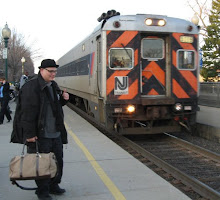
“It’s cold again. The weather is crazy.”
“We’ve had all four seasons in April.”
“I was in a tank top on Sunday. I’ve had on the down parka, the leather jacket, the denim, the light cotton, the hoodie. I’ve worn all the jackets I’ve owned this one month.”
Conversation Snippet
Thursday, April 30, 2009


Wednesday, April 29, 2009
Repaving 6th Street

 "What are they doing,” I ask the cop.
“They’re repaving 6th Street,” he says.
“The whole street?”
“Yes, then they’re going to repave Christopher Columbus.”
"Do you mind if I take a picture," I say, pointing to the contraption with fire.
"Suit yourself. I guess it is something you don't see every day."
“You wouldn’t happen to know what that’s called?"
“It’s a furnace they use to melt the tar.”
“But what is it called?”
An odor of tar is apparent at least two blocks away. There were no construction workers nearby to ask.
“Dante’s Inferno.”
“What?”
“I don’t know what it’s called. But it’s a good caption for your photo.”
“Hey, get your own blog.”
Okay, I didn’t say that, but who knew J.C. cops could be so clever.
B.B. King: One Kind Favor
 No one should try and even if they did try could ever over-shadow B.B. King. One of the greatest masters of electric blues in the history of the music and of course, arguably the last of the legends still picking and singing on God’s good earth, One Kind Favor is a masterpiece and stands proudly alongside the best of his other fine recorded moments. He may have sounded as good, but never better or if better not by much. I present this prologue so my next statement is understood in a proper context: Dr. John makes this record.
You’ve probably heard by now the story behind this record, my favorite of 2008. T. Bone Burnett produced this record, brought together a cream of the crop bunch of musicians and helped B.B. King select a powerful group of Blues songs—classics both well known and obscure—that he knew growing up or were popularized by such long gone contemporaries as Howlin Wolf (one of the greatest artists mankind ever produced).
Blues scholars (you know who are and you have been warned) may disagree with the following analysis. T-Bone Walker is an early master of electric blues, but it was really Muddy Waters who electrified the delta sound first pioneered by prophets like Charlie Patton. Blind Lemon Jefferson and Robert Johnson. Yes, we all know that they had to plug in to amplifiers to be heard above audience din in Chicago and Memphis clubs. Another evolution took place, and perhaps here Mr. T-Bone Walker led the way, in the post-big band world of Rhythm & Blues. The guitar, specifically the electric guitar, migrated from the rhythm section to lead. The horn section and the piano—really a percussion instrument, thus well suited to the rhythm section—joined sides with the drummer. B.B. King is one of those artists from this era—actually an originator of this whole format—where the voice leads the songs and the songs are based around the guitar, which commands the spotlight within a large ensemble and handles most of the solos. Chess bluesmen for example, tended to play in smaller combos, one or two horns were typical while B.B. King was most comfortable with larger, more orchestra-sized backing.
The Blues create a mood. A genius like Muddy Waters with his smaller combo cuts to the emotional core of a song, he takes the mood and hits you with the truth. B.B. King, with his bigger band, takes the mood and loads it with layers of atmosphere. This thick blanket of the same truth wraps around you completely. Whatever journey you take, or prefer, the end result of transportation to humanity’s deepest and most universal emotions is the same.
One Kind Favor, with its selection of bedrock blues tunes and its texture of B.B. King’s traditionally large band sound stands apart from similar recordings in this genre due to the simple fact it has been recorded with contemporary studio equipment. Solely in terms of sonic achievement, this could be the best sounding of all recordings of authentic blues music. Listening to One Kind Favor is an exhilarating experience. There is absolute clarity in the musicianship, the emotional impact of the songs, and the style and gravitas of B.B. King, who is determined to make another signature statement at the sunset stage of a remarkable career.
“World Gone Wrong”, a song I know from Dylan’s acoustic version on the 90s cover record of the same name, depicts love lost, a perennial blues theme. The narrator feels that the loss of love can only be depicted via apocalyptical comparisons. Dylan performs it as a dirge, a mournful death chant. B.B. King swings it wide open, the band cooking up a joyous backbeat. When he sings, “ I can’t be good no more baby, because the world has gone wrong,” the poignancy has an added intensity because we know the singer has more days behind him than in front of him. His age gives him an undeniable authority that embodies the song, and it’s the same elderly persona that finds a happiness in a lyric that on the surface might seem pretty bleak. B.B. King conjures up that blues magic, that paradox of something to both bemoan and celebrate.
The horns make your hips shake and your vertebrae shimmy. But within this texture, heard throughout the record, there’s Dr. John’s distinctive piano. B.B. King invokes the delta origins and electric evolution of blues guitar. With Dr. John we get New Orleans, we get all that jazz, all that boogie-woogie, all that be-bop, all that gutbucket. We hear the marching band inspired funeral drum lines we remember listening to coming from outside the window into the common room at St. James Infirmary where we lay on our sickbeds wondering if we too would die today. We get that dense, simmering, swampy voodoo funk (which encompasses all of the aforementioned) the Good Doctor got us night tripping to thirty some odd years ago.
The band is humongous—six piece horn section, B-3 organ, two drummers and sometimes two bassists—electric & acoustic. Where else do your hear such a sizeable ensemble, outside of Jazz at Lincoln Center, these days? A lot of components are at work creating this humid, midnight hour atmosphere. The catalyst though is Dr. John. His fingers make sure that the big band has got B.B.’s back. I don’t mean to suggest Dr. John dominates, or the incredible playing by the other musicians is not as talented, as noticeable or that they are less than equal cohorts in the mission accomplished here. But he is Dr. John and with Dr. John we hear Big Easy history. B.B. King is an elder sage reminding us of the Delta’s ancient truths, which he distills into a single emotive voice and bended guitar notes. The Delta has probably met the Big Easy before, but rarely with such equal recognition of common ground and equal respect for where their traditions diverge.
“How Many More Years”, a song written by Howlin Wolf (may his name forever be praised) could easily just have been a run through of a well known and beloved classic. Simple is not the case anywhere on this record. “How many more years, are you going to wreck my life!” the singer asks and in the version by The Wolf, there is rage and self-pity. We still get the anger and hurt, but B.B. King’s interpretation abandons the self-pity Howlin Wolf explored so thoroughly. The guy is 80, when he asks how many more years, we do not need to be made aware about the limited number of years being discussed. The big band rocks hard, enabling that mysterious alchemy of the blues when anguish uplifts us. With Howlin, the narrator seems unable to leave a bad woman. B.B. King has had enough and is leaving, turning the song into a farewell invective. It becomes an anthem about enduring the few years one has left. An incredible achievement has taken place here—a song is transformed, yet remains true to its original intent.
The title of this record is a lyric taken from the opening cut, “See That My Grave is Kept Clean”—a Blind Lemmon Jefferson song (which also has a Furry Lewis co-credit) covered by many, including Dylan. The singer imagines his funeral—with two white horses in the coffin line, his hands growing cold, heading to his burying ground. While only a matter of time for everyone, this scenario is a lot closer to the singer than most of us, and his voice has a tenderness that conveys that realization. The moment you realize the particular relevance of the lyrics to the singer, B.B. King slams you with some particularly tasty lead lines that go right up through your spine. You wince helplessly with pleasure. That effect is made possible by Dr. John building the foundation of this shuffle with an irrevocable momentum.
“Blues Before Sunrise”, a John Lee Hooker penned tune covered by Muddy Waters, is my personal standout track. Before the band kicks in towards the end of the song, we get an extended dialog between B.B. King and the Good Doctor. T. Bone Burnett wisely lingers on the interplay of Dr. John’s ivory with King’s picking, producing essentially a jam to begin the song—as opposed to an instrumental break in its usual position of mid-to-end of the cut. The band eventually storms in to bring it on home, but the long introduction here of a master of the piano and master of the guitar talking to each other musically is a moment of historical proportions, captured for prosperity and just about as beautiful as any music gets. Was music created because there are emotions in our souls unable to be expressed by verbal or visual images? I’d argue yes, and to support that argument today I refer the ladies & gentlemen of the jury to the first half of this specific recording.
There is not one lackluster moment on One Kind Favor, even when the song choice seems too obvious, like those old standbys Tomorrow Night or Sitting On Top of the World. King reminds us why they are old standbys, and discovers a newness in their meaning that their familiarity might have overshadowed in recent decades.
Rick Rubin paved the way for senior citizen artists to prove they can still make vital music with his American Recordings series by Johnny Cash. Rubin showed that the age of a performer can enhance some songs. Those mainly acoustic albums were a different sound for Cash—and the work with Rubin stands toe to toe with the Sun Studio and Columbia recordings we all know and love.
T. Bone Burnett has taken a different tact with B.B. King, producing a continuum of a legacy rather than a surprising addendum. B.B. King may be looking at the sunset he is fast approaching, but he makes Blues music that sounds ready for a new dawn.
I can’t recommend that anyone buy a CD for the performance of a sideman—and this CD is worth it for its star and the songs—but if you were to buy a CD just for the sideman, One Kind Favor would be the one because you will hear some of the best piano Dr. John has ever played. More appropriate than ironic that he excels in this rare back-up role. To all parties involved: Sequel soon! Sequel Now!
Monday, April 27, 2009
Loew’s Theatre
 One weekend a month, The Landmark Loew’s Theatre in Jersey City shows movies. My dentist is in Journal Square and last year after an appointment, the Loew’s was opened, hosting some kind of housing seminar, and I finally was able to look around
Movie Palaces—Loewe’s was one of them—are unique pieces of architecture, peculiar to and an emblematic of the time in which they were designed and built, the 1920s. I know they sometimes presented revival films at the newly refurbished Loew’s, but I never really was interested enough in what they were showing to make an effort to attend until February, when they presented “Niagara” with Marilyn Monroe & Joseph Cotton on a double bill with “The Killing”, Kubrick’s early noir classic with screenplay by Jim Thompson. I’m a noir buff and I had never seen “Niagara.” (It was a great noir).
A strange thing happened though, I liked the Loew’s experience at least as much as the films. Now, I’m going once a month, regardless of what’s playing.
Last weekend took in “Journey to the Center of Earth”. Unlike my noir interest, I honestly had no desire to see this film again—like everybody else as kid I saw it on TV. The month before, I went to see “The Innocents”, a British film—screenplay by Truman Capote—based on a Henry James short story, “The Turn of Screw.” I’m not a Henry James fan (or a Jules Verne fan) at all. I’m not a fan of British Film in general. It’s considered a classic British ghost film by folks who rate such things. I guess I was curious, but the reality was that I went because, as the fellow who introduced “Journey to the Center of the Earth,” said, for the “art of seeing a film. The experience of seeing a film.”
I enjoyed “Journey to the Center of the Earth,” more than “The Innocents,” although neither film I would recommend, unless you see it in Journal Square. The atmosphere at Loew’s— huge screen, rundown faux-luxury of the interior design, the comfortable seats and the polite and attentive audience—brought out and enhanced the art almost hidden in this movie (Pat Boone is a star for goodness sakes).
I’ve become a believer. Presentation is not as important as story, character, the grammar of film, the artistry of the acting, direction, screenplay, source material, cinematography, score, etc., but it is worthy of appreciation.
For years, I went to the revival theaters that used to be in New York City, like the Biograph, the Thalia or St. Marks Theater 80 (I think that is what it was called). I still go to Anthology Film Archives and the Film Forum. But all these theaters—the ones long gone and the ones still showing revival films—simply do not hold even a dim klieg light to the Loew’s experience. I only went to or go to those Manhattan screens to see the specific film. I go to Loew’s for Loew’s.
I’m utterly democratic when comes to cinema. I love serious films, genre films, foreign films. I love old films. I love new films. I love films that I don’t even like and even regret seeing. I just like the movies.
In spite of the convenience of watching them at home on tape and now disc, I prefer the movie theater—even the real crappy multiplexes (a-hem, Newport Mall). One of the more transformative things in my life was seeing nearly every John Cassavettes film at The Anthology Film Archives during a special presentation several years ago. I’ve seen a lot of them again on the TV screen. It is simply not the same. Not even close.
Loew’s is a “Movie Palace.” In 1929, Movie Studios built these grand, ornate theaters in inner cities throughout the nation. The great Beacon Theatre in Manhattan is one such palace. Movies had become immensely popular during the jazz age. The early films—the silent one reel films—as well as earlier cinema incarnations such as the zoopraxiscope and the kinetoscope—were usually presented in arcades or carnivals. Except in larger cities, there were few theaters built specifically for cinema. Movie Palaces were an exciting entertainment concept that seemed sure to score big—huge screens, opulent interiors, even a stage and orchestra pit. The new sound films were longer in length, they were often shown as double bills, along with shorts, cartoons and newsreels. Going to a palace was designed as an event in and of itself; the movie may have been the centerpiece, but the evening also included: audience raffles, sing-alongs, and Vaudeville acts—comedians, singers, dancers, jugglers.
The theaters held about 3,000 or more patrons, who would dress up for their night on the town most of which was spent in this unabashedly lavish setting—as flashy and gaudy as the decade in which they were conceived. Reportedly, the first Movie Palace was financed and built by one of the Ringling Brothers, the intention being to create a theater that would present film at its best and still be a stage for live performances. I guess even the studio heads knew that having a movie popular enough on its own to fill 3,000 seats every night was impossible.
Then the depression happened, film going, although still popular, was downsized. Smaller, movie-only theaters, with lower priced admissions, were built. Even shorts, double bills, newsreels, all the other stuff, gradually faded away, especially as television grew in popularity. By the 40s, Night clubs replaced Vaudeville stages and Theater Halls (the movie palaces were essentially a combination of a theater hall and a cinema). By the 50s, the novelty of the Drive-in and their large screens further drew away audience from urban theaters. Let’s not even discuss the multiplex pandemic.
The movie palaces were owned by movie studios, and anti-monopoly lawsuits resulted in rulings against the studios, forcing a divestment of the theater and the companies that produced what we now call content. The ruling further fueled the demise of the Movie Palaces, and by the last half of the 20th century, Movie Places no longer fit into the new system of film distribution.
The movie palaces were beautiful, unique and mimicked some of the great opera houses of Europe, including excellent acoustics and sight-lines. But they were an idea whose time passed almost upon the moment they were constructed. Most, like the Loew’s, fell into disrepair, although a few were re-purposed, like the Beacon, which by the 70s became an intimate venue for popular music.
In the 90s, a volunteer movement in Jersey City rehabilitated the Loew’s. Slowly but surely, it was refurbished and is now being used again for various events—I heard that Beck played there a few years ago—and once a month, cinephiles gather to see real celluloid prints of classic movies projected on a large screen.
I love the Film Forum and likely prefer the movies they show there. I’m old enough to believe Traffaut is still hip. The Film Forum shows more exceptional films, the Loew’s has a more exceptional film presentation. Both should be celebrated—although, the Film Forum often sells out, and at Loew’s there’s never a problem getting a ticket (only 8 bucks too).
Loew’s seems to attract its own kind of film buff too. Bernard Hermaan—the famous film composer of such classics scores as Psycho—did the score for Journey. His name received not just a smatter of applause when it flashed on the screen during the credits, but two other times, bursts of enthusiastic hand clapping sprung up because his name was mentioned by the individual on the stage introducing the film. Nobody ever applauds anything at the Film Forum.
On the PATH ride back to Grove, several New York City film-geeks boarded the train. That’s right. They’re crossing the Hudson to the Jersey side. The new restaurants, bars and clubs in J.C. all want to attract people into the city from outside the city. The Loew’s, which operates with the help of volunteers and on a shoe string budget, gets people from New York—as well as from the rest of New Jersey—to come to Jersey City. Loew’s does it all by providing an experience that is unique to Jersey City and doing it well. As far as I can tell, the only promotion is by word of mouth. Those one weekends per month at Loew’s should be a lesson for the office holders, city planners, real estate developers and business owners of Jersey City. The key word here: should.
Maybe, what appeals to me most about Loew’s—it is still in a sort of ramshackle state. They’ve done a remarkable job renovating it, it is clean and you can still notice the original splendor—like the impressive chandelier hanging in the lobby. The renovation, though, falls just a little short of a complete restoration. A slight but pleasantly musty aroma of mildew seems to drift through the air. There are places where the plaster is broken and several aspects of the venue are only partially intact—for example, the large fountain separating the immense bathrooms is chipped and missing sections of tile. It’s fine by me—authentic, and decayed—I love that mix.
I don’t mean to imply that a full renovation should not be completed—it would be fantastic to have a Beacon Theater in Jersey City and one can only imagine the positive ramifications for the city and the Journal Square neighborhood. But I love the semi-renovation, I love seeing the rebirth stalled at mid-birth. I love its tarnished luster. The theater seems frozen not in its glorious opening day grandeur, but in the moment that the splendor began to go to seed. Dingy charm—it can’t be planned and only occurs by happy accident.
Sunday, April 26, 2009
“You’re wearing a tie. You must still have a job.”
“You’re wearing a tie. You must still have a job.”
C- lives in my building. We almost always shoot the breeze when we see each other around. We ran into each other one night during the last weeks of winter. I was coming home from another long, dreary day in the New York office.
C- worked in Marketing for the online division of a national bookseller. Smart and fun to talk to—we often talked about books and music—she was laid off the second week of January. Merry Christmas, Happy New Year, the economy sucks and you’re being let go and whoever is left will be doing their job, your job, and the jobs of all your other colleagues let go during this economic downturn. I talked to her about a week after it happened. She looked stunned. Tonight, it is painfully obvious she is still reeling from being let go and the rotten job market only amplifies anxiety.
“At least for another week, I have the tie and the job. Publishing is bad. Things are bad. No one is enthused about business.”
“I’ve been going on five interviews a week.”
C- had faith that online was a growing business and she was good at it. She persistently improved her skills. She devoted herself to the career, sacrificed personal time to build that career, endured office politics to move ahead. Online was the new gold rush, she survived the dot.com bust, young enough to master the technology and old enough to apply proven business experience and avoid the pitfalls of other web businesses which the bust eventually had killed off. Can she—and will her field—survive the current economic crisis? Uncertainty grows one piece at a time.
“That is good. It’s about numbers. The more interviews, the closer you get to your number being up.”
I always use the numbers line when somebody is ‘on the beach.’ What else can you say, really. The more resumes you send out, the more interviews you go on, the more likely you will get a job offer. That’s how things used to go, in bad times and good. These days are not the same as other bad times however.
It is a very dark night. A chilly wind scrapes across our faces as we stood on the corner.
She is hurting. So much worry on her mind. Probably cooped up in her apartment all day. I’m used to being along, thrive on solitude as I believe Bukowski once put it. Not everybody can take so much alone time, especially when you are doing all you can to find a job and nothing positive results. I’ve been there. I do not recommend it.
“They aren’t calling back. Somebody told me that for this position, where they would usually get 40 resumes, they are getting 4,000.”
That’s what she said. A hundred times more resumes than usual for this particular job opening. To be selected for an interview out of that number should boost confidence. Then again, how many more interviews are being conducted for this position? Then you read the newspaper and unemployment is up, then you hear about another person you know joining the ranks of the jobless. It’s almost incomprehensibly daunting. More of your waking hours are taken up quelling anxiety, sleep is harder to come by because you can’t stop worrying about everything you worried about during your waking hours.
Then A-, passing by, stops and asks how C- is doing.
Real Estate sales guy, also a neighbor. He’s very gregarious, knows everybody. Two, three years ago or maybe four, A- tooled around the neighborhood in a Foxton car—it was a little bigger than a go-cart and had an emblem of a fox on the side. He sold commercial and residential properties. That company went belly up. Made a lot of news at the time—a harbinger of the real estate woes that grew in its wake. I shot the breeze with A- about it a few times. Almost immediately though, he had another real estate job. A- is always upbeat, even after being hit by a motorcycle crossing a Jersey City street. He had to deal with a court case where he was suing the driver who hit while also recuperating from his injury, which required physical therapy. He had a limp for a long time.
“I didn’t get one interview this week.” That’s how I find out he is also unemployed now.
“I had five job interviews this week.”
“All through the internet?” he asks.
“Yes. There were some head hunters, who just wanted to see me and put me on file.”
“You have to be positive,” says A-.
“I’ve sent out more than a hundred resumes.” More than 100 resumes, and it was only about a month since being let go.
“You just have to downsize,” says A-.
“I don’t want to downsize,” said C-.
“You have that big apartment. I have a studio, like Tim.”
I don’t even want to think about that scenario—looking for a job and a new apartment and then explaining to prospective landlords that you are unemployed.
“I still have the severance. And the unemployment.”
“They just raised it $25,” sneers A-., “like that is going to help.”
“You can’t live on unemployment, you can’t. I have the severance, and I have parents too, but I can’t ask them. I’m going to be 40. I don’t want to ask my parents for help.”
“You just have to downsize,” A- insists.
“I bought a few outfits to go on the interviews. Probably the last time I’ll be able to buy new clothes for a while.”
“Everybody is in the same boat,” says A-, “which is not much solace.”
I’m in a different boat, the guy wearing a tie. I’m over-worked and under-paid and no one is enthused. The economy is at a high level, business is being done. But one expects growth in capitalism. If your competitor isn’t doing something new, why should you. I interview and deal with in general people in several different industries. Let’s just say there’s a lack of exuberance at every level.
“I am not ready to work part time yet, I won’t.”
“But you can work part time and still look, but then that messes up your unemployment,” says A-.
“A lot of marketing people have lost their jobs.”
“I see that all the time.” I finally have something to add. “You have sales people and marketing people so they keep the sales people because they make the sale, produce the revenue, that’s the one to keep. But then they have no marketing support.”
“Then their sales go down even further.”
“I don’t want to work for $45,000,” says C-. Her eyes catch the light from the street lamp and glisten with her fear and frustration.
“Stay positive, something will break if you keep looking,” says A-, who says he has be somewhere and says goodbye. “Let’s go Mets, Tim.”
That’s right, Spring Training is beginning. Who can keep track of these things anymore? I notice that his limp seems entirely gone.
“I was told by one interviewer that they are just doing interviews now and won’t be able to hire until the budgets are approved, and the budget was supposed to approved in December.”
“Save by delay. That’s a trick people do. Not just not give raises, but delay. Save by delay. Budgeting gets done not the first month of the first quarter, but the third, or the second quarter. That will automatically cut the budget because we will just make do for another month or so. Why budget when there’s no reason to anticipate growth? You delay the budget, and that means you forestall spending and don’t spend, and then you say, we saved money by what I did, except everybody works harder for less salary.”
“The people I know still at my old company, they’re miserable. Their salaries were cut 10 percent across the board and they have to do so much more. I think they’re more miserable than I am.”
I look at the expression on her face. I want to believe her.
Saturday, April 25, 2009
Friday, April 24, 2009
Stump Removal

Streetscaping has come to Tree Stump Park (Robert Mercado Park), on the corner of Newark & Jersey.
First step: remove the stumps.
“We’re going to be putting in new trees,” says the construction worker.
“Yes,” I reply, snapping an exclusive Dislocations photograph.
“Are you a tourist?”
“I’m a tourist in my own home town!”
Subscribe to:
Posts (Atom)