Friday, November 2, 2012

Sandy in Jersey City


Sandy… Sandy… Sandy… all you heard about or could think about or talk about… the days before and of course in the ongoing aftermath.

Electricity went out about 9:30 Monday night. Three days/three nights – the longest I’ve been without power in Jersey City. You’re not totally isolated of course, you have the phone and the radio, but the inconvenience keeps getting more aggravating and depressing. Not just the disruption of the routines, and worries of spoiling food or dwindling paper money supply but the essentials of life – eating and cleanliness – become central activities of your day, no longer the minor chores on your way to work and love. The radio reminds you of the many, many people who have it worse than you do loss of life, loss of home. Updates on the extent of the destruction and the progress of restoration. The former still outweighs the latter.

You get on with it, you deal. Hardship is part of the human condition, but is also temporary. You may become more appreciative of simple creature comforts, but lord, moment to moment can be sad and annoying. Time becomes grueling. You wait. The unknown eventually becomes known.

Sandy – seems the media is split between tagging this Super Storm Sandy or Hurricane Sandy – I think I prefer using her sole surname –anyway, Sandy is similar to 9-11 for Jersey City in this respect: there was a before Sandy and now there’s an after Sandy. Enduring the first typhoon that ravaged territory far above the normal tropical radius of this category of weather event has created new community awareness – or perhaps, a new awareness of our community.

I moved to Jersey City in the 90s and while I have dear friends who are born and bred Jersey City folks, born and bred Jersey City folks often indulge in their own type of snobbery towards any one who grew up anywhere else. This insularity sneers with a you-are-not-from-here bias, a faux superiority. This tendency is far from being exclusive to J.C. It is typical of many places, especially those with a deep-rooted culture that has fostered several generations and families. I know people living in the south for 25 years or more and still considered “Yankees” by their neighbors. After 9 -11 though, going through that ordeal together. I just didn’t see that attitude so much anymore in Jersey City.

I did see that attitude rise up though, post 9-11, even among the non-Jersey City born and bred but who had moved here pre-gentrification and now were looking at the new comers as the carpet baggers. Didn’t help any that most of the new residents, especially in downtown, were young, a new generation with a different style. Will they and their tattoos and different ways ruin the neighborhood? Make it less affordable? Blah blah blah. Prejudice is always the same, and seems one group inevitably uses the same prejudices that were heaped upon them against the group who follows. Maybe to feel like an insider you need to disparage an outsider. A lot of it has merely to do with age, as the deeper one gets into middle age, the more apt one is to resent younger folks merely for their youth. That was at the root of what I felt 20 years ago when Jersey City became my home and it sure sounds familiar when I hear my generational peers knock the Gen Yers now amongst us.

Sandy I believe has changed that. We have survived this together and the new comers are no longer new. As Bob Dylan says, “strange how people who suffer together have stronger connections than those who are most content.”

God help those who move to town from hereafter cause they will have to hear about Sandy. You think this is bad, you weren’t here for the Sandy! SANDY!!! Some will always grasp any reason to appear superior. But I fear Sandy is far from the last word on devastating weather events. Pollution will not end tomorrow. Having spent our national treasure on fighting wars and giving tax breaks to the wealthy, we neglected to reinvest in our infrastructure, which is now crumbling and in need of repair. But we now need an infrastructure that can withstand our new weather realities. Repairing the old is insufficient. When the infrastructure collapses, the class war begins.

Sunday things started changing. The air was as thick as a soaked sponge. Windy… Monday morning… it’s about as windy as I can remember… I walked around some, the wind intensifying as you get closer to the Hudson River… Sandy had become a malevolent entity, a personage bestowing mounting dread – make landfall at 6, 8… announcements of voluntary evacuations, preemptory closings of schools, subways, highways… dread dominates.

Seemed all your Facebook friends were on Facebook with updates and worries and even good advice (freeze bags of water).

All day the wind whistles and wails, I went outside … you could still walk, but barely… branches falling. I only made it a few blocks before the curfew. The gusts of wind shake parked cars. That was weird. The rain comes in sheets, bands they call it. During Monday night, there are periods of perfect stillness, no rain or even breeze. Then the squall returns with a vengeance, the gales roar and a million splinter-sized raindrops loudly crackle against the rattling window.


The first morning of no power is not so bad. My gas stove still functions, I can make breakfast.

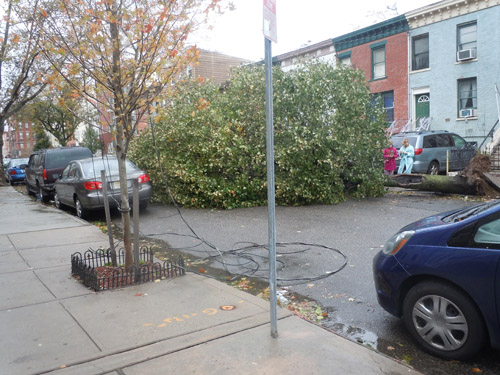
Within a block or so I spot my first downed tree. First of many. Boughs and branches, tangled with wires draped between poles, now the wires are entwined with the fallen tree, sprawling on the ground.

I walk down to the river. The river surged in the middle of night, filling the streets near the bank of the Hudson, heading up several blocks, to City Hall, I heard. Intersections are lakes. Some cars pass through, others turn around. I wore boots. In some places the brown water is still a foot deep


This is further up Columbus, about a mile from the river. A friend of mine lives nearby, water filled the first level of his house. Jersey City is an isthmus, meaning lowlands. Basically, the perimeter of downtown is a flood zone. It’s just a matter of time when a Hudson River surge meets the flood zone waters. Water always seeks out other water.
 
Rainy, gusts of wind but nothing compared to the day before. Grim and gray. The Hudson is ugly, dark and disturbing. It seems so tamed, excavated centuries ago to make the bottom deep enough for big ships. The internationally known home of the landmark of our immigrant past – France’s gift of the Statue of Liberty beckons at the mouth of the river, which flows between the isle of Manhatto and the Jersey shoreline. River while you’re rambling you can do some work for me, sang Woody Guthrie, but that’s just an illusion. In spite of appearances, all rivers are wild rivers. Everyone – and every city –is at the mercy of Nature.


 This is the very groovy Warehouse Café, which was serving the day after the day after Sandy. See how high it is from the cobble stone street? The water rose higher than that, the owner told me, and filled the lobby area of the café.
This fish was on the sidewalk near the Warehouse Café. The surge brought depths of water sufficient to carry this fish ashore. Keep in mind, this fish lays about five blocks from the actual Hudson. It is not within flopping distance of the river.
 
 
 The area is around the waterfront – Exchange Place, our city’s“financial” district and the Powerhouse District is desolate, silt and gunk are strewn in the drenched street. Everything seems saturated, what isn’t stone or metal is muck. These blocks were flooded the night before. A brownish patina coats the lower portions of cars and buildings


Water Seeps up, like a fetid spring, through the cracks in the curb and sidewalks.


 This is what Post-Apocalypse looks like.


Everyone is shell shocked. The bad news keeps coming. Down the shore, the Atlantic ripped apart boardwalks. Subways and PATH flooded, service suspended indefinitely. We cope. We discover new supplies of patience we never knew we had. Hardly any cars on the roads, no traffic lights are working. We survey the damage. Did we survive or is this Purgatory? 
 
A military vehicle drives up Christopher Columbus.


Entire trees pulled out of the grown, the panels of the sidewalk torn asunder. Every block seems to have a fallen Tree or at least, large limbs.


On Tuesday Night, Helens Pizza is serving a limited menu. There’s a line outside. It’s the only place open on the utterly dark Newark Avenue.

 
PSE&G workers checking on one of the several gas leaks reported.


Wednesday morning I went to the Shop Rite. I’m not sure if it was running by generators or that it was part of the first section of the J.C. grid that got electricity, a corridor of energy that ran up 4thand 5th streets, fading a few houses east of Monmouth. People plugged into the outlets to charge their phones. There are outlets along the walls of the store, also around the edges of frozen food cases and amongst the thickening throngs of food shoppers, are people sitting along the walls, waiting. I recharged my phone there. A small group of people waited around the ice machine, applauded when an employee came with a cart of ice bags. I didn’t take any pictures at Shop Rite. People were tired and wiped out, hell; I was tired and wiped out.


 Electricity was beginning to return to different blocks. People found outlets and loitered as their phones charged.This cord was plugged into a street lamp post at the small concrete park on Jersey Avenue.
By Thursday the clean up began more in earnest. Garbage neatly piled; some places require a good pumping out and will be ready to go today or tomorrow, others the repair and restoration will be more extensive.


Sunday, October 28, 2012

Happy Saint Jude Feast Day


Happy Saint Jude Feast Day
Congratulations to everyone completing
 the Saint Jude Novena today.
 Peace and blessings be unto you.


Saint Jude Thaddeus

Pray For Us

And for all who invoke your aid

Wednesday, October 24, 2012

McGovern, Marlo & Me


Me and my boyhood chum Guy Hartman rode our bicycles to the new development on the other side of the park to meet Marlo Thomas. She was the star of That Girl, my favorite sit-com. Guy’s father was a teacher and a Democrat and Marlo was campaigning for George McGovern. Our friendship faded sometime after High School. Guy worshiped Ronald Reagan, and to this day is a registered republican. I guess we all have our own ways of rebelling against our Dads. My father supported Nixon – until Watergate – but in 1972 Nixon was his man. I not only supported McGovern, I campaigned for him in my grammar school mock presidential election.

My father may have leaned Republican, but he was not a right winger and was proud that he always split the ticket. He made sure to vote for candidates of both parties every election. Unlike Guy’s dad, who put a sign on his lawn supporting the national, state and local Democrats every autumn, my father never even wore a button. I like to think that my McGovern support was some kind of rebellion or an early sign of maturity regarding a worldview, but the reality probably was more likely that Sister Henora wanted us to hold a mock election and my homework assignment was George McGovern.

Nixon ruined my childhood. My brothers – they had long hair, participated in war protests, went to rock concerts and smoked pot – fought all the time with my father. Their clashes disrupted the family. They made me sad and nervous. When I entered my teenage years in the wasteland of America’s malaise era, I followed these unhealthy role models. Nixon was a point of contention that tore my family into The Blue & The Gray. John F. Kennedy’s picture hung in every classroom at Our Lady of the Visitation, usually under Pope Paul VI. For years, we thought he was a saint and some kind of American co-pope. Even though he lost, the Sisters of Charity never forgave Nixon for having the nerve to oppose our beloved martyr, the Irish-American Lincoln.

My father liked Nixon, a lot of people did. He came from a genuinely working class background and had the Ike connection. Nixon always scared me, those dark eyes and big head that quivered when he talked and he hated hippies. I remember when I was a kid in the backseat of Mr. Hartman’s car – a white tornado – and him pointing and saying there’s a hippie. Guy and I gawked through the window. This beautiful young woman, with a fringe suede jacket and long blonde hair and a guy with hair just as long and a beard. They were lying on a blanket near a motorcycle. For a very short time, hippies were even rarer than black people and you had to go to New York City to see a living example. From the news stories about rock festivals on TV and the footage of cops beating on kids during a protest, you knew that nonconformity existed, but that notion was only a vague idea to me until I saw her long blonde hair and fringe jacket.

I remember most Life Magazine in doctor and dentist offices. I was one of six kids, seemed whenever one went for a visit, we all went. I read the magazines. Glossy pictures of the Vietnam war. Violent images, dead mutilated bodies, terrified Vietnamese in muddy clothes and wide straw hats, and the exhausted soldiers whose eyes were dark and hollowed out, like Nixon’s. The protestors seemed a lot more fun and onto something more relevant to me than Nixon or the soldiers or those club-wielding cops. They listened to the music my parents were always turning off. That hippie woman in the park was beautiful. I had only an inkling of an idea of what sexuality was, but I was convinced she epitomized it, just as I instinctively knew she intended to vote McGovern.

Before Watergate, many people loved Nixon. Democrats did not trust him and certainly had no love for him, but among the adults there was not yet the absolute and universal hatred for him. I remember Carl, the local mechanic, owned the Texaco, the neighborhood gas station, telling my mother – “I wanted to vote for Bobbie Kennedy, but after he was shot they had nobody else but Humphrey.”

Humphrey could not inspire confidence. One factor was the Democratic Convention that year, when the whole world watched police and protesters battle in the streets. Nixon promised law and order. The WWII Generation, permanently scarred by their Great Depression childhoods, had an obsessive yearning for stability. The chaos of the Chicago Convention ensured that Humphrey would lose, and with his demise went the 1960s legacy of the New Deal: the New Frontier/Great Society. America was polarized, but not like today where Republicans and Democrats seem to barely talk to each other. My father and Guy’s father were pals. Political parties were incidental. Young people and old people were the ones at each other’s throats. The polarization was solely generational, least that is the way it seemed through my childhood eyes. I had yet to meet a wobbly or a young republican. The younger generation – 18 year olds first got the vote in 1972–hated Nixon. The older generation believed in respecting the president, regardless of your personal feelings about him or who you supported during the election.

By 1974, everybody hated Nixon. After years of social upheaval and constant battle over civil rights, the draft, the war against communism, the length of hair, recreational drugs and premarital sex, old and young finally agreed to despise Richard Nixon together. The president lied to the people. When that became undeniable and the corrupt old man resigned from the highest office in the land, the resentment was universal. Hating Nixon did not immediately end the hostility between my father and my brothers, but they finally had one less thing to argue about. The healing began. However, one national custom was discarded into the dustbin of history – respecting the president just because he held the office. Post-Nixon, even if you like and support whoever is in the White House, nobody respects the president just for being president.

I remember writing a speech, reading it to my family at the supper table before I recited it to the class. It was probably about stopping the draft and the war. Thou shall not kill. I’m sure I somehow tied McGovern into the catechism we learned every day– Jesus being a beacon of compassion –we said our fathers, hail marys and glory bes before every class throughout the day. I’m positive we had to make a Catholic reference even in the secular activity of elections. McGovern may have gone on to lose in a landslide to Nixon, but he won the 7th grade vote. I like to think it was my speech. I was one of the classes cut-ups so maybe the nuns were trying to channel my energy into something positive. I wish I could remember my Nixon jokes, I’m sure they killed.

I loved That Girl. I can still sing the theme song from memory.

Diamonds. Daisies. Snowflakes.

That Girl.

Chestnuts. Rainbows. Spring Time.

It’s that Girl…

Her name was Ann Marie – Marie was her last name. I always found that way clever. She moved from the suburbs – Brewster – to New York City to follow her dream of becoming an actress.

That Girl was the first sitcom to feature a smart, single woman. She was not the career girl that Mary Tyler Moore would be, but she was smarter and more interesting than Gidget. She had a doting widowed father, and a steady boyfriend – Donald, a magazine writer. Beautiful, friendly, funny – That Girl was the only adult show I liked, except for the Evening News and Star Trek and some occasional Channel 13 broadcasts that would inexplicably fascinate me. I never watched That Girl as a teen or adult, it did not become a college obsession like the Odd Couple, subject to bong-induced, post-modern deconstruction. I’m sure That Girl would now seem utterly dated and lacking humor to me, which is maybe why I avoided the reruns as I grew up. That Girl remains preserved as an unblemished ideal in my personal amber. Ann Marie is eternally good, friendly and fun to be with – appealingly unaware of her sexuality –enthusiastic, sincere and loyal. Marlo Thomas went on to make feminist made for TV programing like “Free To Be You and Me.” She married Phil Donahue and still appears in the occasional acting gig. Her most prominent role these days is as spokesperson for St. Jude’s Children Hospital, which her father founded.

The houses in the new development belonged to folks definitely from a higher economic bracket than my family. The houses were bigger and nicer. One of the major neighborhood news events was when a film crew came to shoot a scene for What’s Up Doc, a Barbara Streisand movie. Just a few years before, we caught frogs in ponds where the new development now stood. My house and Guy’s, were part of the first housing developments on the woodlands and celery farms of Paramus. When we graduated high school, all of the farms and nearly all of the woods were gone.

The party was on a redwood deck. Me and Guy were the only non-adults. Us being there was a big deal, made possible only due to Guy’s father’s connection to the local party and my success with the Parochial school electorate. I am sure that this was a fund raiser and everybody there had contributed so they could meet That Girl. Marlo probably went to similar events throughout the state. New Jersey was in play in 1972 and would ultimately vote Nixon. I have no idea whose house it was. I never knew anybody in the new development, the park was a boundary separating economic classes. I was unequivocally from the neighborhood where the houses had no redwood decks.

Everybody was waiting for Marlo. When she arrived there were gasps, applause. I remember she gave a short speech, then said hello to everybody, one person at a time. She seemed very down to earth –her hair was longer than Ann Marie’s, whose hair ended with a bob several inches above her shoulders. Marlo’s was as long as that hippie girl’s in the park, but black as a raven’s.

She smiled at me and said I heard about you. She was stunningly beautiful. I mumbled something about George McGovern and how much I loved That Girl. I can still see her, leaning down at me and looking into my eyes, shaking my hand and smiling at me, her black hair bursting with sunlight. I heard about you.

Then Guy and I left on our bicycles. I seem to remember that we would only be allowed to meet her. I do not remember even being offered refreshments. There was nobody else our age, or even close to our age, like a teenager, there. Just adults, just parents. Back then kids were best seen and not heard and when seen, the briefer the glimpse the better. Mingling between generations was contrary to the social norm and unlike today, the constant presence of children was not tolerated. Being allowed here was a privilege. Lingering was not permitted. But I had met Ann Marie, the personification of my earliest romantic yearnings. She had smiled at me and looked into my eyes and said I heard about you. I met someone who was the closest thing to an angel I could imagine and all because I supported the candidate my father opposed.

What if our nation could have been spared the 2nd Nixon term? What if the healing needed after the 60s occurred a decade earlier? McGovern would have continued and strengthened FDR’s New Deal, which Carter let flounder than Reagan decimated. At the time, what bothered me was only how most adults, like my father, could vote Nixon when such a lovely goddess as Ann Marie liked McGovern?

A That Girl episode I’ve never forgotten was when she was going to cast her first vote. She took it very seriously, had this stack of books on government and politics she studied before making her decision. Ann Marie was always comically earnest and relentless enthusiastic. Thanks to Google, the episode: "Secret Ballot" has this synopsis: “Ann gets excited about voting in her first presidential election, learns all she can about the system, but won't tell her father who she's voting for since it's a secret ballot.”. As I got older, my father and I argued about a lot of things, but never politics, which we talked about a lot. We were both avid newspaper readers. He supported Reagan, I did not. My life was crazy in the 80s. I did not like Dukakis and had voted for Millicent Fenwick. The fall of 1988 I was on again with my on again and off again girlfriend. One night as she undid her bra, she said that Bush will never care about people like us. My record of voting for the Democratic candidate for president remained intact.

My parents would bring me along when they voted. I always wanted to go. There was a mini-voting booth for kids to play in, you would push the tiny lever down and a red x appeared in the square alongside the name of a non-existent candidate. Voting was held at the local grammar school, Parkway School named after New Jersey’s famous toll highway. I went to kindergarten there. My first vote was for Governor. I pulled the lever for the socialist candidate. Chalk that decision up to the vanity of youth.

I’ve never missed an election. Unlike “Secret Ballot,” I have no problem saying who I voted for but I really prefer revealing my vote only if I can explain my reasons why and be prepared, that could take a while. America’s disgrace is that voter turnout plummeted through the 80s and 90s. I will never understand why people do not vote, even though a lot of my friends do not even register. How can somebody not love the act of going to the polls and being alone in the booth and realizing, however imperfectly and filled with compromise, that the act you take expresses your political philosophy, which is just the civic outgrowth of your personal view of life itself. Yes, you have to select someone who only comes closest to your view because no candidate will embody it completely, but perfection, like paradise is meant only for the next world; all we have in this one is each other. Not voting leaves me dumbfounded.

McGovern passed away this week, hailed as a decent man, a real Midwest guy. He is an inspiration. I liked his demeanor but he just could not connect with voters on a national scale. He could not sew together the tears that split apart the uneasy coalition of progressives of his era – the unions, the anti-war protestors, and the identity political groups of minorities, feminists, gays and the poor – part of the problem was that the leaders of those groups lacked the foresight to overcome their egos and personal biases to achieve goals that transcended their narrow, single-issue ideologies. The inability of progressive leadership to work as a coalition impeded the progressive movement, making them unable to prevent the wealthy and right wing to make Reaganism and income inequality to be the law of the land. We may still suffer from many of the failures to engage support for McGovern – he was the last candidate to offer a policy for redistribution of wealth – but perhaps some of his political lessons were learned well enough to help win victories for Carter, Clinton and Obama.

Nixon refused to debate McGovern. Astounding now to think an elected leader could get away with not  confronting the candidate of his loyal opposition (although Bloomberg was able to pull the same stunt when bought his re-election (s)). McGovern famously debated an empty chair, and said that Nixon “was listening,” a wisecrack about the news about wire tapping that was beginning to leak out, a steady trickle of malfeasance and corruption that grew into the Watergate tsunami. A debate between McGovern and Nixon would have shed some light on the issues of day – the way those issues were eventually decided not only cost lives by prolonging the Vietnam War, but continue to form many of the current parameters of our politics. The positive though is that Nixon was the last presidential candidate able to duck a debate.  The recent Obama/Romney trilogy of interchanges was extremely positive in terms of showing us the contrast in rhetorical styles and giving us a sense of where the two men stand on many of the leading issues. Some credit can be given to McGovern for the fact that debates between presidential candidates is now a mandatory component of the process.

Even though he was a Nixon man, my father helped me with my McGovern campaign homework and taught me why voting should be loved. I guess McGovern/Nixon was the first presidential election I was aware of, my tiny step into the world of politics and adulthood. McGovern may seem like a tragic figure, but I’ll always be grateful to him. I learned an important lesson. Liberalism leads to beauty.
She's mine alone, but luckily for you...


If you find a girl to love,

Only one girl to love,

Then she'll be That Girl too...

That Girl!